My account
Menu
Your experience on PreventionWeb

Please help us improve PreventionWeb by taking this brief survey. Your input will allow us to better serve the needs of the DRR community.

See the survey

Published on
12 March 2019
Status
Progress not updated

One Billion Coalition for Resilience

Expected duration
Mar 2015 - Dec 2025
SFVC commitment ID
20190214_004
Version
1.0
Author
Ian O'donnell
Upload your content

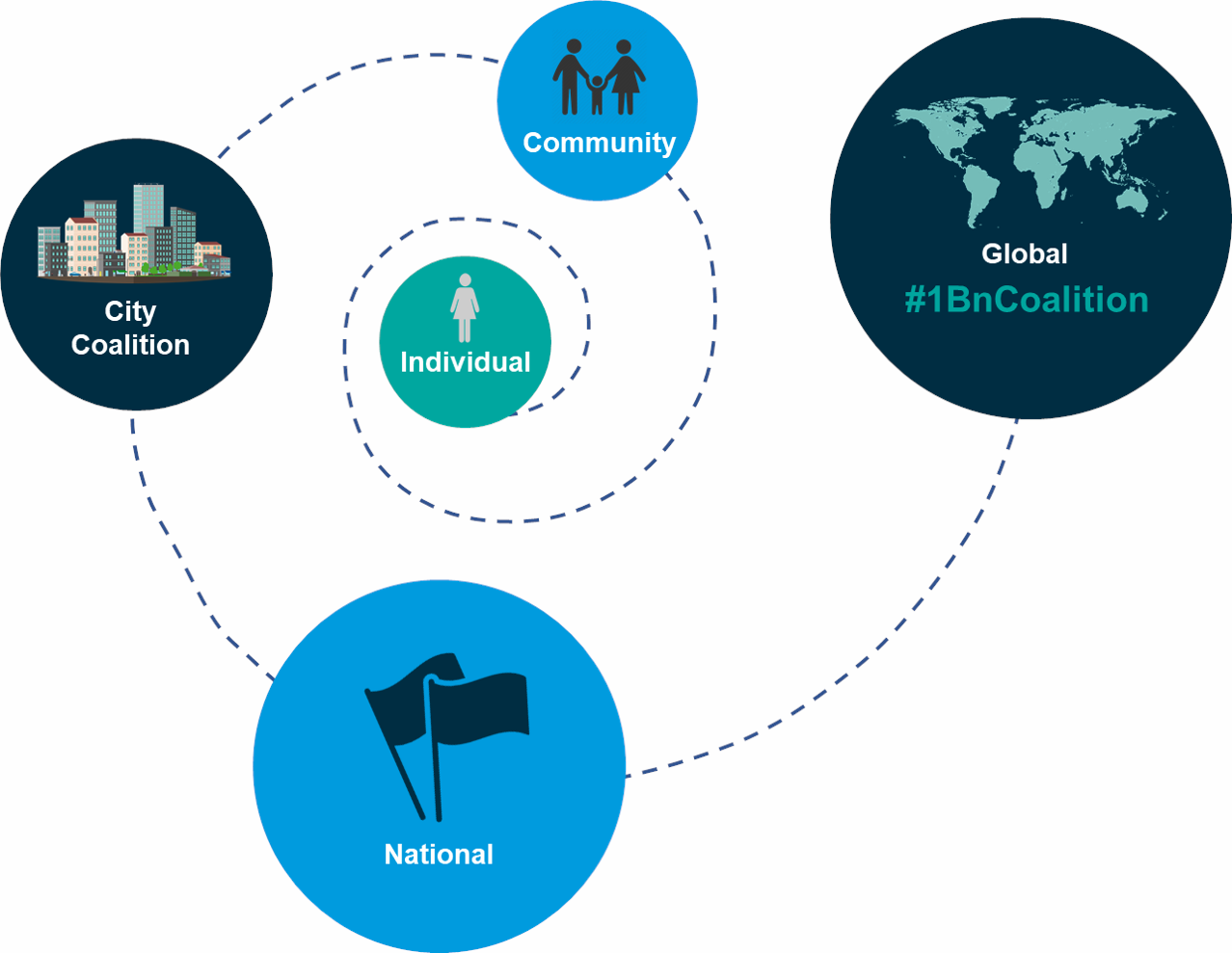
Our goal for the One Billion Coalition for Resilience (1BC) is that by 2025, at least one billion people around the world will have taken active steps to strengthen their resilience.

    Description

    Our vision for the One Billion Coalition for Resilience (1BC) is that, given the right support, people and communities everywhere can work together to be safer, healthier, and more prosperous, even in the face of adversity. 1BC provides a unique opportunity for individuals, households, communities, and organisations to work together to increase collective impact in resilience-building through:

    *** Global and regional partnering – help partner organisations to engage across their networks; link campaigns; and support regional, national, and local coalitions to increase collective action on community resilience (e.g. the ASEAN Coalition for Resilience).

    *** National level partnering– help national partners (in coalition) to identify specific targets for scaling community resilience as contributions for 1BC (e.g. helping someone in every household learn First Aid, or helping every school provide humanitarian + life skills education).

    *** Volunteer and public engagement – to help volunteers and members of the public to assess their own risks, identify and take relevant resilience actions, and count their contribution toward global goals.

    1BC also envisions four mobilizing channels: Schools, Community volunteer teams, Household campaigns, Business networks (especially to reach small businesses).

    Did the Sendai Framework change or contribute to changes in your activities/organization? If so, how?

    The Sendai Framework provides a strong rationale for greater action and investment in disaster risk reduction and a mechanism for tracking commitments, particularly to strengthen the enabling environment.

    What led you to make this commitment/initiative?

    What was your position before making this Voluntary Commitment / prior to the Sendai Framework?

    1BC provides a channel for engaging communities and partner organisations at scale through multi-stakeholder coalitions to support community action on disaster risk reduction and resilience more generally.

    Additional motivation comes from the fact that one of the guiding principles of the Sendai Framework requires an all-of-society engagement and partnerships for disaster risk reduction. This inclusive approach should be reflected across mechanisms and institutions for the implementation of instruments relevant to building resilience for all and sustainable development. Moreover, the Sendai Framework underlines that partnerships have an important role because they can harness the full potential of countries as well as supporting their national capacities.

    Deliverables and Progress report

    Deliverables

    Deliverables are the end-products of the initiative/commitment, which can include issuance of publications or knowledge products, outcomes of workshops, training programs, videos, links, photographs, etc.

    One billion people taking resilience actions
    Intended date of delivery
    31 December 2025

    The overall goal of the One Billion Coalition for Resilience is to engage at least one billion people around the world to take active steps to strength their resilience, connectedness, and inclusion.

    Link
    https://1bc4resilience.github.io/resilience-mapper/
    IFRC contribution through specific Disaster Risk Reduction activities
    Intended date of delivery
    31 December 2030

    The IFRC is contributing to the 1BC goals building on the strengths of its existing DRR activities, projected to serve up to 640 million people (with some overlap in services and counting) through investment of CHF 3.2 billion in DRR projects by 2030, and expanding its impact and reach through partnerships. The IFRC has been conducting a DRR mapping since 2009 to measure its DRR work through close collaboration and coordination among its member National Societies.

    Link
    https://public.tableau.com/profile/ifrc.r.v#!/
    Organizations and focal points

    Implementing Organization(s)

    • Interpeace
    • Connecting Business initiative
    • United Nations Children's Fund (UNICEF)
    • International Federation of Red Cross and Red Crescent Societies (IFRC)
    • World Food Programme (WFP)

    Focal points
    Main focal point
    Ian O'donnell (Team Leader, One Billion Coalition for Resilience, International Federation of Red Cross and Red Crescent Societies (IFRC))

    Explore further

    Sendai priorities
    Priority 1Understanding disaster risk
    Priority 2Strengthening disaster risk governance to manage disaster risk
    Priority 3Investing in disaster risk reduction for resilience
    Sendai targets and indicators
    A-1 (Compound)Number of deaths and missing persons attributed to disasters, per 100,000 population
    B-1 (Compound)Number of directly affected people attributed to disasters, per 100,000 population
    C-1 (Compound)Direct economic loss attributed to disasters in relation to global gross domestic product
    E-1 (Compound)National average score for the adoption and implementation of national disaster risk reduction strategies in line with the Sendai Framework for Disaster Risk Reduction 2015-2030
    E-2 (Compound)Percentage of local governments that have adopted and implemented local disaster risk reduction strategies in line with national strategies
    G-1 (Compound)Number of countries that have multi-hazard early warning systems
    G-4Percentage of local governments having a plan to act on early warnings
    G-5Number of countries that have accessible, understandable, usable and relevant disaster risk information and assessment available to the people at the national and local levels
    Hazards Avalanche Cold Wave Cyclone, Hurricane and Typhoon Drought and Desertification Earthquake Epidemic and Pandemic Flood Heatwave and Extreme Heat Insect infestation Landslide NBC - Nuclear, Biological, Chemical Storm surge Technological hazard Tornado Tsunami Volcano Wildfire
    Themes Disaster risk communication Capacity development Children and Youth Civil Society/NGOs Climate change Community-based DRR Preparedness Early warning Financing DRR Education and school safety Environment and ecosystems Food security and agriculture Gender Governance Traditional and Indigenous knowledges Data and information management Insurance and risk transfer Private sector Recovery Risk identification and assessment Science-policy-practice interface Social impacts and social resilience Structural safety Urban risk and planning Water
    Sustainable Development Goals SDG4: Quality education SDG11: Sustainable cities and communities SDG13: Climate action SDG17: Partnerships for the goals
    Scope
    Global
    Scale of beneficiaries
    More than 10,000 people
    Estimated number of beneficiaries
    1,000,000,000 people
    Secured budget size
    10%
    Donors
    Variety of donors supporting 1BC member oranizations' contributing activities
    UPS
    UNICEF
    Umbrella initiative(s)
    One Billion Coalition for Resilience
    Commitment previously announced at WCDRR?
    One Billion Coalition for Resilience
    Videos
    Related links
    One Billion Coalition for Resilience (1BC) website
    Twitter feed for #onebillioncoalition

    Is this page useful?

    Yes No
    Report an issue on this page

    Thank you. If you have 2 minutes, we would benefit from additional feedback (link opens in a new window).

    PreventionWeb is the global knowledge sharing platform for disaster risk reduction (DRR) and resilience.

    • Newsletter
    • Submit your content
    • Blog pitches
    • Submission and publishing policy
    • About PreventionWeb
    • Contact us

    Hazards

    • Avalanche
    • Cold Wave
    • Cyclone, Hurricane and Typhoon
    • Drought and Desertification
    • Earthquake
    • Epidemic and pandemic
    • Flood
    • Heatwave, extreme heat and heat stress
    • Insect infestation
    • Land subsidence
    • Landslide
    • Nuclear, biological, chemical (NBC)
    • Sea level rise
    • Technological hazard
    • Thunderstorm
    • Tornado
    • Tsunami
    • Volcano
    • Wildfire

    Regions

    • Africa
    • Americas
    • Asia
    • Europe
    • Oceania

    Themes

    Understanding & managing risk

    • Preparedness
    • Early warning
    • GIS and mapping
    • Data and information management
    • Risk identification and assessment
    • Small Island Developing States
    • Earth Observation

    Natural environment

    • Climate change
    • Environment and ecosystems
    • Food security and agriculture
    • Water

    Cross-cutting

    • Systemic risk
    • Recovery

    Human development

    • Capacity development
    • Children and youth
    • Civil society / NGOs
    • Community-based DRR
    • Cultural heritage
    • Gender
    • Human mobility
    • Inclusion
    • Social impacts and resilience

    Science, knowledge & advocacy

    • Disaster risk communication
    • Traditional and Indigenous knowledges
    • Science-policy-practice interface

    State, governance & economy

    • Financing DRR
    • Fragility and conflict
    • Governance
    • Insurance and risk transfer
    • Private sector

    Infrastructure & critical services

    • Critical infrastructure
    • Education and school safety
    • Health and health facilities
    • Structural safety
    • Urban risk and planning
    Loading