1. Home
  2. Knowledge Base | PreventionWeb
  3. Themes

Social impacts and social resilience

The ability of a community or society exposed to hazards to resist, absorb, accommodate, adapt to, transform and recover from the effects of a hazard in a timely and efficient manner, including through the preservation and restoration of its essential basic structures and functions through risk management. 

Latest Social impacts & resilience additions in the Knowledge Base

Meetings and conferences
Birmingham
In person
Aston Crisis Management Centre is organizing an event to discuss how to promote resilience in UK communities and explore the potential of technological advances to help communities face the impact of disruptions.
Meetings and conferences
Online
Join AIDR for a thought-provoking discussion exploring how individuals, communities and organizations can work together to create safer, more resilient futures.
Update

Authoritarian regimes have a history of keeping information about escalating disasters secret, even when it could harm their own citizens.

Conversation Media Group, the
Conclusions - Meeting of experts on occupational safety and health in extreme weather events and changing weather patterns thumbnail
Documents and publications

Conclusions from the ILO Meeting of Experts on occupational safety and health in extreme weather events and changing weather patterns, providing guidance on prevention, preparedness, risk assessment, early warning, workplace measures and resilience.

International Labour Organization (ILO)
Putting people at the centre of UK climate adaptation & resilience thumbnail
Documents and publications

This report synthesises social science evidence on climate adaptation and resilience for UK policymakers, highlighting adaptation as an ongoing social process shaped by people’s lived experiences, vulnerabilities, and social context.

Government Office for Science
Advancing Capacity for Climate and Environment Social Science
On call in a burning city: Women platform workers and he impact of working in extreme heat thumbnail
Documents and publications

This report shows that for women in beauty services, domestic work, food delivery, e-commerce, and ride-hailing, heat is not just a climate issue. It is a labour rights, gender, health, and urban infrastructure crisis.

HeatWatch
Breaking point: Heat and the garment floor, a HeatWatch and TISS study thumbnail
Documents and publications

Experiences of garment workers in this study show that extreme heat is not just uncomfortable but determines health, mental well-being, productivity, and livelihood. Yet workplace regulations and climate responses remain poorly equipped to address risks.

HeatWatch
Resisting resilience? Negotiating responsibility, counter conduct and agency in participatory risk management thumbnail
Documents and publications

Based on five years of research with flood action groups in England, this paper shows how communities negotiate, contest and resist resilience agendas, developing a typology of emotional, symbolic, discursive, collective and procedural resistance.

Global Environmental Change: Human and Policy Dimensions
Global public health situation analysis El Niño 2026: Implications for public health and early action thumbnail
Documents and publications

WHO’s 2026 situation analysis warns the strong El Niño will bring extreme climate conditions, escalating health threats particularly for the vulnerable, urging early action to anticipate, mitigate, and respond.

World Health Organization (WHO)
Invisible allies: Donkeys promote drought resilience in pastoralist communities but are excluded from policy thumbnail
Documents and publications

This study examines policy and provision for working donkeys in Kenya and Ethiopia, countries severely affected by drought and heavily reliant on donkeys for community resilience.

Journal of Rural Studies (Elsevier)
Update

The interaction of land subsidence with urbanization, reclamation and climate variability in contributing to massive flooding must also be examined, along with possible governance failures in light of increasing flood risk in Philippines.

Inquirer.net, Philippine Daily Inquirer
Update

Governments across Europe are increasingly telling citizens to prepare at home for a major crisis like war, extreme weather and cybersecurity threats, with Ireland becoming the latest country to push emergency preparedness guidance.

Newsweek
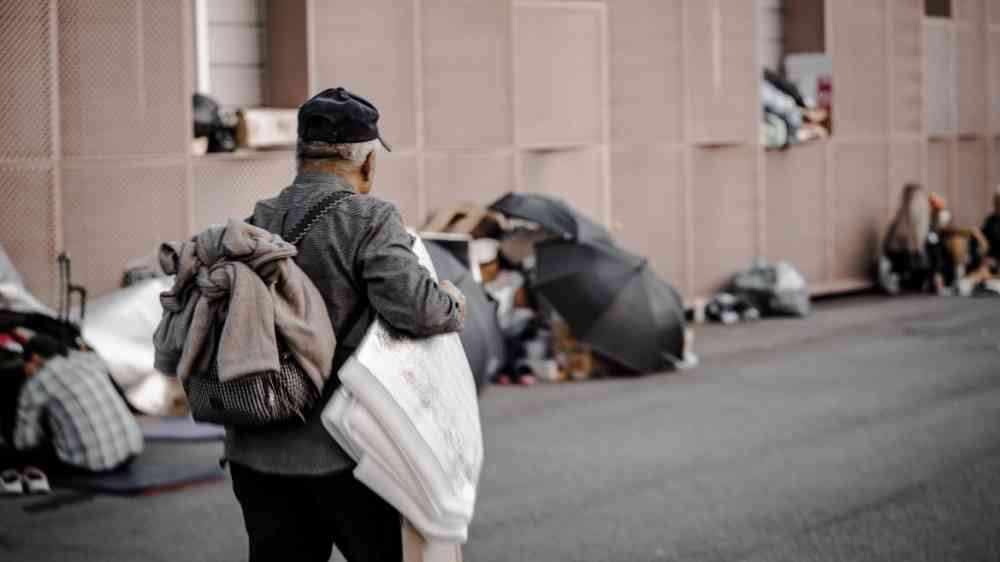
Homeless person walking on front of Seoul Central Station, in South Korea
Research briefs

As record-breaking global temperatures and extreme weather events spark intense debate over global warming speed-up, a new study led by UC Santa Cruz reveals how warming is accelerating differently across distinct regions.

University of California, Santa Cruz
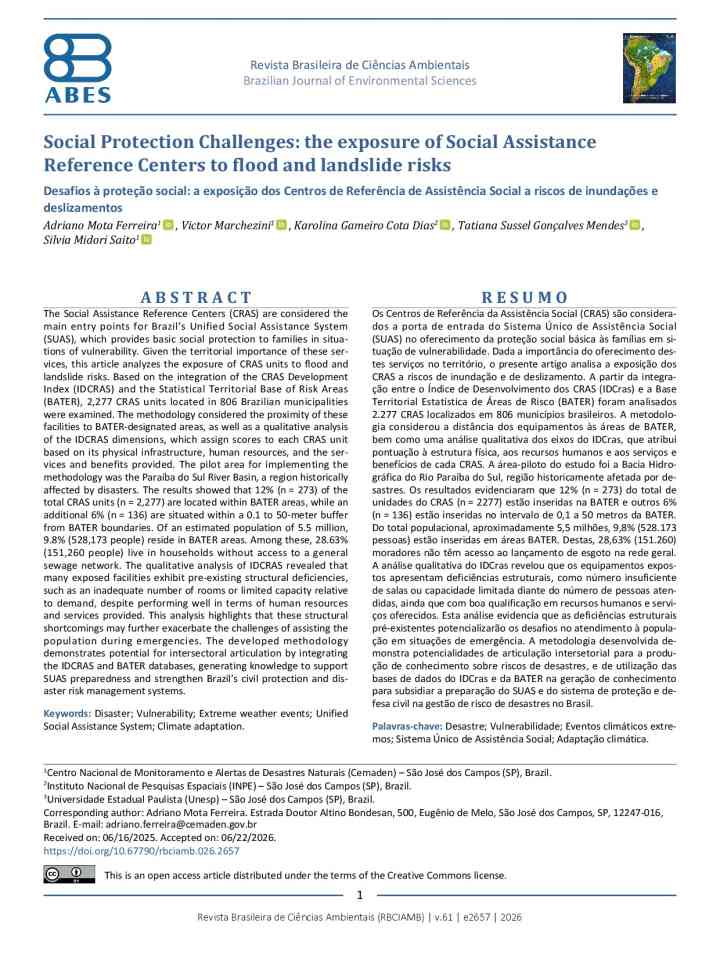
 Social Protection Challenges: the exposure of Social Assistance Reference Centers to flood and landslide risks  thumbnail
Documents and publications

This article analyzes the exposure of Brazil’s Social Assistance Reference Centers (CRAS), the main entry points for the Unified Social Assistance System (SUAS), to flood and landslide risks

Centro Nacional de Monitoramento e Alerta de Desastres Naturais (CEMADEN)
Earth System Science Center of the National Institute for Space Studies
Universidade Estadual Paulista "Júlio de Mesquita Filho"
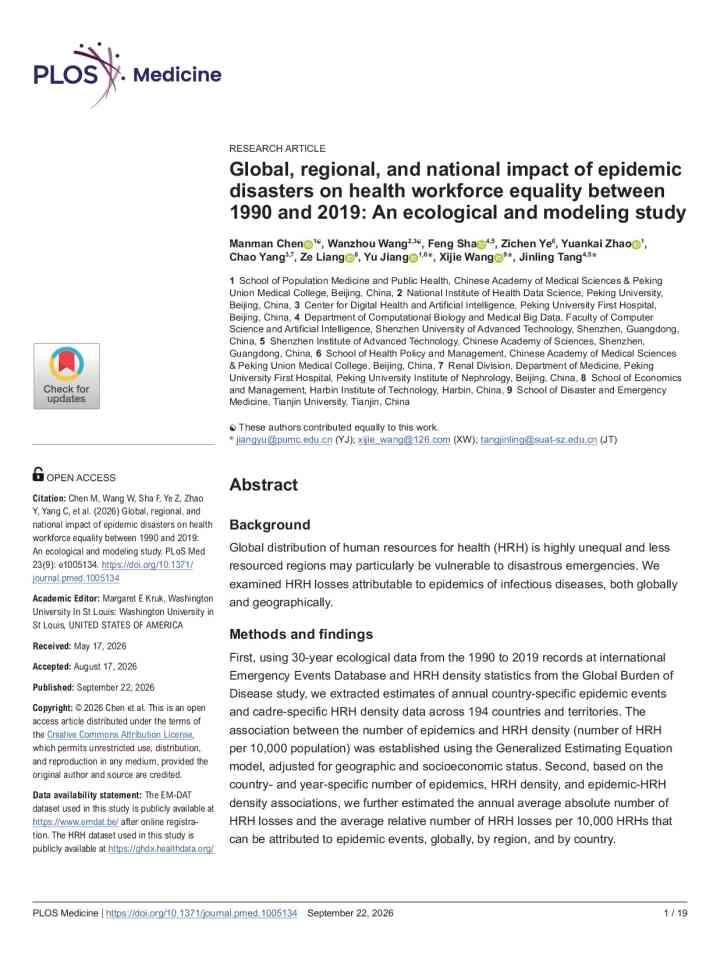
Global, regional, and national impact of epidemic disasters on health workforce equality between 1990 and 2019: An ecological and modeling study thumbnail
Documents and publications

This paper estimates that epidemics were associated with an average annual loss of 17,549 health workers globally from 1990 to 2019, with the greatest burden in South Asia, sub-Saharan Africa, and lower-income countries.

PLOS Medicine
Breathtaking view of Monument Valley's sandstone buttes during a golden sunset.
Update

1 in 3 Navajo need to haul-in water from another place due to the lack of proper infrastructure in the midst of a drought. Hope is on the horizon, as the local government and nonprofit organizations have invested in proper water supply projects.

Onewater
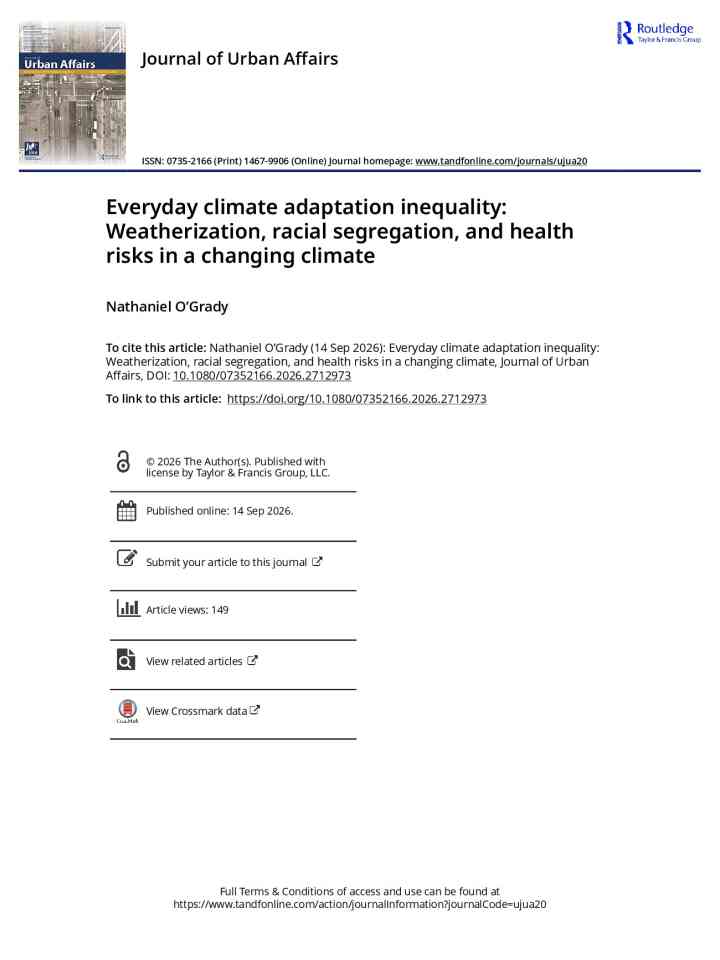
Everyday climate adaptation inequality: Weatherization, racial segregation, and health risks in a changing climate thumbnail
Documents and publications

This article extends debates at the intersection of infrastructure, adaptation, and vulnerability by exploring everyday practices of climate adaptation through people’s attempts to weatherize their houses during climate-related emergencies.

Journal of Urban Affairs (Taylor & Francis)
Update

The interplay of water, infrastructure, and danger drives home the central lesson of disaster risk reduction: there is no such thing as a ‘natural’ disaster. A natural hazard becomes a disaster only when people are placed in its path.

Time Magazine Inc.
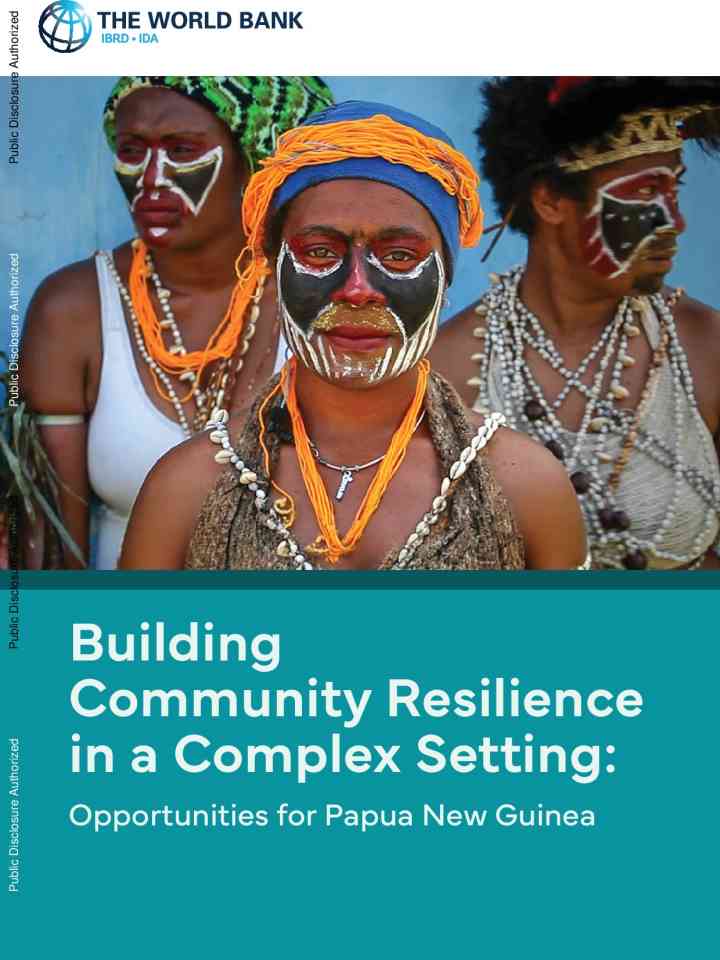
Building community resilience in a complex setting: opportunities for Papua New Guinea thumbnail
Documents and publications

This report examines opportunities to strengthen community resilience through locally led climate action, with a focus on empowering local governments and communities to address climate risks while improving alignment with national climate priorities.

World Bank, the
Flood exposure and vulnerability to poverty: evidence from rural India thumbnail
Documents and publications

This study examines the relationship between flood exposure, coping behavior, and vulnerability to poverty in rural Bihar, one of India’s most flood-prone regions.

Nature Scientific Reports
Update

Following a series of major disasters and inquiries that questioned New Zealand’s capacity to deal with them, the new Emergency Management Act 2026 is the most significant improvement in more than two decades.

Conversation Media Group, the
Assessing community resilience outcomes of flood-vulnerable people in Bangladesh by using a 5-point Likert Scale: A study on Bakshiganj Upazila thumbnail
Documents and publications

Paper assesses 16 community resilience outcomes among flood-vulnerable people in Bangladesh. Vulnerability mapping, community participation and precautionary measures scored highest; NGO support, DRM awareness and post-disaster health safety scored lower.

Open Journal of Social Sciences (SCRIP)
A modern architectural building in bright orange and blue serves as a temporary evacuation center for the tsunami disaster in Bantul, Yogyakarta
Rama Nassif
This blog poses that trust is a critical performance condition in DRR. Early warnings, shelters and preparedness plans may exist, but protection depends on whether people see them as credible, accessible, understandable and accountable.
Collective action for extreme heat resilience: Strengthening community resilience to extreme heat through partnerships in Greater Western Sydney and beyond (2023-2026) thumbnail
Documents and publications

This report documents how the Urban Climate Resilience Program strengthened extreme heat resilience in Greater Western Sydney through community action, applied research, policy influence and cross-sector partnerships from 2023 to 2026.

Australian Red Cross
International Federation of Red Cross and Red Crescent Societies (IFRC)
Z Zurich Foundation
Divergence between physical and emotional heat resilience in Chinese cities thumbnail
Documents and publications

Using social media and meteorological data, this study quantifies the mismatch between physical heat exposure and public emotional responses from 2010 to 2024 in China.

Nature Climate Change
Wildfire exposure and political participation in Africa thumbnail
Documents and publications

Combining Global Fire Atlas records with Afrobarometer surveys of more than 100,000 people in 34 African countries, this study shows that people living close to wildfires are more likely to vote, contact local councillors and attend community meetings.

Nature Communications (Nature)
Man looking out a house
Update

Residents in predominantly Hispanic communities in Florida, USA are paying on average $5,014 more annually for their policies, a report says.

Grist Magazine
Update

Smoke from fires in Indonesia's Borneo and Sumatra regions has affected millions, disrupted education and worsened air quality across Southeast Asia. Dry El Niño conditions and land-clearing fires have intensified emissions, haze and health impacts.

Inquirer.net, Philippine Daily Inquirer
Disaster risk management in informal settlements: Household evidence from KwaZulu-Natal, South Africa thumbnail
Documents and publications

This study examines how flooding and fire are experienced and managed in Khan Road informal settlement, KwaZulu-Natal Province, South Africa.

International Journal of Disaster Risk Reduction (Elsevier)
Person with disability on a motorized wheelchair
Research briefs

Study from Kerala shows how climate hazards can deepen inequalities for people with disabilities through inaccessible warnings, evacuation routes, shelters and services. Similar challenges in Sierra Leone highlight the need for inclusive climate action.

Mongabay
Update

Ethical preparedness requires communities to recognise vulnerability beforehand. Ethical leadership must move beyond the actions of individual leaders and become embedded within the culture and practices of organisations and communities.

Monash University
Food market, Kilifi Kenya
Research briefs

In some regions of the world, the poorest people may spend about 50 percent of their income on food, while the richest spend about 5 percent.

MIT News, Massachusetts Institute of Technology
Contrasting community experiences and recovery challenges in slow- and rapid-onset flooding: Insights from the 2022–2023 Australian floods thumbnail
Documents and publications

This study compares community experiences of slow- and rapid-onset flooding during Australia’s 2022–2023 floods. While both caused long recoveries, slow-onset floods created prolonged uncertainty, unique preparedness challenges, and delayed recovery needs

International Journal of Disaster Risk Reduction (Elsevier)
Research briefs

New social science research is helping strengthen tsunami safety messaging by showing how people understand evacuation maps, natural warnings and official alerts.

Earth Sciences New Zealand
Sea level meter
Update

The ocean is rising faster now than at any point in recorded history. Rising sea levels have a significant impact on human rights, economic development, health, culture, the future of many countries and basic human dignity.

United Nations - Headquarters
Update

Climate-driven displacement is widely expected to push millions across international borders. Drawing on monthly bilateral flows for 127 developing-country origins, this column finds the reverse

VOXEU/ CEPR
Factors shaping disaster preparedness of immigrant women: Revisiting the community engagement theory thumbnail
Documents and publications

This study underscores the significant barriers immigrant women face, including language limitations, limited access to resources, and strong reliance on faith-based coping strategies.

Integrated Disaster Risk Management Society
What can 150 years of census data tell us about population impacts from extreme weather in sparsely populated Northern Australia? thumbnail
Documents and publications

This paper analyses 150 years of census and hazard data to assess how extreme weather affected population trends in Northern Australia. It finds floods and cyclones can disrupt population growth highlighting need for resilience and adaptation planning.

International Journal of Disaster Risk Science
Drought adaptation mapping in the Southern African Development Community: A scoping review thumbnail
Documents and publications

This scoping review maps peer-reviewed evidence on drought adaptation in the SADC region, which exhibits an observed downward trend in precipitation, making it a valuable case to study diverse approaches to managing changing risk.

PLOS Climate
Research briefs

Study reveals correlation between heat and demographic structure, with air and land surface temperature showing different patterns in Germany.

Karlsruhe Institute of Technology
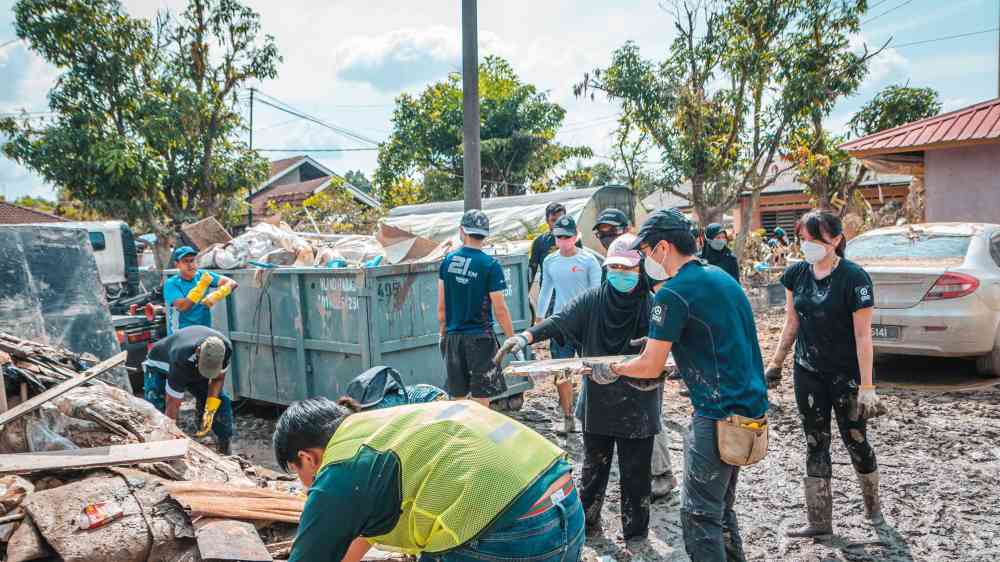
Volunteers work together to clean up debris after a disaster, showcasing community effort and teamwork.
Update

Along the Nepal-Tibet border, the long road to recovery has only just begun. Amidst profound grief and loss, local communities are already providing support to their most vulnerable. Governments and international organisations should follow their lead.

Conversation Media Group, the
Vegetation fire burns jungle forest near Florida houses as firefighters and fire trucks work to contain flames threatening nearby neighborhoods, USA (2025).
Update

Despite decades of warnings, neighborhoods in Reno and Spokane have sprawled ever closer to a hotter, drier wilderness. And in the summer, months of low humidity and hot weather prime the landscape to burn.

Grist Magazine
The view of yurts nomad village in Tash-Rabat in Kyrgyzstan
Salavat Baktybek
Case study of 15 households affected by Kyrgyzstan’s 2024 mudflow reveals how poverty, low insurance coverage and infrastructure gaps prolonged recovery. Residents want stronger drainage, risk reduction investments and community participation.
Update

Major floods in Nepal and Sri Lanka show how disasters that strike before recovery is complete can deepen losses, weaken resilience and increase vulnerability. Experts argue that recovery progress should be measured alongside disaster risk.

Conversation Media Group, the
Update

Zambia’s 2024 drought exposed chronic infrastructure, water and sanitation failures in Mazyopa, fuelling a cholera outbreak and disproportionate impacts on women. Community advocacy is now driving demands for long-term resilience investments.

International Institute for Environment and Development (IIED)
The role of remittances in household resilience to extreme weather in the Kyrgyz Republic: Evidence from panel data thumbnail
Documents and publications

This paper examines how remittances influence household expenditure during drought and excess rainfall in the Kyrgyz Republic.

Asian Development Bank (ADB)
Update

This article reports public reactions to a UK emergency phone alert on wildfire risk, highlighting concerns over alert fatigue, unclear guidance and the need for effective crisis communication.

Guardian, the (UK)
The lived experiences of vulnerable populations in the context of extreme heat thumbnail
Documents and publications

The survey of over 2000 respondents in Nepal and Bangladesh confirms extreme heat is a pervasive and escalating risk, significantly degrading public health, livelihoods and well-being and provides evidence for increasing investment in heat interventions

Red Cross / Red Crescent Climate Centre
Update

Heat-related deaths look less dramatic than other climate disasters, yet they are far more frequent. This article looks into why Europe’s deadliest climate hazard remains its least visible one.

The European Correspondent
Getting the story straight: common misconceptions around volcanoes and eruptions with case studies of recent events thumbnail
Documents and publications

This paper describes eighteen misconceptions grouped in six themes (seismology, volcanoes and climate, systems and structures, volcanic hazards, timescales, photographs and footage) commonly encountered by volcanologists

Journal of Applied Volcanology (Springer)