1. Home
  2. Knowledge Base | PreventionWeb
  3. Themes

Education and school safety

Policies and activities in the education sector to protect students and educators from disasters impacts, ensure continuity of education through all expected hazards and strengthen risk reduction and resilience through education.

Additional resources:

Japan is using Augmented Reality to teach children the dangers of flash floods.

Latest Education and school safety additions in the Knowledge Base

Vacancy
Odisha
Closing date
The consultant will support the State Project Manager in coordinating and facilitating the implementation of INSPIRE Programme activities in Odisha, with a primary focus on the large-scale rollout of PRI training programmes.
From knowledge to action: Educational pathways to climate adaptation in Nepal thumbnail
Documents and publications

This study examines associations between education and climate change knowledge, awareness, and adaptive actions using 11,568 observations from the 2016 and 2022 waves of Nepal's National Climate Change Impact Survey.

International Journal of Disaster Risk Reduction (Elsevier)
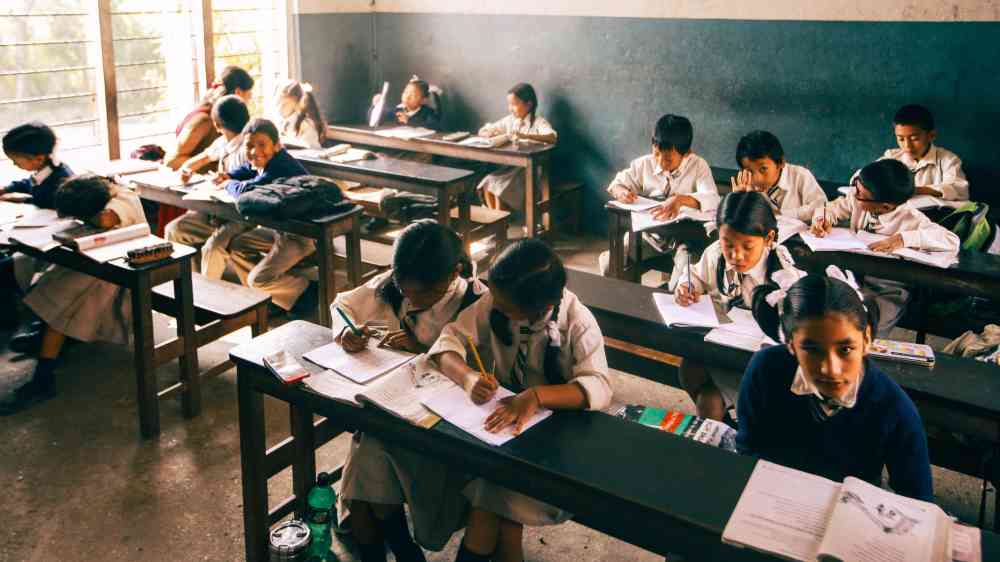
Elementary school children studying in a classroom, focusing intently on their work.
Update

As climate hazards intensify, conventional coping measures alone can no longer ensure safe, conducive learning environments. Schools now need innovative, climate-resilient solutions that ensure continuity of education during extreme summer temperatures.

Zurich Climate Resilience Alliance
Update

As NHS told to prepare for extreme weather, strain also felt in other areas including transport and farming.

Guardian, the (UK)
Last updated 6 Aug 2026
Games can be a powerful tool to support awareness-raising initiatives and capacity building efforts in disaster risk reduction (DRR).
Update

Extreme heat, smoke, floods, and storms are disrupting education across the country.

Yale Climate Connections
Disaster risk assessment of schools in Mato Grosso thumbnail
Documents and publications

The report presents a disaster risk assessment of 75 public schools in the state of Mato Grosso, Brazil. The study analyzes schools’ exposure to climate-related hazards and identifies priority areas for resilience-building measures.

World Bank, the
Rapid diagnostics of school infrastructure in Rio Grande do Sul thumbnail
Documents and publications

The report presents a rapid diagnostic of school infrastructure in Rio Grande do Sul, Brazil, developed in the aftermath of the severe floods that affected the state in 2024

World Bank, the
Disaster risk assessment of schools in Rio Grande do Sul thumbnail
Documents and publications

The report presents a comprehensive disaster risk assessment of school infrastructure in the state of Rio Grande do Sul, Brazil.

World Bank, the
Heatwave on the city
Update

When classrooms become overheated or outdoor recess gets canceled, students struggle to focus and learn. Excessive heat impairs cognitive performance, putting students who need extra academic support during the summer at an even greater disadvantage.

Grist Magazine
Participants of a Stop Disasters workshop in Athens, Greece
Sofia Karma Alex Tsakiridis Dimitrios Alexandris Efstathia Athinaiou Evangelos Aggelopoulos Ioannis Kolovos
A culture of safety requires investing in younger generations and creating opportunities for them to engage with disaster risk in meaningful ways.
Update

It’s important to recognize that many schools are underprepared to carry out their days in extreme heat, without the physical infrastructure or planning to keep students and educators comfortable and safe in the classroom or outside on school grounds.

Conversation Media Group, the
Landing
Wildfires can disrupt education systems by damaging schools, interrupting learning and affecting the wellbeing of students, teachers and communities.
A class using the Stop Disasters game for education purposes
Reza Habibisaravi
No simulation can fully represent the complexity of real disasters. Stop Disasters simplifies reality. However, when combined with local hazard information and a structured learning approach, it provides students with a safe environment to make decisions.
Financing implementation of the comprehensive school safety framework: Policy brief thumbnail
Documents and publications

This policy brief provides a first entry point for governments who have endorsed or are implementing aspects of the Comprehensive School Safety Framework (CSSF) to identify potential financial resources they can access, and how to secure them.

Global Alliance for Disaster Risk Reduction and Resilience in the Education Sector (GADRRRES)
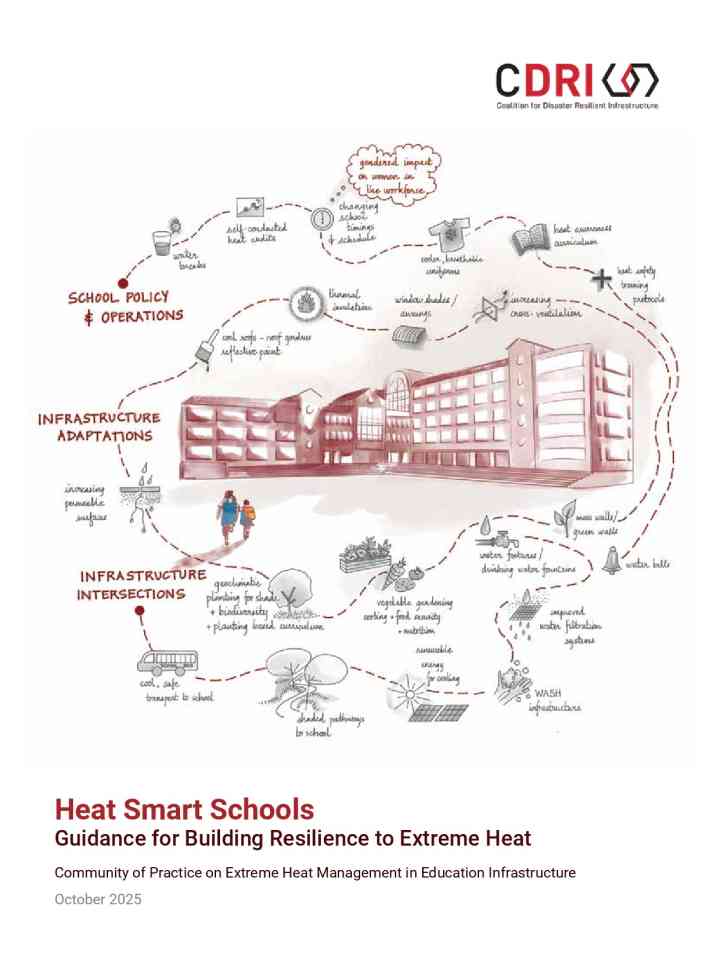
Heat smart schools thumbnail
Documents and publications

Heat Smart Schools is a guidance framework by CDRI to help schools adapt to rising extreme heat risks. With over two billion children projected to face frequent heatwaves by 2050, the document emphasizes that heat threatens health, learning, and equity.

Coalition for Disaster Resilient Infrastructure (CDRI)
Integrating the education sector into the National Adaptation Plan process: a briefing for NAP teams thumbnail
Documents and publications

This report aims to support National Adaptation Plan (NAP) teams to consider the education sector in the NAP process.

National Adaptation Plan (NAP) Global Network
Engaging the education sector in the National Adaptation Plan process thumbnail
Documents and publications

This guidance note aims to support education ministries in engaging effectively throughout the National Adaptation Plan (NAP) process.

National Adaptation Plan (NAP) Global Network
Meetings and conferences
Online
Join for the online launch of COPE’s newest book, Lightning, created to help children and families understand one of nature’s most powerful hazards and learn how to stay safe during thunderstorms.
Research briefs

Climate change is making southern Africa hotter. While much attention has focused on climate impacts like droughts, floods and food insecurity, another crisis is unfolding quietly inside classrooms.

Conversation Media Group, the
School drill in Vanuatu
Update

On 29 April 2026, Vanuatu marked its first national observance of the International Day in Memory of the Victims of Earthquakes, bringing together partners to strengthen earthquake preparedness and disaster resilience.

United Nations Office for Disaster Risk Reduction - Sub-Regional Office for the Pacific
woman on the construction of a hut at Omorate on Ethiopia
Israel Hinkossa
A statistics graduate in rural Ethiopia built a game that translates the UNESCO‑recognized Oromo Gadaa democracy into digital climate action, allowing players to earn points that fund real‑world, community‑verified reforestation.
Update

The Ministry of Primary and Secondary Education (Kemendikdasmen) in collaboration with Muhammadiyah Disaster Management Center (MDMC), held a Disaster Safety Education Unit (SPAB) and Psychosocial Support Training.

Muhammadiyah Disaster Management Centre
Toward disaster-resilient universities: A pre-COVID assessment of American institutions of higher education thumbnail
Documents and publications

This article investigates the state of resilience of academic institutions in the Southeastern United States prior to the COVID-19 pandemic.

International Journal of Disaster Risk Reduction (Elsevier)
Stop disasters game
Last updated 16 Apr 2026
This page brings together ready-to-use lesson plans, classroom activities, and teaching guides for the Stop Disasters online simulation game, developed by the UN Office for Disaster Risk Reduction (UNDRR).
Teaching resilience with the Stop Disasters game: a teacher's guide thumbnail
Documents and publications

This Teacher’s Pack supports the use of the Stop Disasters online game as a practical way to introduce disaster risk reduction (DRR) and resilience in the classroom.

United Nations Office for Disaster Risk Reduction (UNDRR)
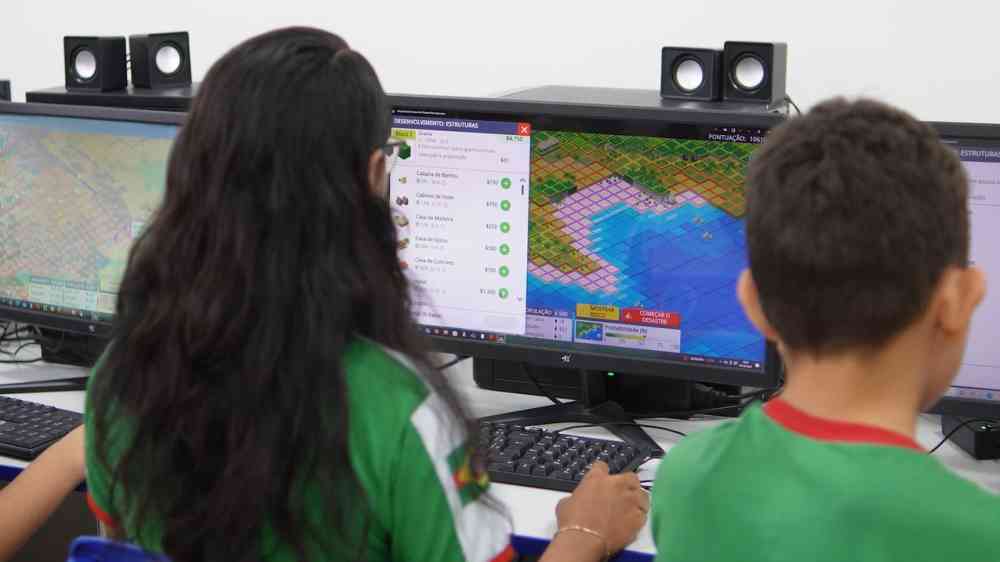
Schoolchildren playing the Stop Disasters game in Barcarena, Brazil, in the lead up to COP30 (October 2025).
Update

2025 marked a year of exceptional growth for the Stop Disasters game.

United Nations Office for Disaster Risk Reduction (UNDRR)
What are the likely impacts of rising temperatures on students and how are countries adapting? thumbnail
Documents and publications

This policy brief summarises the results and discusses the policy implications of an assessment the number of schools and students at risk of rising temperatures in 2050 across 13 OECD countries and economies.

Organisation for Economic Co-operation and Development
Using climate projections to assess increasing student exposure to high temperatures thumbnail
Documents and publications

This technical paper develops a methodology to assess the number of schools and students at risk of rising temperatures in 2050 across 13 OECD countries and economies.

Organisation for Economic Co-operation and Development
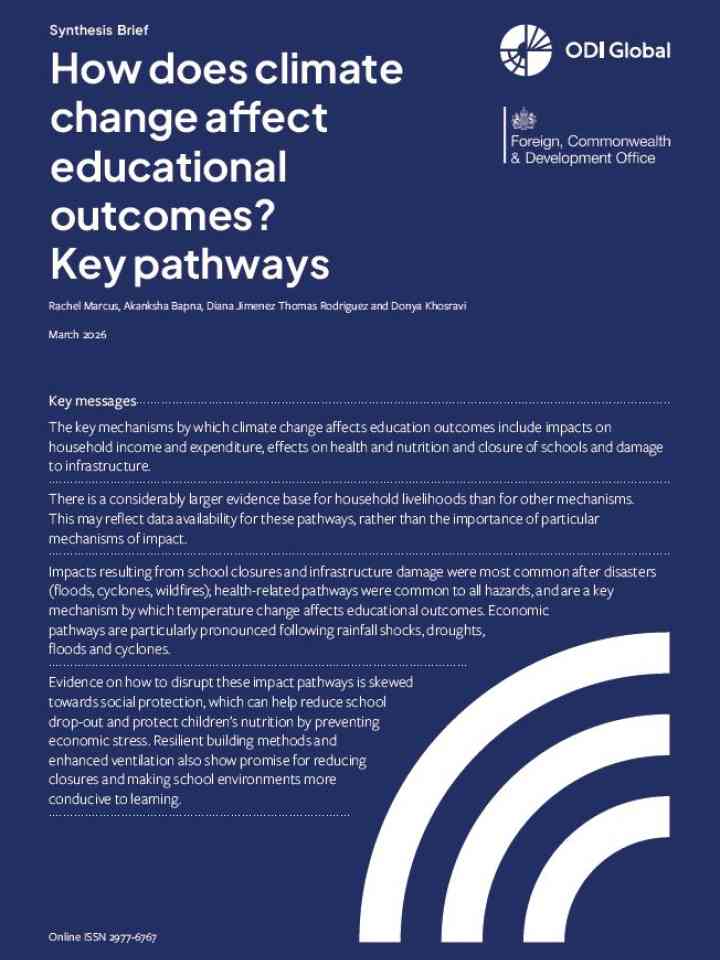
Cover
Documents and publications

This brief outlines three key impact pathways: damage to school infrastructure, effects on children's health, and impact to household livelihoods.

ODI Global
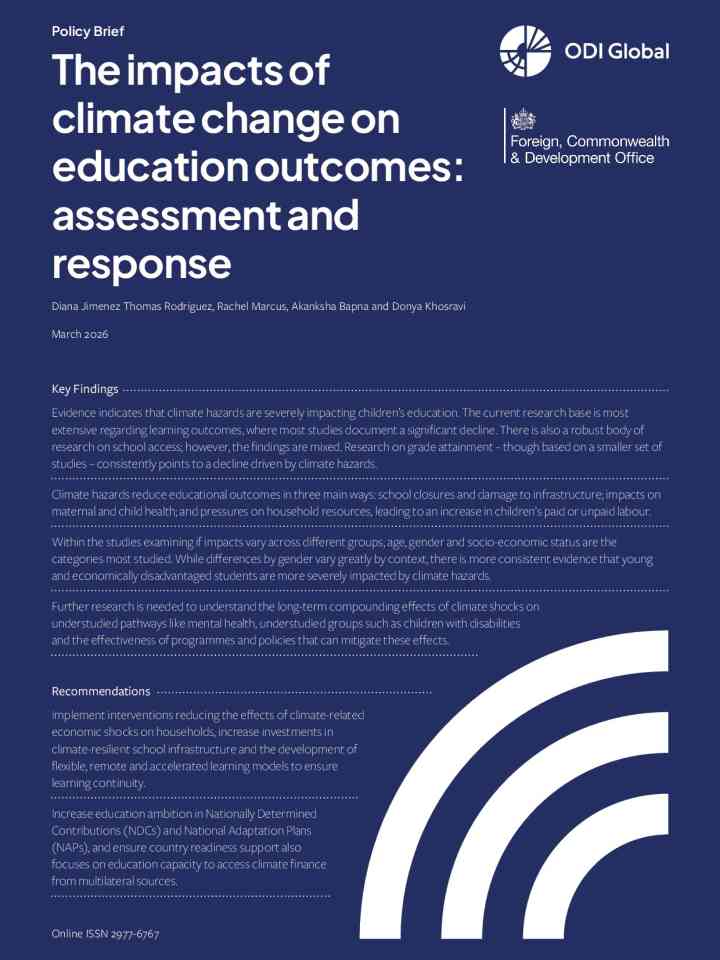
The impacts of climate change on education outcomes: assessment and response thumbnail
Documents and publications

This brief presents findings from a global systematic review examining how climate change affects primary and secondary education across low-, middle- and high-income countries.

ODI Global
Effects of early life exposure to climate shocks on education outcomes thumbnail
Documents and publications

This policy brief examines how exposure to climate shocks in early life has distinct and often persistent effects on educational outcomes and implications for life-time earnings.

ODI Global
illustration
Update

Early and sustained engagement with DRR knowledge and opportunities is essential to nurturing future professionals who will carry forward the principles of risk-informed development and community safety.

United Nations Office for Disaster Risk Reduction (UNDRR)
Training event
Bangkok
Online
Resilient Education in Times of Emergency: UNESCO–EEA Webinar to spotlight resilient learning strategies to strengthen education systems.
Training course
Online
Join COPE on their Floods mission to Kelantan State, Malaysia, where they put their disaster risk reduction skills into action.
  • COPE Disaster Champions
Children doing outdoor activities in a school in China
Research briefs

In many countries across the Northern Hemisphere, school reopens in early autumn — a time that is supposed to offer a welcome break from the intense summer heat.

Institute of Atmospheric Physics, Chinese Academy of Sciences
Training event
Online
CDRI, in collaboration with UNDRR-GETI and SEEDS India, is organizing a webinar on Heat-Smart Schools.
Extreme heat risk perceptions and readiness in schools thumbnail
Documents and publications

This study outlines how rising extreme heat poses growing risks to pupils and staff in schools across the United Kingdom, highlighting limited preparedness and the absence of robust heat action plans.

International Journal of Disaster Risk Reduction (Elsevier)
Update

The article argues that climate education must include emotional resilience, as young people feel worry, powerlessness and disengagement. Supporting wellbeing, agency and meaningful action can better prepare them for a climate‑changed future.

Conversation Media Group, the
Meetings and conferences
Online
Are you a student passionate about building a safer, more resilient world? Join us for a live introduction to PreventionWeb, UNDRR’s global platform for disaster risk reduction (DRR) knowledge.
Meetings and conferences
Kavala
-
Online
The International Hybrid Conference on Crisis and Disaster Governance, Planning and Resilience (ICPCDGR 2026) is presented as a global platform designed to address the growing complexity of contemporary risks.
Children in the classroom in a rural school in Jalal-Abad region / Kyrgyzstan
Update

As the new school year begins, students across the country are stepping into brighter, safer, more resilient classrooms, as part of a major milestone in the Enhancing Resilience in Kyrgyzstan (ERIK) Project.

Global Facility for Disaster Reduction and Recovery, the (GFDRR)
Update

The familiar “A for Apple” has just been replaced with “A for Alert” in government schools across Palghar, thanks to an innovative and deeply personal campaign by a district official.

Mid-Day Infomedia Ltd.
Meetings and conferences
Online
This webinar explores how disasters and climate extremes affect education outcomes, and why this is an important but often overlooked consideration in disaster risk reduction, resilience and recovery.
Meetings and conferences
Paris
Online
Bringing together researchers, educators, and practitioners, this event explore how narratives, illustrated stories, and participatory classroom practices can support children as rights-holders active learners and agent of change.
Training course
Online
The Comprehensive School Safety Framework (CSSF) is the global gold standard for protecting schools from disasters and conflict. We’ve distilled this vital framework into a high-impact, 1-hour online course.
  • Global Alliance for Disaster Risk Reduction and Resilience in the Education Sector (GADRRRES)
Update

The UNESCO Regional Office for the Pacific States has advanced efforts to integrate intangible cultural heritage into education systems across the Pacific, with a particular focus on disaster risk reduction and resilience-building.

United Nations Educational, Scientific and Cultural Organization (UNESCO)
Meetings and conferences
Bangkok
Online
The event marks the culmination of the regional Partnerships for Strengthening School Preparedness for Tsunamis in the Asia-Pacific Project, implemented by UNDP and the Government of Japan since 2017.
Training course
Location: Nepal
Online
Come alongside the COPE squad as they embark on another risk-reduction adventure. This time to the beautiful region of Lamjung, Nepal, an area prone to landslides. Look out for signs when a landslide may occur and be ready and prepared to know what to do.
  • COPE Disaster Champions
Training course
Online
The COPE squad travels to Pretoria, South Africa, to meet experts and learn all about wildfires.
  • COPE Disaster Champions