1. Home
  2. Knowledge Base | PreventionWeb
  3. Themes

Urban risk and planning

This theme contributes to the understanding of urban risk, which includes urban hazards, exposure and vulnerability. It also covers aspects related to improving awareness, as well as local governance and local capacity to effectively reduce disaster risk.
Latest Urban risk & planning additions in the Knowledge Base

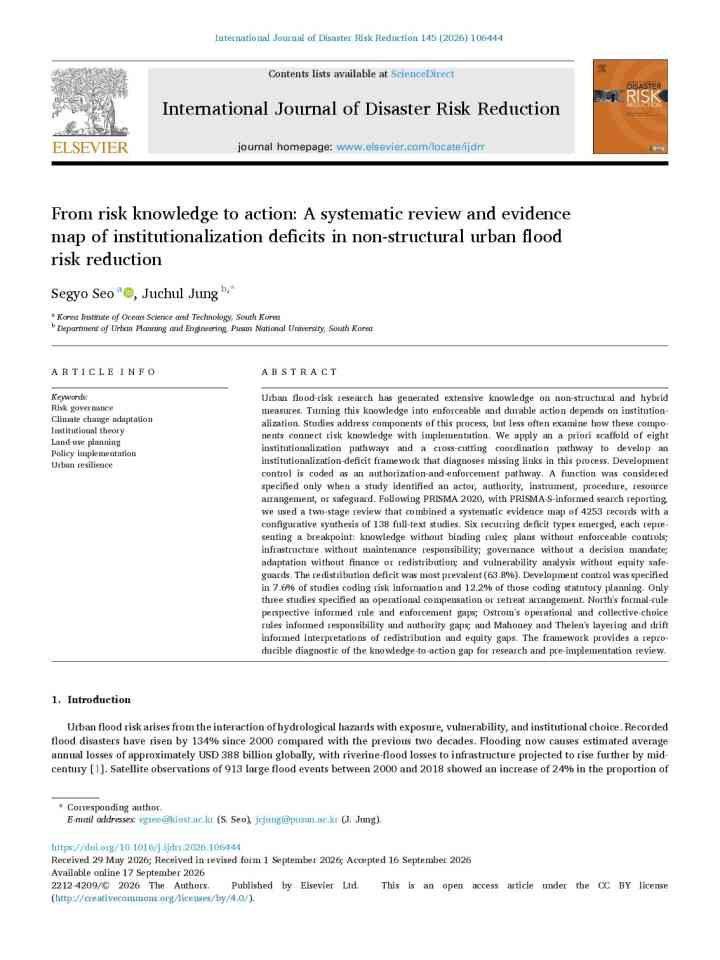
from-risk-knowledge-to-action-a-systematic-review-and-evidence-map-of-institutionalization-deficits-in-non-structural-urban-flood-risk-reduction.pdf thumbnail
Documents and publications

This study applies an a priori scaffold of eight institutionalisation pathways and a cross-cutting coordination pathway to develop an institutionalisation-deficit framework.

International Journal of Disaster Risk Reduction (Elsevier)
Update
USA: Houses of worship in NYC prepare for growing climate threats

Free climate-readiness audits are helping religious organizations identify ways to buttress their buildings for extreme heat, flooding, and other dangers.

Yale Climate Connections
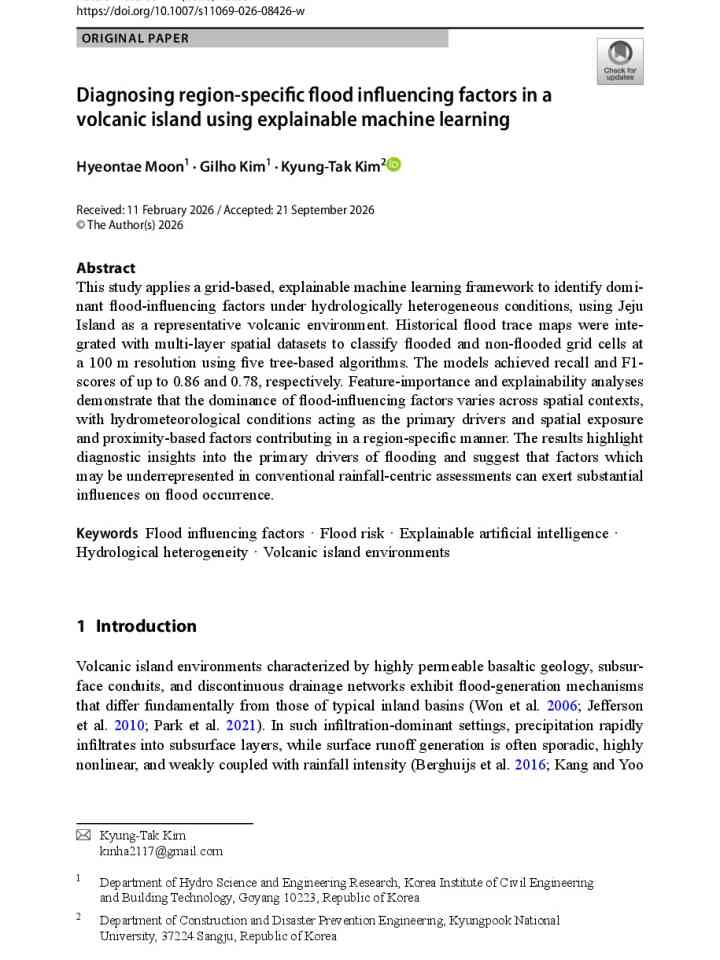
Diagnosing region-specific flood influencing factors in a volcanic island using explainable machine learning thumbnail
Documents and publications

This study applies a grid-based, explainable machine learning framework to Jeju Island and finds that rainfall, groundwater, and proximity to water bodies are key, regionally variable factors for flood occurrence, supporting nuanced flood risk management.

Natural Hazards (Springer)
JAKARTA, INDONESIEN
Update
Indonesia: Cities are sinking

As cities continue to sink, we need to examine these changes at the local scale. Averages across a whole city can tell us how big the problem is, but knowing where the land is sinking fastest – and who lives there – is essential to deciding for response.

Conversation Media Group, the
Update
Resilience starts at home in LAC

For this year’s International Day for Disaster Risk Reduction, UNDP describes how risk-informed housing and land-use planning is taking shape in Cuba, Jamaica and Venezuela, in a region where 81.2 per cent of the population lives in cities.

United Nations Development Programme (UNDP)
Meetings and conferences
Online
Online, 14 October 2026, 13:30–16:40 Costa Rica time. The University of Costa Rica’s XV Research Conference on Disaster Risk Management presents recent research from Costa Rica, Paraguay, Chile and the United States. Free and open to all.
Meetings and conferences
Kurayoshi
Online
Kurayoshi, Tottori, Japan, and online, 17 October 2026, 16:30–18:00 JST. A workshop at Bousai Kokutai 2026 uses a disaster-prevention song and a short film to teach shelter resilience, mutual aid and risk reduction through urban planning.
Dhunge Bazaar near Trishuli in Nuwakot, Nepal, shows extensive damage following severe flooding in the Bhotekoshi River. Floodwaters have damaged houses, roads, bridges, public buildings and other infrastructure, while security forces and rescue teams work to evacuate affected residents and clear blocked roads. Aerial footage shows the scale of destruction across the flood-affected area.
Research briefs
Nepal: Almost 300,000 people now live in flood‑prone areas

Study finds built-up areas potentially exposed to flooding in Nepal and neighbouring river catchments grew by 46% between 2016 and 2023. Rising exposure in valleys highlights the need to integrate disaster risk into land-use and infrastructure planning.

Conversation Media Group, the
mcr-smart-cities.pdf thumbnail
Documents and publications

This briefing paper shows how disaster resilience can be integrated into Smart City development across theory, policy and practice. The findings indicate that technology and digital infrastructure alone are not sufficient to create resilient Smart Cities.

Making Cities Resilient 2030 (MCR2030)
Identifying determinants of evacuation reliability in flooded suburban railway stations: A large-scale virtual reality approach thumbnail
Documents and publications

This study uses immersive VR simulations and machine learning to identify manual guidance by station staff as the most effective factor for reliable flood evacuation in suburban railway stations, emphasizing staff deployment and clear emergency broadcasts

International Journal of Disaster Risk Reduction (Elsevier)
IDDRR - innovation starts at home
Update
IDDRR: Five innovative ways to bring resilience home

When confronted by disaster, home is the first thing we fight to protect, and the first line of defence too. Resilience is innovated at the household level – through smarter design, better data and nature being put to work. 🌿

United Nations Office for Disaster Risk Reduction (UNDRR)
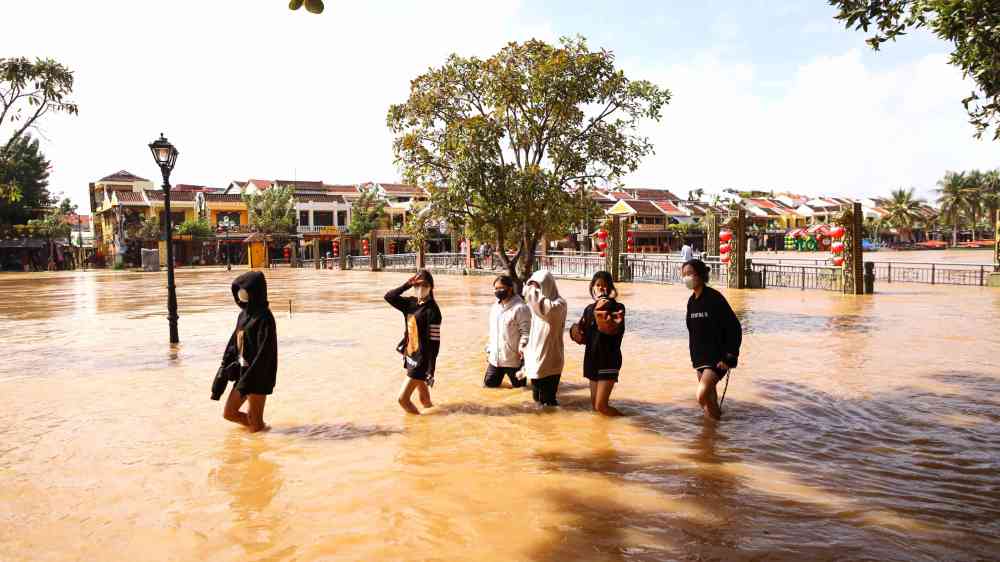
A group of people walking through floodwaters in an urban area, showcasing a natural disaster.
Update
Thailand: Warming puts Bangkok at greater risk of deadly floods

Bangkok’s extreme flooding highlights how climate change, urbanization, land subsidence and intense rainfall are increasing flood risk, underscoring the need for resilient drainage, green infrastructure and stronger early warning systems.

Conversation Media Group, the
Integrating three plan evaluation approaches for coordinated heat resilience in cities across the Arizona urban corridor thumbnail
Documents and publications

This study examines how cities across the Arizona urban corridor incorporate heat resilience into their networks of plans, using an integrated assessment approach. The researchers applied three complementary plan evaluation methods.

Elsevier
Urbanization erodes heat resilience across Chinese cities thumbnail
Documents and publications

This study aims to systematically reveal the nexus among urban heat resilience, urban-scale expansion, and land-cover transformation in 70 rapidly urbanizing Chinese cities

Elsevier
Escaping the heat: urban heat resilience and public cool spaces thumbnail
Documents and publications

This paper analyses London’s Cool Spaces scheme, finding a misalignment between policy intentions and real-world use, with depoliticisation and structural vulnerabilities undermining its effectiveness as a long-term urban heat resilience strategy.

Springer Nature
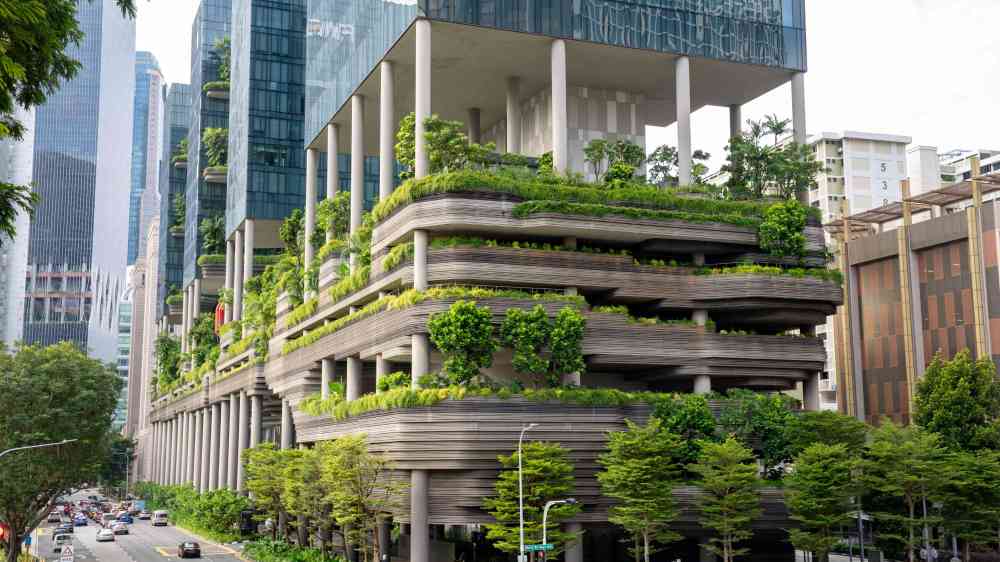
Modern high-rise with vertical garden, showcasing urban sustainable design.
Kaiqi Yang
This blog suggests cross-referencing environmental evidence can support early design decisions under uncertainty. Risk-informed design under uncertainty is not about immediate conclusions, but about a more informed reasoning process behind decisions.
Case study
Location: Kenya
This case study assesses flood and coastal risks in Mombasa using probabilistic modelling, GIS and economic appraisal tools to inform resilient infrastructure, risk-informed planning and investment-ready urban resilience strategies.
  • Intra Africa, Caribbean and Pacific (ACP) Disaster Risk Reduction Programme (DRRP)
Case study
Location: Fiji Kiribati Marshall Islands Micronesia, Fed States of Palau Papua New Guinea Samoa Solomon Islands Tonga Tuvalu Vanuatu
Case study on risk-informed urban planning across Pacific Island Countries, combining urban analysis and multi-hazard risk assessment to guide resilient infrastructure, inclusive urban growth and climate adaptation.
  • Intra Africa, Caribbean and Pacific (ACP) Disaster Risk Reduction Programme (DRRP)
Case study
Location: Saint Lucia
Case study on how risk analytics, urban resilience assessments and flood mitigation studies are informing climate-resilient investment and infrastructure planning in St. Lucia.
  • Intra Africa, Caribbean and Pacific (ACP) Disaster Risk Reduction Programme (DRRP)
Earthquake risk in Accra, Ghana: Household perceptions, awareness, and preparedness in a rapidly urbanising metropolis thumbnail
Documents and publications

This study examines household earthquake risk awareness and preparedness in Ghana’s Greater Accra Metropolitan Area, revealing high awareness but low preparedness. Education and prior tremor experience significantly predict readiness.

International Journal of Disaster Studies and Climate Resilience (IJDSCR)
Extreme heat is a slow-onset and unequal urban disaster thumbnail
Documents and publications

This report highlights extreme heat as an unequal urban disaster in India and Asia, detailing impacts on informal workers and urban poor, and calls for preventive, equity-focused responses like early warnings and participatory action plans.

All India Disaster Mitigation Institute
Quantifying the impact of landform modifications on flood hazards thumbnail
Documents and publications

This research quantitatively evaluates how historical landform modifications and urban expansion have altered rainfall–runoff behaviour and flood exposure.

Journal of Hydrology: Regional Studies (Elsevier)
Update
Philippines: Cities are sinking into deeper flood risk

The interaction of land subsidence with urbanization, reclamation and climate variability in contributing to massive flooding must also be examined, along with possible governance failures in light of increasing flood risk in Philippines.

Inquirer.net, Philippine Daily Inquirer
ARRIVE – Analysis of risk for urban migrants, refugees, and IDPs in vulnerable environments thumbnail
Documents and publications

The study examines how secondary cities and development cooperation can better respond to these challenges, It looks past visible outcomes such as informal settlements and flooding to the underlying practices, capacities and paradigms that produce them.

Deutsche Gesellschaft für Internationale Zusammenarbeit (GIZ)
Research briefs
Real-time rainfall detection for urban flood forecasts

The Korea Institute of Civil Engineering and Building Technology (KICT) announced that it will apply its early detection technology for quasi-stationary linear rainbands and sudden localized torrential rainfall to the Urban Flood Forecasting Platform.

Phys.org
Research briefs
AI predicts seismic vulnerability in milliseconds

A hybrid neural network reproduces pushover analysis in about 70 milliseconds, opening the way to city-scale seismic risk mapping.

Bioengineer.org
From global AI predictions to city-scale extreme winds thumbnail
Documents and publications

This study presents an AI-physics hybrid framework that couples five AI weather prediction models with Weather Research and Forecasting (WRF)-Urban Canopy Model (UCM) for high-resolution city-scale extreme wind prediction.

npj Natural Hazards (Nature)
Cover page for the publication "Cities at the Frontline", with project logos at the top, and a circle cropped photo of an urban area in the bottom right corner
Documents and publications

This publication details notable highlights from the Resilience Initiative Africa Project, which was implemented by UNDRR's Regional Office for Africa between August 2023–March 2026.

United Nations Office for Disaster Risk Reduction - Regional Office for Africa
Meetings and conferences
Geneva
In person
This roundtable experts together in Geneva to discuss how housing affordability, availability, and changing risk landscapes shape vulnerability in cities, and how housing resilience can strengthen broader urban resilience outcomes.
Update
Building Resilient Cities

The nature‑based solutions for urban heat are specifically designed for neighborhoods and communities because the standard will provide users with tools and techniques to identify areas where nature‑based solutions can be most effectively implemented.

ASTM International
Human mobility and urban flood risk: Dakar’s case thumbnail
Documents and publications

This case study explores how climate-related mobility and flood risk intersect in Dakar, highlighting community-based disaster risk reduction, nature-based solutions, flood governance reforms and lessons for evidence-based planning.

Deutsche Gesellschaft für Internationale Zusammenarbeit (GIZ)
Urban heat
Last updated 14 Sep 2026
Urban heat islands occur when human activity and construction create higher temperatures in urban areas than the surrounding landscape.
Update
Britain's cities are heating up and trapping more heat

New analysis from Ordnance Survey has found more than eight in ten cities in Great Britain are already highly vulnerable to urban heat islands, and almost two thirds are set to reach severe heat vulnerability by the turn of the century.

Ordnance Survey
Pathways for mainstreaming nature-based solutions for climate adaptation: grounding, capitalising, embedding and anticipating across 12 Mediterranean cities thumbnail
Documents and publications

This study examines nine case studies across the Mediterranean to analyse different mechanisms that contribute to institutional mainstreaming of nature-based solutions (NbS) for climate resilience in urban and peri-urban areas.

npj Urban Sustainability (Nature)
Divergence between physical and emotional heat resilience in Chinese cities thumbnail
Documents and publications

Using social media and meteorological data, this study quantifies the mismatch between physical heat exposure and public emotional responses from 2010 to 2024 in China.

Nature Climate Change
Regulating urban resilience: the need for interconnected standards and responsibilities for climate change resilience in UK urban areas thumbnail
Documents and publications

Study of climate resilience governance in UK urban areas. Through a scoping review and policy analysis, it finds fragmented responsibilities, inequitable vulnerability and a lack of common resilience standards, proposing a place-based resilience benchmark

Urban Research & Practice Journal (Taylor & Francis)
heat-action-plan-hap-toolkit_june-2026_v2.pdf thumbnail
Documents and publications

This toolkit provides a practical, step-by-step framework to support cities, urban local governments, planners, practitioners, and community stakeholders in developing and implementing Heat Action Plans (HAPs) to address the growing risks of extreme heat.

Sustainedge
Update
Portugal: Guimaraes uses science-based tools to drive NBS

As heat, drought and extreme rainfall put growing pressure on Europe’s cities, the city of Guimaraes is using digital tools and scientific data to decide where climate action is needed most, and to measure what works.

Eurocities
Assessing the consequences of compound coastal–fluvial flooding under climate change: exposure, vulnerability and damage estimates in eastern England thumbnail
Documents and publications

This study applied an integrated flood risk assessment framework to evaluate climate-driven compound flood risk in Broadland, with particular emphasis on how methodological choices influence exposure, damage and spatial risk estimates.

International Journal of Disaster Risk Reduction (Elsevier)
Update
Paris, Milan and Phoenix: Heat has us all facing the same question

Three cities are learning from each other about how to protect residents. These climate policies are also public health measures.

Guardian, the (UK)
People walking on a hot day
Update
Extreme heat is worsening other climate impacts on health

As heat overlaps with other intensifying climate events, scientists are uncovering how they compound each other – and how cities can adapt

Dialogue Earth
Modern high-rise buildings with vertical greenery and integrated plants on facade connected by skybridge.
Update
The greenest building is the one still standing after a disaster

As storms happen more often and with more intensity, considering the full life cycle of a building and its costs over time becomes increasingly important to get an accurate picture of how sustainable that building really is.

Conversation Media Group, the
Update
Manhattan’s flood walls are almost done. What will Mamdani do next?

The new mayor wants to invest in coastal resilience, but he will have to decide which areas of the city to protect. New York City has more than 500 miles of coastline, no two miles of the waterfront are quite the same and are vulnerable in different ways.

Grist Magazine
Vegetation fire burns jungle forest near Florida houses as firefighters and fire trucks work to contain flames threatening nearby neighborhoods, USA (2025).
Update
In the American West, wildfire comes for the suburbs

Despite decades of warnings, neighborhoods in Reno and Spokane have sprawled ever closer to a hotter, drier wilderness. And in the summer, months of low humidity and hot weather prime the landscape to burn.

Grist Magazine
Update
US: Extreme heat is a risk for transportation infrastructure

Contemporary transportation infrastructure is not designed for the extreme levels of heat as the frequency and severity of high temperatures increases. Those in charge must respond to increased stress on infrastructure systems, with mitigation techniques

Eno Center for Transportation
Update
The natural defence that could help cities beat extreme heat

Green and blue spaces, such as woodlands and riversides, could provide a vital line of defence for cities facing increasingly hot summers, according to new research from the University of Surrey.

The University Of Surrey
Meetings and conferences
Online
This session will combine global perspectives, practical case studies, and scientific expertise.
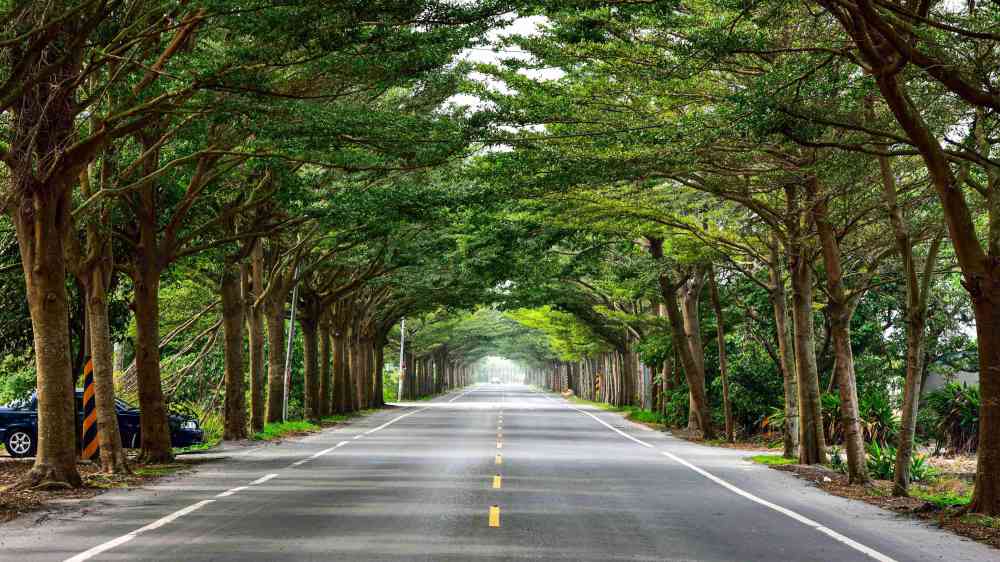
A scenic road enveloped by lush green trees, creating a tunnel effect in summer.
Update
Proper maintenance can help trees withstand hurricanes

Proper tree maintenance can help trees withstand hurricanes. The audio explores how pruning, planting the right species and managing tree health can reduce storm damage and help communities build resilience.

Yale Climate Connections
Update
USA: $95 million cloudburst project to manage flooding

New York City is investing US$95 million in a Cloudburst project in Homecrest, Brooklyn, using porous pavement and underground storage to reduce flooding, improve water quality, and strengthen resilience to intense rainfall driven by climate change.

City of New York
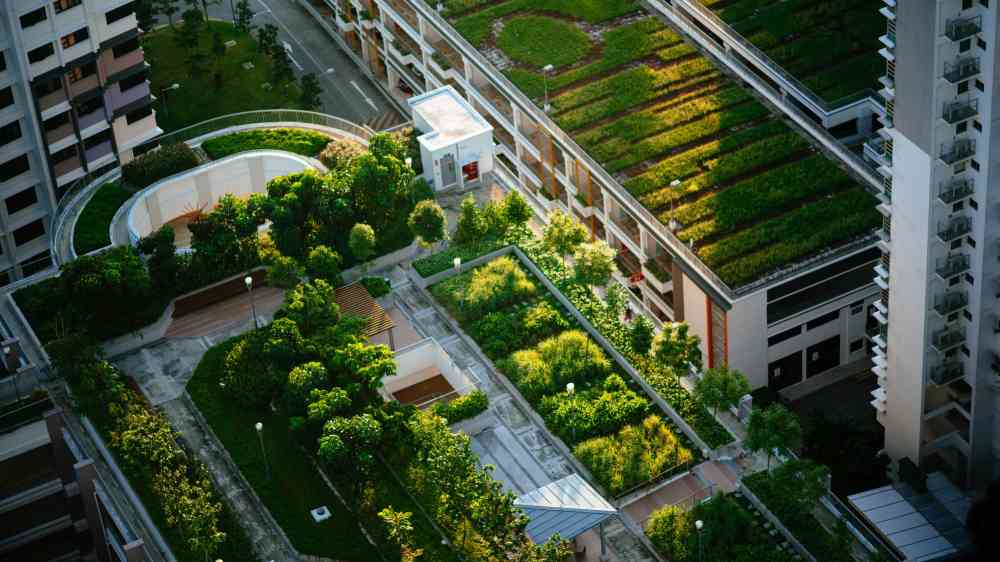
Green roofs onbuildings in a city.
Update
Green roofs cool cities, if they survive

Long-term maintenance plans, clear ownership responsibilities and funding for stewardship may prove as important as the installation. Climate adaptation isn’t just about building infrastructure, but ensuring it continues to thrive for years to come.

Conversation Media Group, the