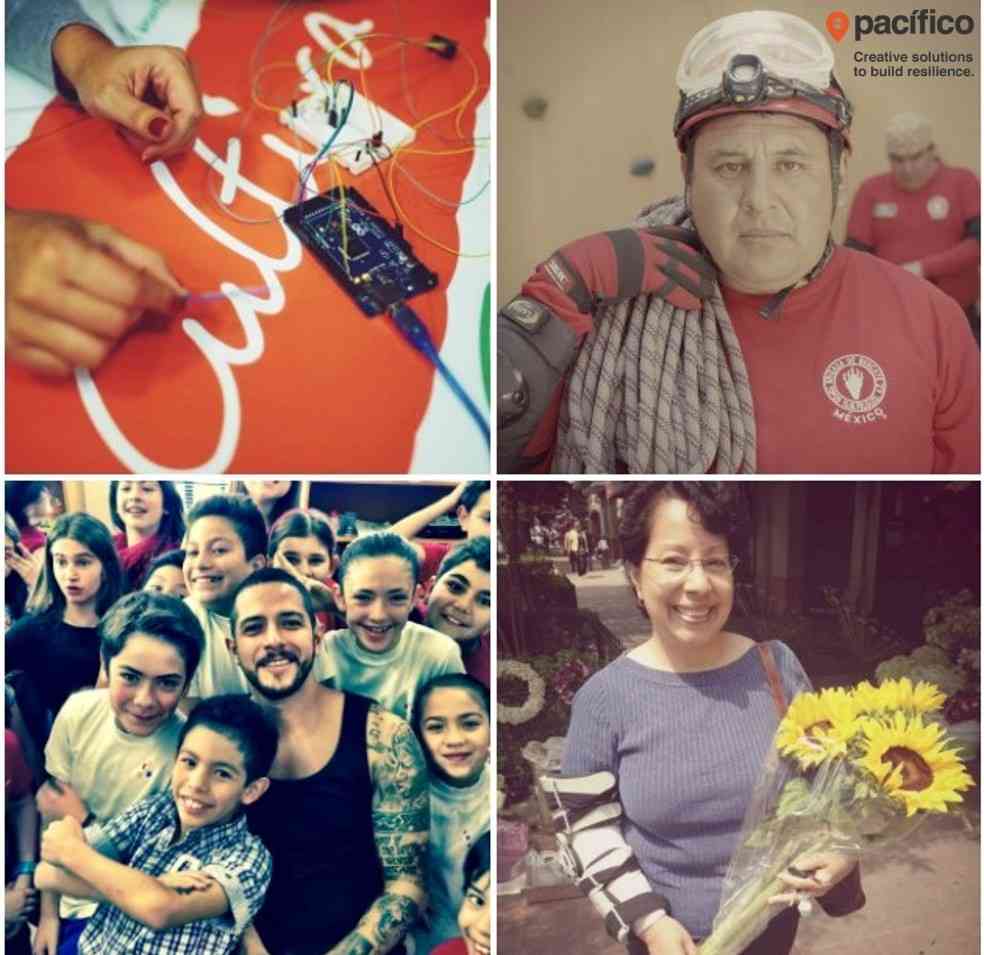
Applied Risk Communications by Pacífico
At Pacífico Creative Risk Communications we are committed to find more effective ways to educate about risk, engaging citizens along the way. We help international organizations and governments around the world to allow communities to make more informed decisions with a positive, creative approach.
Description
Pacífico provides creative solutions to make communities affected by disasters more resilient. We use creativity to help understand risk in new ways, drive behavioral change and tap into culture to draw people's attention and trigger meaningful conversations about the environment.
Citizens are the best partners for designing solutions for the city. They have local knowledge, ideas of possible improvements for the places they inhabit, and, as taxpayers, they pay for the solutions they demand. But, integration of the citizenry into the public-policy is complex. In our projects, we explore models for triggering a meaningful conversation with citizens engaging them as co-designers of solutions.
Disaster stories in the media are mostly about destruction. We believe that creative storytelling has the power to transform that representation into inspiring stories that drive positive change. In our projects we use music, design, art and storytelling to trigger a meaningful conversation about the environment and the places we live in.
People around the world are learning to use new technologies. Yet, we as citizens learn as consumers but not as makers or co-creators of the devices we use or the systems behind them. In our projects, we explore ways to engage citizens in building early-warning systems, so that they feel part of a system, connect with it, make it more human and become more aware of risks in the city.
Different risks are interconnected in complex ways. Sea-level rise and ocean-water intrusion may relate to water security. Wildfires and coastal erosion may be connected to endangered natural or cultural patrimony that in turn affects the local economy. This requires a multi-hazard approach and a deep understanding of how systems are interconnected before applying design techniques. In our work, we present systems-thinking platforms as tools to visualize variables in complex systems and identify where transformative interventions can make those systems more resilient.
As a result our methodology is based in systems thinking, participatory design, rapid prototyping, learning and iteration, and integration with public policy.
Did the Sendai Framework change or contribute to changes in your activities/organization? If so, how?
The Sendai Framework created a shift from managing disasters to managing risk. For this purpose, it called to strengthen the design and implementation of inclusive policies, including through community involvement, for integrated livelihood enhancement programmes, access to basic health-care services, food security and nutrition, housing and education, and eradication of poverty, to find durable solutions to disaster risks and building resilient communities. At Pacífico, our work is well aligned with the Sendai Framework.
What led you to make this commitment/initiative?
What was your position before making this Voluntary Commitment / prior to the Sendai Framework?
In recent years, Governments and aid organizations have made various commitments about ensuring that the world’s most vulnerable people are not “left behind”. But the pace of progress suggests that those commitments are not going to be reached on time. For example, the 2018 World Disasters Report, estimated that millions of people living in crisis are not receiving the humanitarian assistance they desperately need.
At Pacífico, we are motivated to help achieve the 2030 Agenda for Sustainable Development by doing research, creating and building things. We believe in multi-disciplinary work and exploration to generate new ideas. As a result, our creative solutions can contribute to making communities affected by disasters more resilient.
Deliverables and Progress report
Deliverables
Deliverables are the end-products of the initiative/commitment, which can include issuance of publications or knowledge products, outcomes of workshops, training programs, videos, links, photographs, etc.
In Mexico, 70% of rivers are polluted with chemicals. Greenpeace Mexico needed to share the results of a scientific study describing this problem.
Our challenge was to draw people’s attention to the problem and spark an environmental debate.
We created the Toxic Tours initiative, with a provocative campaign and a real invitation for people to visit polluted places.
The Topos Rescue Brigade is an independent civil organisation of volunteer rescuers. Since 1985, they travel to earthquakes around the world to save people trapped in collapsed structures.
They are unknown heroes who save hundreds of lives but they do not receive any financial suppport.
After participating in their trainings and learning about the organization challenges, we came up with an idea. Instead of creating a campaign, we created a product. A product for them to give to donors in exchange for a donation. We called it the Earthquake Amulet.
On Saturday August 20th we organised a Risk Lab on Flooding in Santiago de Chile, as part of the Do Smart Cities event.
Among the participants were neighbours from places in the city which suffer recurrent flooding.
It was coordinated by Gabriela Elgueta, the Chief Resilience Officer of Santiago, Víctor Salazar, Innovation director at Aguas Andinas water company and the Pacífico team of engineers.
For the practical activity we organised a drill.
We used sensors, Arduinos and low cost rain gauges to simulate a big storm in the city of Santiago and measure how rain affects neighbourhoods which suffer flooding recurrently.
We projected a city map on the wall showing data coming real time from citizens rain gauges and configured an early warning system.
Government officials and citizens discussed ways in which citizen data can enrich current average data provided by government agencies with more granularity at the neighbourhood level.
Last December we started working with the City of New Orleans. We will develop a communications campaign that connects residents to the coast, targeting young residents and inviting them to support the coastal protection and restoration initiatives. Louisiana’s coast is a precious natural, economic, and cultural resource, but its complex and fragile ecosystem is disappearing at an alarming rate. The Coastal Master Plan sets an ambitious path to respond to the loss of the coastal land and the threats from storm surge events. In line with this plan, the City of New Orleans wants residents to share this commitment. The process started with a field trip and the coordination of a workshop with community stakeholders who will shape the campaign, in which we explored the message territories. The creative message will tell the story of how the past, present and future of New Orleans are shaped by water.
On October 31st we organised a Risk Lab in Buenos Aires, with the participation of more than 60 public officials from argentine national and local governments.
It was sponsored by the Inter-American Development Bank. The context was the presentation of the study ‘A perspective on local risk management in Argentina’. Speakers included Dr Omar Darío Cardona, international expert in Risk Management, Sergio Lacambra, Lead Specialist in Disaster Risk Mangement at the IDB and Viviana Alva Hart, specialist in rural development, also the IDB.
On Saturday 27th August we organised a new Risk Lab on seismic risk in the City of Los Angeles, California.
Together with the California Institute of Technology, renowned seismologists Lucy Jones and Jean Paul Ampuero and the organisation Mujeres de la Tierra, we invited the latino community to take part in a full day of activities around seismic risk at the Sonia Sotomayor School of History and Dramatic Arts in Cypress Park.
In collaboration with the Resilient Cities Network (R-Cities), ideation workshops were executed.
More than 130 people from the government, civil society organizations, the private sector and residents participated. More than 500 ideas were proposed to nurture the City’s Resilience Strategy.
How can Easter Island—Rapa Nui—become more resilient with regards to tsunamis? Is there a connection between tsunamis, wildfires and coastal erosion on the island?
Together with the Provincial Government of Easter Island, the Chilean emergency agency ONEMI, Chile’s National Forest Corporation (Spanish acronym CONAF) and the Inter-American Development Bank (IADB), Pacífico has addressed risk management on Easter Island-Rapa Nui launching an awareness campaign
This was carried out using mechanisms such as participatory design, art and illustration, ancestral knowledge, documentary narrative, and systems thinking tools.
Risk from tsunamis, rising sea levels and coastal erosion endanger this heritage, located mostly along the coast. Ever more frequent wildfires destroy vegetation and accelerate coastal erosion, affecting the archaeological heritage, on which tourism depends.
Every year, hurricane season brings great destruction to Haiti.
According to a study by the World Bank, messages about prevention often fail to reach the people who most need them.
This is why we launched a campaign with a positive preparation message designed to reach the entire country through different platforms.
With popular Haitian artists Boukman Experyans, Tafa Mi Soleil and other musicians, we created a prevention song.
How can meteorology be made more attractive and open to everyone? This challenge has brought us to work together with the Hydrometeorological Service of Haiti (Haitian UHM).
As part of a presentation workshop, we created “Young Meteorologists.” This is an educational activity with special guests like Nicole F. Celhomme, a member of the National Meteorology Center (CNM), to help children get to know the UHM and encourage them to become its ambassadors.
In a country as affected by disasters as is Haiti, capacities for weather prediction are fundamental for reducing the vulnerability of the population. With the support of the World Bank, Pacífico has partnered with the nation’s Ministry of Agriculture, Natural Resources and Rural Development (MARNDR) in order to institutionally strengthen the UHM as an organ for providing important information in order to better prepare the population.
“Music and Climate Change” was the topic chosen for the closing of the tenth annual “Understanding Risk 2020,” the main event for the global community working in risk-management and communication.
With the support of the World Bank, we at Pacífico presented this closing event, with a short video hat explores the various ways of creating resilience through music and science.
“Creating Change Through Music” is an encounter between two talented artists from two different cultures and generations, who perform music in order to raise awareness of natural phenomena, climate change and disasters.
Although they live in the middle of the Pacific Ocean, the majority of children on Ecuador’s Galápagos Islands have no access to the sea, nor have they had the opportunity to visit the other islands of the archipelago.
At Pacífico, with the support of the Inter-American Development Bank (IDB), we have developed an initiative of social and digital inclusion, along with the Governing Council of Galápagos, the Galápagos Special Regime and the Naveducando Foundation.
Galápagos Infinito is an experiential-education program aimed at students in the archipelago. The goal is for the 12-year-old boys and girls of Galápagos to have educational experiences that bring them closer to the sea, help them value their surroundings, and connect with the other islands in Galápagos and elsewhere in the Pacific.
The Caribbean and Central America of two of the world’s most vulnerable and disaster-prone regions. They are confronted with an increasing number of devastating storms and extreme weather events.
Disaster Fighters is a regional communications platform to improve disaster preparedness and build resilience in 29 countries.
The project is supported by the World Bank, CDEMA and CEPREDENAC.
People around the world want action to prevent the impending crisis from the changing climate, but are struggling to understand how to make a difference.
Tempo proposes a collaboration between
artists and scientists to promote climate action, communicate viable solutions, and better understand the risks we face from climate change.
Moving stories of resilience and citizen participation have the potential to spread important preparedness information and to inspire the next generation of community leaders.
"The girl and the tsunami" is a short animated film about the story of Martinna and the community of Juan Fernández in Chile who on the night of February 27, 2010 survived a tsunami.
Triggered by one of the biggest earthquakes in history, the tsunami affected thousands of kilometers along the Chilean coast, as well as the small Pacific island of Juan Fernandez, also known as Robinson Crusoe.
Most of the community on the island was already sleeping that summer night, unaware of the up-coming hazard. But it was a 12 year old girl, realizing that a tsunami would hit its coast, that ran to the firemen's office and rang the gong to wake up and protect her community.
This film celebrates the courage of a young girl who took the lead to save many lives.
Resilience and the telling of stories are closely related. The narration of stories is a powerful tool for sharing experiences and information valuable to people, allowing us to connect with empathy in a universal way.
Tsunami Ladies is a documentary about six women connected by the ocean, across thousands of kilometers.
Six Chilean and Japanese cooks, who survived the tsunamis of 2010 and 2011 to lead the reconstruction of their towns, meet in Japan to tell their stories and share recipes.
Tsunami Ladies is a celebration of cooking as a universal language.
Porgress report
During 2021 and early 2022, Pacifico has developed a series of projects and communication campaigns with components of disaster preparedness, community engagement, genre perspective and climate change action.
Disaster Fighters, a communications platform to share knowledge about disaster risk across the countries in the Caribbean and Central America was launched in 2021.
Tempo - Music for climate action is a project created in collaboration with renowned seismologist Dr. Lucy Jones.
The short film The Girl and the Tsunami was presented during World Tsunami Day 2021. It will also be presented at the UN Ocean Decade Conference in April 2022.
The documentary Tsunami Ladies has been screened in Japan, America and Caribbean as well as English speaking countries during 2021.
Pacifico launched Disaster Fighters, a regional communications platform in collaboration with the World Bank, CDEMA and CEPREDENAC to improve disaster preparedness and build resilience in communities. The campaign impacted 16 million people in 26 countries in the Caribbean region and Central America.
TEMPO - Music for Climate Action brought together specialists in neuroscience, risk studies, the environmental agenda and music to understand the climate problem and how to use music to action. The project already did its first Symposium with participants from the U.S. and Japan, as well as participants from Argentina, the UK, Sweden, and Canada.
The short film The Girl and the Tsunami was presented during World Tsunami Day 2021 with the support of UNESCO and UNDRR.
Tsunami Ladies has been screened in Japanese, English and Spanish languages during 3 world online events.
Organizations and focal points
Implementing Organization(s)
Focal points
Partners
- Dr. Lucy Jones Center for Science and Society
- Resilient Cities Network
- City of New Orleans
- Municipality of Santiago
- Rockefeller Foundation, the
- Chile - government
- California Institute of Technology
- United States Geological Survey (USGS)
- National Aeronautics and Space Administration (NASA)
- Japan International Cooperation Agency
- Inter-American Development Bank (IDB)
- Greenpeace International
- World Bank, the