Anticipatory action
Anticipatory action allows humanitarians and affected communities to make informed decisions ahead of a humanitarian crisis – saving time and money; preventing displacement, disease, loss of livelihood; and preserving the dignity of those affected.

Anticipatory action allows more effective delivery: the FAO calculates that every dollar they invest in anticipatory action could give families seven dollars in benefits and avoided losses.
On this page
Pre-emptive humanitarian interventions, based on forecasts, can save lives and livelihoods.
Anticipatory action is a smart way to respond to potential crises when it is possible to forecast a disaster. Evidence shows that anticipatory action can be fast, economical, inclusive, dignified, and resilient – complementing traditional humanitarian responses.
Yet, according to a report from the Centre for Disaster Protection, "just 0.2% (USD78 million) of humanitarian funding reported to the OECD DAC in 2021 was funding for anticipatory action."
UNDRR supports anticipatory action as a way to bridge the gap between longer-term disaster risk reduction efforts and humanitarian crisis response. With expertise in understanding risk and forecasting, and in building networks between national governments and the international community, UNDRR is well-positioned to act as an enabler of anticipatory action. The Global Risk Assessment Framework (GRAF) can also support the development of the necessary risk data and risk-analysis capabilities.
How it works
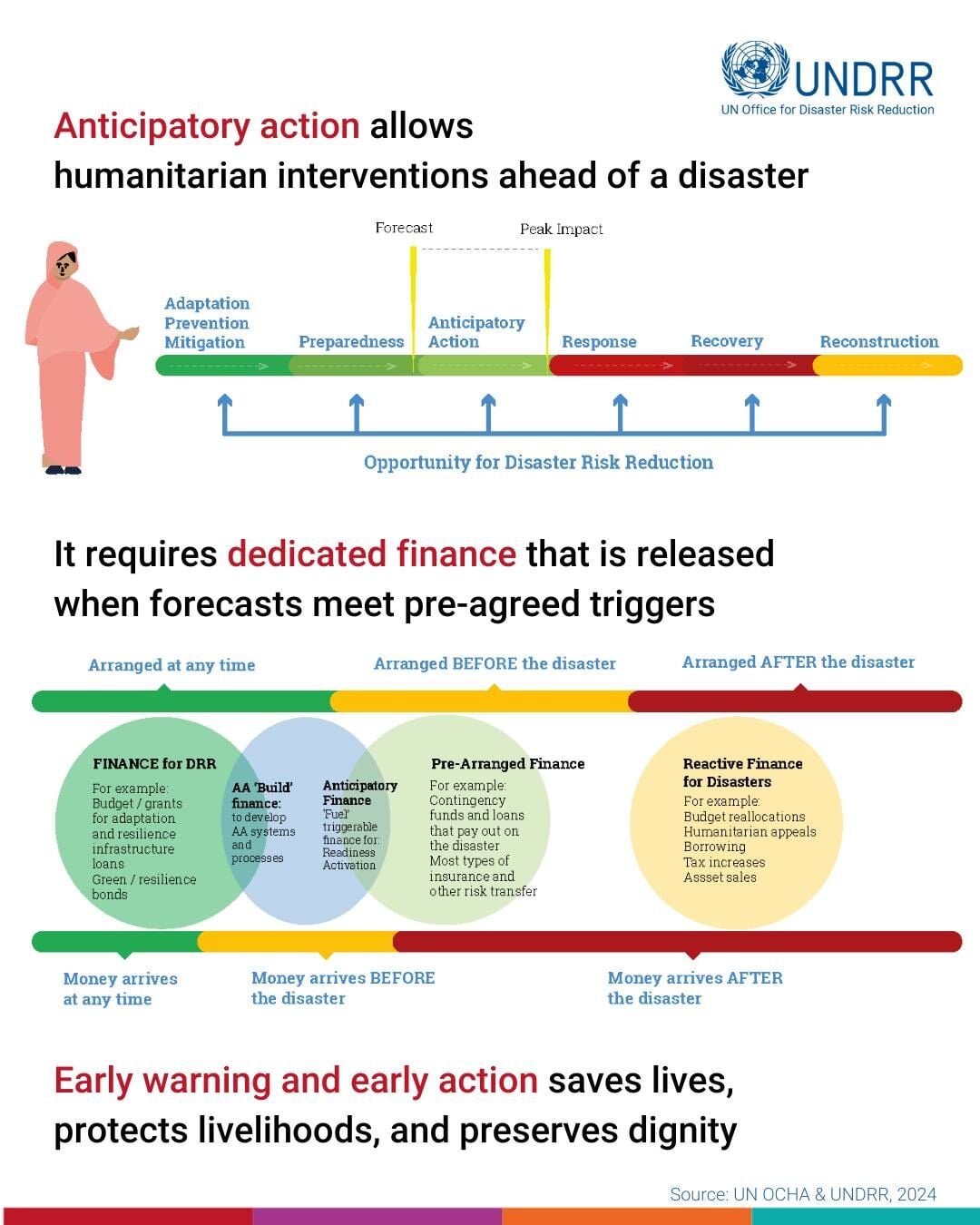
An anticipatory action plan comprises a set of pre-agreed and pre-financed actions to be implemented once forecasts have reached an agreed trigger threshold. The trigger could, for example, be a predicted windspeed of a certain magnitude for an approaching storm, or water flow of a certain volume upstream of a flood-prone region. This trigger releases the necessary funds to begin activities, with particular emphasis on reaching the most vulnerable: distribution of provisions or cash; evacuations; reinforcement of structures.
Depending on the nature of the hazard and forecasting capabilities, such interventions can be made well ahead of the shock (for slower onset events) or at least earlier than traditional humanitarian responses for more rapid onset events. This reduces the impact of the crisis – saving time and money; preventing displacement, disease, loss of livelihood; and preserving the dignity of those affected. Early intervention can also provide benefits beyond providing relief from the immediate impact, by helping to protect development gains in the long run.
An anticipatory, forecast-based approach to humanitarian action has been taken up under a range of labels – “anticipatory action”, “early warning early action”, “forecast-based early action”, amongst others. An anticipatory action thesaurus was developed to facilitate better mutual understanding and cooperation. See also how anticipatory action connects to other sectors and approaches.
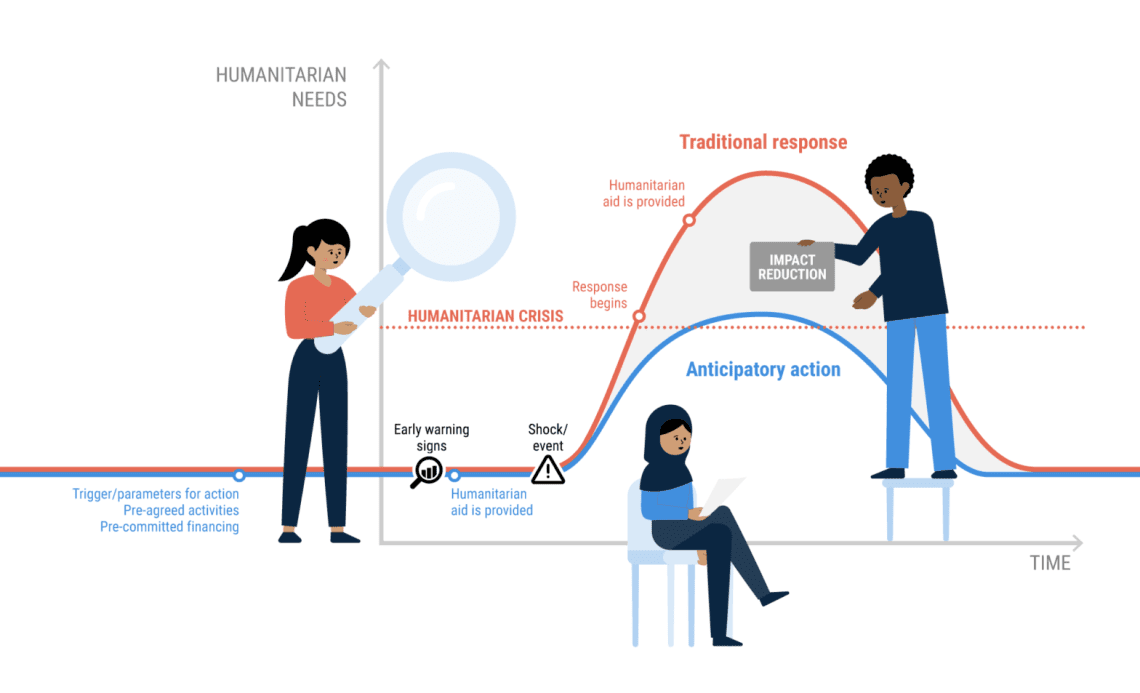
"Anticipatory action is a set of humanitarian interventions triggered once a pre-agreed forecast threshold is crossed. Supported by pre-agreed finance, anticipatory action prevents or mitigates potential disaster impacts before a shock, or before acute impacts are felt. Acting early mitigates the shock impact and reduces humanitarian needs, helping to protect hard-won development gains and enhance resilience. "
- UN OCHA
A brief history of early action
Securing finance in advance
Anticipatory action uses forecast-based financing: funding that is secured well in advance, along with a response plan that is activated by predetermined triggers. Once the trigger threshold is reached, the funding is immediately available and the assistance activities can begin, without delay. This means that obstacles to reaching a quick decision can be avoided during the critical early stages of the crisis.
Major humanitarian networks have begun dedicating more resources to anticipatory action. These include the UN system through its Central Emergency Respond Fund (CERF) and its country-based pooled funds; the Red Cross Red / Crescent Movement’s Forecast-based Action by the Disaster Response Emergency Fund (FbA by the DREF); and the Start Network’s Start Fund.
No regrets
Anticipatory action depends on an acceptance of risk: donors and humanitarians need to accept some degree of uncertainty for the sake of acting early.
Enhancing forecasting capacity
Early response is activated by pre-agreed triggers based on the forecasted impacts of events like cyclones, droughts, flooding, or other hazards. The lead time that these predictions provide depends on the nature of the threat, the accuracy of the forecast, and the availability of data.
Advance planning draws in experts from diverse disciplines – like risk analysis, meteorology, logistics and delivery, both at the global and the local level. Potential disasters are predicted using climatic models and weather forecasts, complemented by risk information from various other sources, such as satellite images and demographic data. Impact-based forecasts combine analysis of the nature of the hazard with information about potential effects on people, particularly the more vulnerable.
As humanitarian organisations integrate forecasting and risk analysis into their programmes, there is a growing need for expertise that straddles the practicalities of humanitarian delivery with the technical understanding of forecasting – including the development of new professional profiles.

Local preparedness
Anticipatory action facilitates greater coordination and planning, with more community input and participation, as the activities and the selection of the best-placed providers can be established well in advance, and capacities developed as necessary when there is time. Greater preparedness not only improves the outcomes of anticipatory responses, but arguably increases local resilience to hazards overall, regardless of whether the plan is triggered.
Locally led planning and implementation helps to foster greater participation, and plans that are inclusive and appropriate to local environments are more readily accepted.
The evidence is in
Humanitarian organisations and governments around the world recognise that anticipatory action should be an essential part of the humanitarian toolkit in a world with mounting threats of climate-related crises. In order to boost the confidence of funders and operators, networks have been formed to gather evidence to make the case for scaling up, to share lessons learned, and to identify gaps and bottlenecks.
The Anticipation Hub provides a platform to facilitate knowledge exchange, learning, guidance, and advocacy, including a database to collate evidence from the experiences of its partners. The Risk-informed Early Action Partnership (REAP) has explored how anticipatory action can be enabled at the national level, based on ten in-depth national case studies, and has offered a set of recommendations for bringing early warning and early action to scale. The Red Cross / Red Crescent Climate Centre and the UN Office for Coordination of Humanitarian Affairs (OCHA)’s Centre for Humanitarian Data collate data and assist end-users in putting it to best use.

The UN Office for Coordination of Humanitarian Affairs (OCHA)’s pilot programme includes twelve large-scale anticipatory action plans for a range of hazards. Other UN agencies, such the Food and Agriculture Organisation (FAO) and World Food Program (WFP), have also increasingly used anticipatory, forecast-based approaches in their delivery of humanitarian assistance, while contributing to the growing evidence base.
“If we act early, we act smart.”
- Former SRSG Mami Mizutori
It is time to scale up
The humanitarian, development and disaster reduction sectors realise the need to combine forces to adopt forecast-based approaches at scale to meet the challenges posed by extreme climatic events. UNDRR has an important role as a catalyst for anticipatory action, forging links between agencies involved in humanitarian action, climate research, long-range forecasting, and disaster risk reduction.
Anticipatory action protects lives, livelihoods, homes and entire communities. These early investments also prevent higher response costs down the road. This is at the core of my prevention agenda — to put better data, and more innovation, foresight and inclusion, into our work to address major risks.
- Antonio Guterres, UN Secretary General
Last updated on: September 2026
Additional resources
Training courses
Access more training courses on Anticipatory Action.
Build your capacities with these training courses available at any point.
Videos
Featured publications
The guide aims to help the reader understand what Anticipatory Action (AA) is and what benefits it offers; explain the different potential sources of AA finance available in a country; present real-world examples; and identify risks and challenges
This report examines the financial protocols of five multilateral and non-governmental AA financing mechanisms (AA funds) that finance anticipatory interventions.
This report outlines current gaps and key policy options available to bridge the gap between available disaster loss data and what is needed to translate them into anticipatory action.
This report reviews the feasibility, behavioural and political-economy factors that affect the demand and financing of AA programmes integrated in government SP systems, and discusses recommendations for increasing support for these interventions.