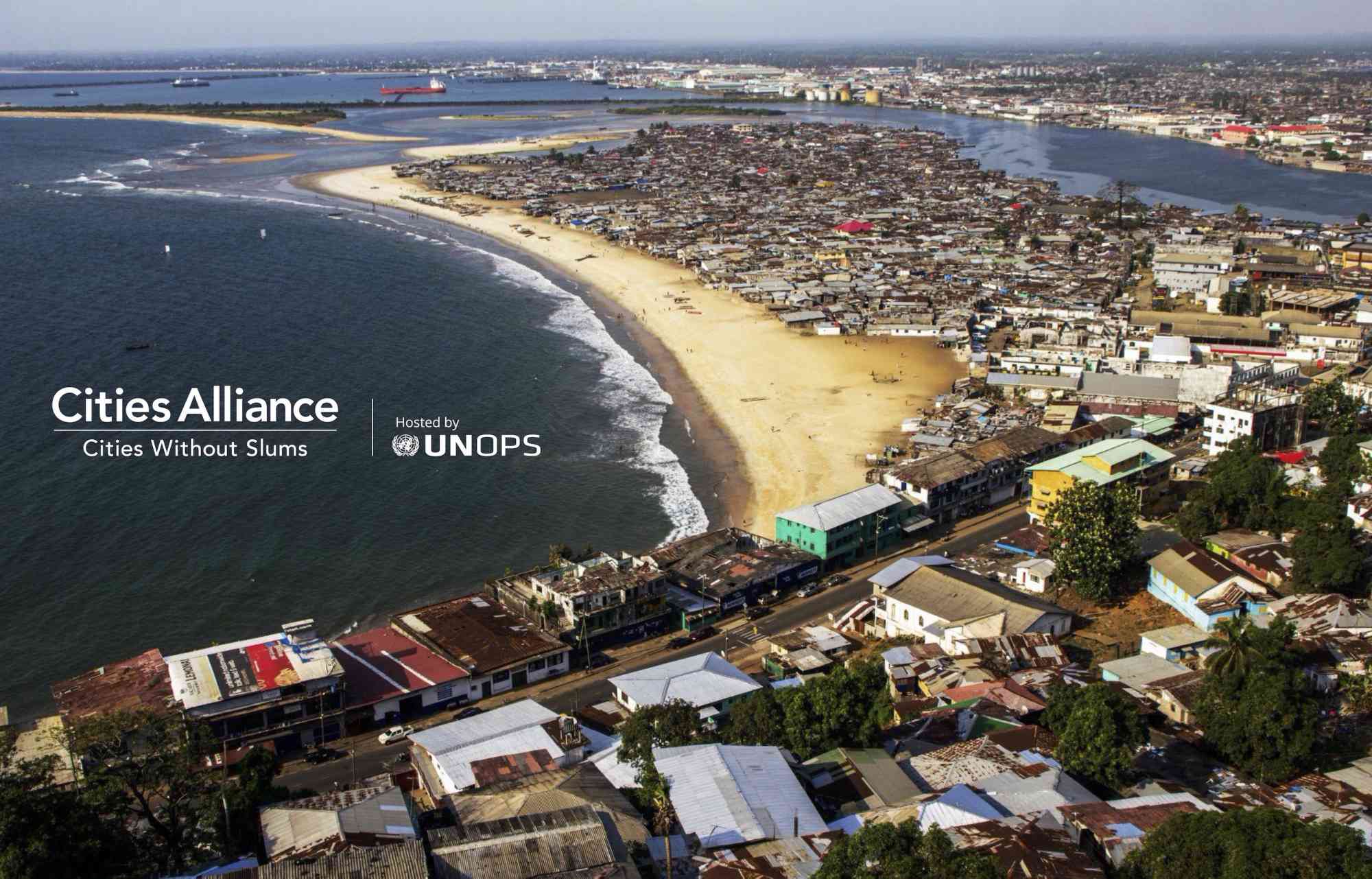
Climate Change, Resilience and Informality in Cities by Cities Alliance
The Programme on Climate Change, Resilience and Informality supports communities - in partnership with local governments - to build resilient cities that reduce risk and vulnerability by strengthening urban ecosystems, promoting investment in resilience, and advocating for people-centred resilience.
Description
Cities Alliance global work is designed to advance new tools, practices and understanding of emerging urban issues and support joint advocacy with our members. The Global Programme on Climate Change, Resilience and Informality in Cities is operating through advocacy, diagnostics and implementation piloting, examining various aspects and covering multiple countries, including a global perspective to promote resilience and the importance of public-community partnerships.
While cities should be centres of opportunity, innovation and economic growth, too often it is slum dwellers, informal traders and residents of vulnerable settlements that bear the brunt of environmental, economic and political risks that impact cities, particularly in rapidly urbanising economies. With the increasingly evident impacts of a changing climate, these pressures and casualties will only increase in the future.
Cities need resilient environmental, social, and economic systems that can withstand these shocks and stresses, particularly when measured through the eyes of the urban poor. City-wide actions to adapt to and mitigate climate change, can make a decisive contribution to national and subnational efforts aimed at fulfilling international commitments, such as the 2030 Agenda, the Paris Climate Agreement, the Sendai Framework and the New Urban Agenda.
Over the last decades, the Cities Alliance has been working on climate change, resilience, and sustainable urban ecosystems that are at the heart of the recent urbanisation discussions - always with a special emphasis on communities in informal settings and equality for all.
Did the Sendai Framework change or contribute to changes in your activities/organization? If so, how?
The Sendai Framework underlines the importance of effective global and regional campaigns as instruments for public awareness and education to promote a culture of disaster prevention, resilience and responsible citizenship, generate understanding of disaster risk, support mutual learning and share experiences; and encourage public and private stakeholders to actively engage in such initiatives and to develop new ones at the local, national, regional and global levels. Furthermore, it encourages local governments to continue supporting cooperation and mutual learning for disaster risk reduction and the implementation of the present Framework. Cities Alliance contributes to this and other areas of the Sendai Framework.
What led you to make this commitment/initiative?
What was your position before making this Voluntary Commitment / prior to the Sendai Framework?
António Guterres, Secretary-General of the United Nations, stated that “Cities are where the climate battle will largely be won or lost. With more than half the world’s population, cities are on the frontlines of sustainable and inclusive development.”
Building upon the roadmap set by the Sendai Framework to reduce disaster risk by 2030, the Cities Alliance is motivated by the delivery of concrete results. We monitor and evaluate our operational activities within an approved results framework. It incorporates several indicators, which will be used to inform on progress towards the overall intended outcomes, including potential replication and mainstreaming of learning generated.
For more than 10 years, the work on climate change and resilience remains a cornerstone of our work - resulting in comprehensive outputs, like detailed assessments of economic and environmental resiliency challenges, guidelines for future urban programming, various diagnostic studies on informality, strategic urban planning, and improved decision-making on the local level.
Deliverables and Progress report
Deliverables
Deliverables are the end-products of the initiative/commitment, which can include issuance of publications or knowledge products, outcomes of workshops, training programs, videos, links, photographs, etc.
The intent of this pocket guide is to inspire local-level resilience actions by providing readers with concrete examples of how their peers are pursuing more positive patterns of development and re-development.
In providing case studies from a diverse group of cities, this guidebook aims to improve readers’ understanding of what it means to be resilient, no matter the size of your city, or the local challenges you face –be it rapid urbanization, unemployment, threats from natural hazards and climate change, or other concerns. In this way, the guidebook seeks to improve awareness among local governments of how multiple socio-economic, environmental, and other factors influence a city’s capacity to prepare for, and respond to, the many shocks and stresses they confront.
Cities, particularly in developing countries, are especially vulnerable to climate change due to the large concentration of populations and their role as national economic hubs. At the same time, cities are growing, and urbanisation is a source and driver for socio-economic development.
Strategically guiding city development and enabling sustainable urbanisation is one of the key aspirations of City Development Strategies (CDS), and the related methodology advocated by Cities Alliance and its members.
This publication attempts to provide a modest input into the effort of unifying both thematic areas, Climate Change and CDS. This attempt of climate proofing city development strategies is an ongoing process and requires additional effort by governments, academia, and city development partners worldwide.
Find all related documents in the link below.
For the first time in over 20 years of United Nations negotiations, COP21 aimed to achieve a legally binding and universal agreement on climate. The event was held in Paris, France 7-8 December 2015.
Within that context, COP21 was a fitting place for the Cities Alliance to announce a new Joint Work Programme on Resilient Cities. This new Joint Work Programme will include over 14 international development partners to highlight and address the relationship between resilience and poverty.
The Cities Alliance Joint Work Programme will also partner with the Medellin Collaboration on Urban Resilience (MCUR), a global partnership formed at the World Urban Forum in 2014 to build urban resilience. The MCUR partners collectively work in over 2,000 cities globally and commit more than $2 billion annually toward advancing resilient urban development.
Resilient Cities 2016, the 7th Global Forum on Urban Resilience and Adaptation, took place from 6 to 8 July 2016 in Bonn, Germany. That year, and looking ahead to Habitat III, the congress featured three thematic pillars: (1) Inclusive and Resilient Urban Development; (2) Financing Urban Resilience; and (3) Local Implementation of Global Frameworks (Sendai Framework for Disaster Risk Reduction, urban resilience targets of the Sustainable Development Goals).
Cities Alliance was pleased to make a financial contribution as a Supporting Partner for the Forum and the lead partner for the “Inclusive and Resilient Urban Development” theme.
The Guiding Principles for City Climate Action Planning reviews typical steps in the city-level climate action planning process in light of proposed set of globally applicable principles. These principles, shown below, developed through a robust and open multi-stakeholder process, support local officials, planners and stakeholders in climate action planning. Such plans aim to help cities to reduce greenhouse gas emissions and adopt low emissions development trajectories, as well as adapt to the impact of climate change and build local climate resilience.
A City Development Strategy (CDS) is a tool that helps a city harness the potential of urbanization through strategic planning. As an action-oriented process, it is developed and sustained through participation. It seeks to promote equitable growth in cities and their surrounding regions to improve the quality of life for all citizens.
A CDS helps cities integrate a strategic development approach and a long-term perspective into their urban planning. The idea behind a CDS is that “well-positioned, well-timed public, private and civil society strategic interventions can significantly change a city’s development path and improve its performance.”
A CDS first focuses on developing a strategy, and then the implementation and the sustainability of initiatives by integrating operation and maintenance issues into the whole process.
The CitiesIPCC Cities and Climate Change Science Conference, held March 5-7 in Edmonton, Canada, was a breakthrough. It brought together scientists, city representatives, and urban practitioners to discuss cities and climate change and to inspire new research.
The Cities Alliance was a partner and co-sponsor of the conference, ensuring that informality and the role of secondary cities were reflected throughout the event.
Cities Alliance co-hosted to the conference.
The toolkit is a practical, step-by-step guide for local governments officials that compiles basic data, system, resources and security needs so that cities can plan and govern more effectively.
Cities are key players in the global movement to address the threats posed by climate change. They invest in climate-resilient infrastructure, information management systems, and risk-reduction programs. But poor urban residents who live in risk-prone areas are often left out of the planning and implementation process, leaving them more vulnerable to extreme climate-related events.
The new Urban Community Resilience Assessment (UCRA) tool described in this report aims to address this critical omission. This resilience planning process can help link local knowledge from cities, neighborhoods, and individuals with planning priorities. The report describes the pilot application of the approach in three cities—Rio de Janeiro, Brazil; Surat, India; and Semarang, Indonesia—and presents the tool’s potential for future applications in other cities.
Cities alliance contributed to this policy paper.
In cities which are home to informal settlements, efforts to reduce climate and disaster-related risks for the city and its residents cannot be effective without upgrading these settlements. At the same time, upgrading must take account of the impacts of climate change to protect the settlements from climate risk.
This research report identifies ten priority upgrading interventions which can yield multiple social, economic, climate and environmental benefits. These include improved solid-waste management, diversion of organic waste and recycling, pedestrianisation, increased neighbourhood density and encouraging mixed-use development. The priority interventions are based on research in the Mukuru settlement in Nairobi, Kenya, and while they are specific to Mukuru they may be indicative for upgrading efforts in other cities.
The report also includes recommendations for city policymakers, as well as for international and national policymakers, local organisations and NGOs.
This video highlights how local projects, supported by Cities Alliance, in Kenya, Uganda and Bangladesh are making a difference, improving climate adaptation and resilience in informal settlements.
Organizations and focal points
Implementing Organization(s)
Focal points
Partners
- Swiss State Secretariat for Economic Affairs
- Institute for Housing and Urban Development Studies, Erasmus University Rotterdam
- Federal Ministry for Economic Cooperation and Development
- International Institute for Environment and Development (IIED)
- Stockholm Environment Institute
- Swedish Agency for International Development Cooperation