Cascading risk
Cascading risk is the risk that one or more hazard event(s) may precipitate subsequent risks and events. (UNDRR, 2021)
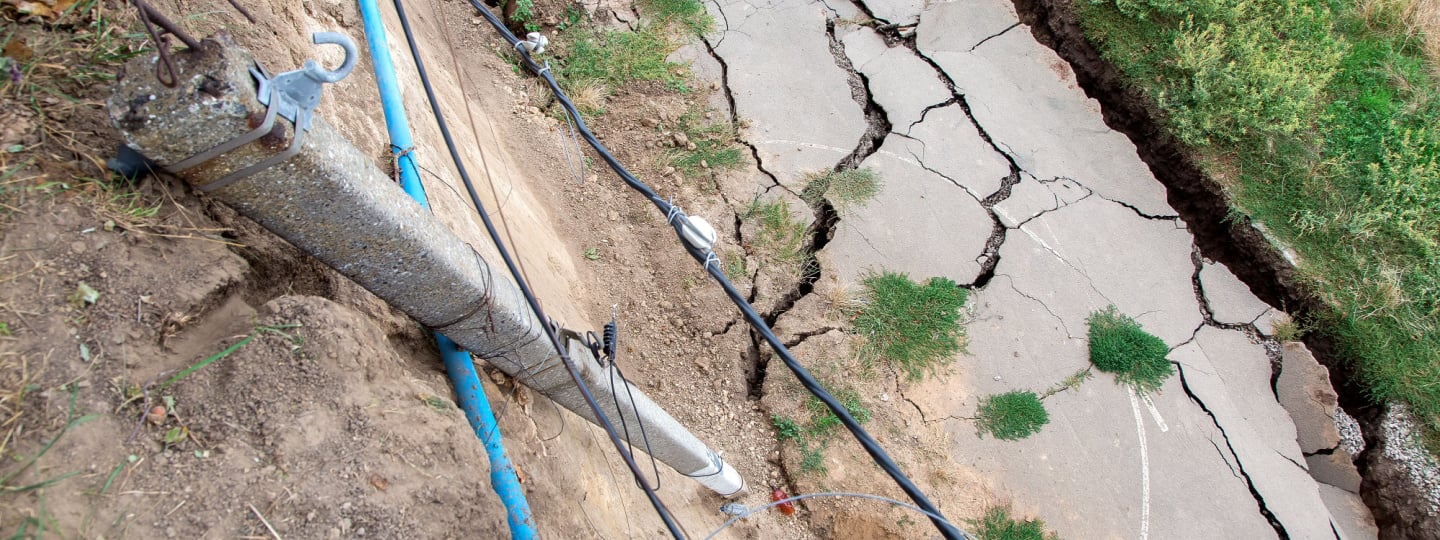
Essentially, cascading risk is the probability of a chain reaction resulting from a hazard or failure which triggers interconnected impacts that may escalate across systems and sectors.
Cascading risks may result in cascading disasters, which are extreme events in which impacts increase over time and generate unexpected secondary and tertiary events of strong impact.
They occur when hazards or failures trigger chains of interrelated hazards or impacts (for example, an earthquake triggering landslides and flooding).
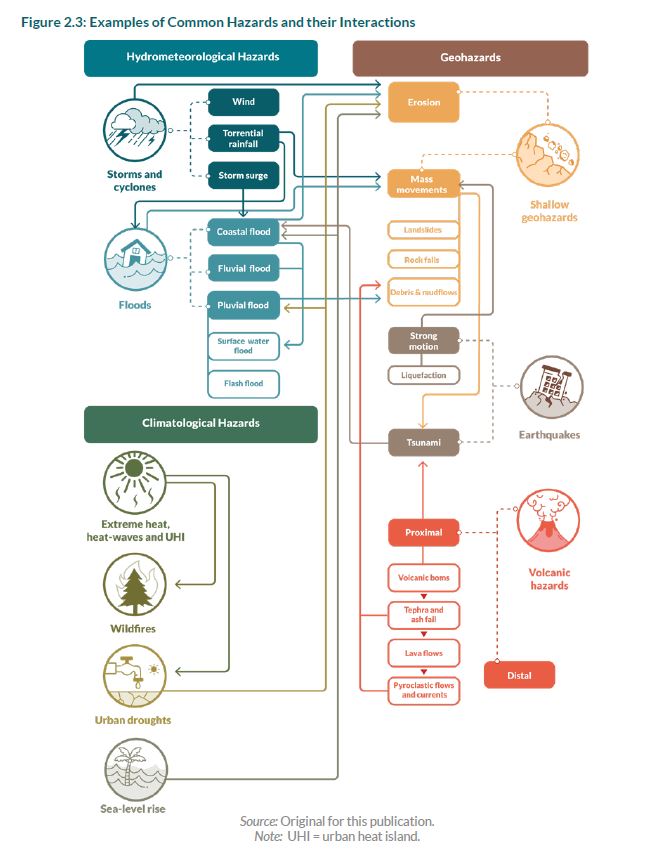
Why understanding cascading risk matters?
Understanding cascading risk matters; global risk analysis has shifted from single hazards to complex scenarios where hazards trigger additional hazards or overlap in time and space.
Cascading disasters pose major challenges because traditional risk management struggles to estimate rare combinations and complex event chains.
How does cascading risk work?
- Trigger event (hazard) ->
- Primary impact (direct damage or disruption) ->
- Interdependent system failure ->
- Secondary crises across sectors ->
- Long-term societal effects.
Cascading failures occur when the failure of a part in a system triggers the failure of successive parts, or when the disruption of one system component triggers failures in other interconnected systems, escalating rapidly if not contained.
COVID-19
The initial biological hazard triggered public-health measures such as lockdowns, which disrupted supply chains, employment, education, and mobility. These disruptions amplified pre-existing vulnerabilities, especially among women, informal workers, and marginalised groups. As impacts spread through interconnected global systems, local shocks translated into worldwide economic and social consequences, demonstrating how modern risks propagate across sectors and borders.
Fragile contexts
In fragile contexts such as Somalia, Central African Republic, and Iraq, hazards worsen instability and trigger displacement. Large displaced populations strain housing, sanitation, health care, and education systems. As these services degrade, disease risks increase, tensions rise, and governance weakens, forming a reinforcing cycle in which each impact intensifies the next.
Humanitarian contexts
In Bangladesh, evidence shows how monsoon rainfall triggered more than 130 landslides, damaging thousands of shelters and affecting tens of thousands of refugees. The physical hazard quickly evolved into a humanitarian challenge because damaged housing forced emergency relocation. Limited land availability then constrained response options, illustrating how environmental triggers can cascade into spatial, logistical, and protection crises.
Hazard triggering hazards
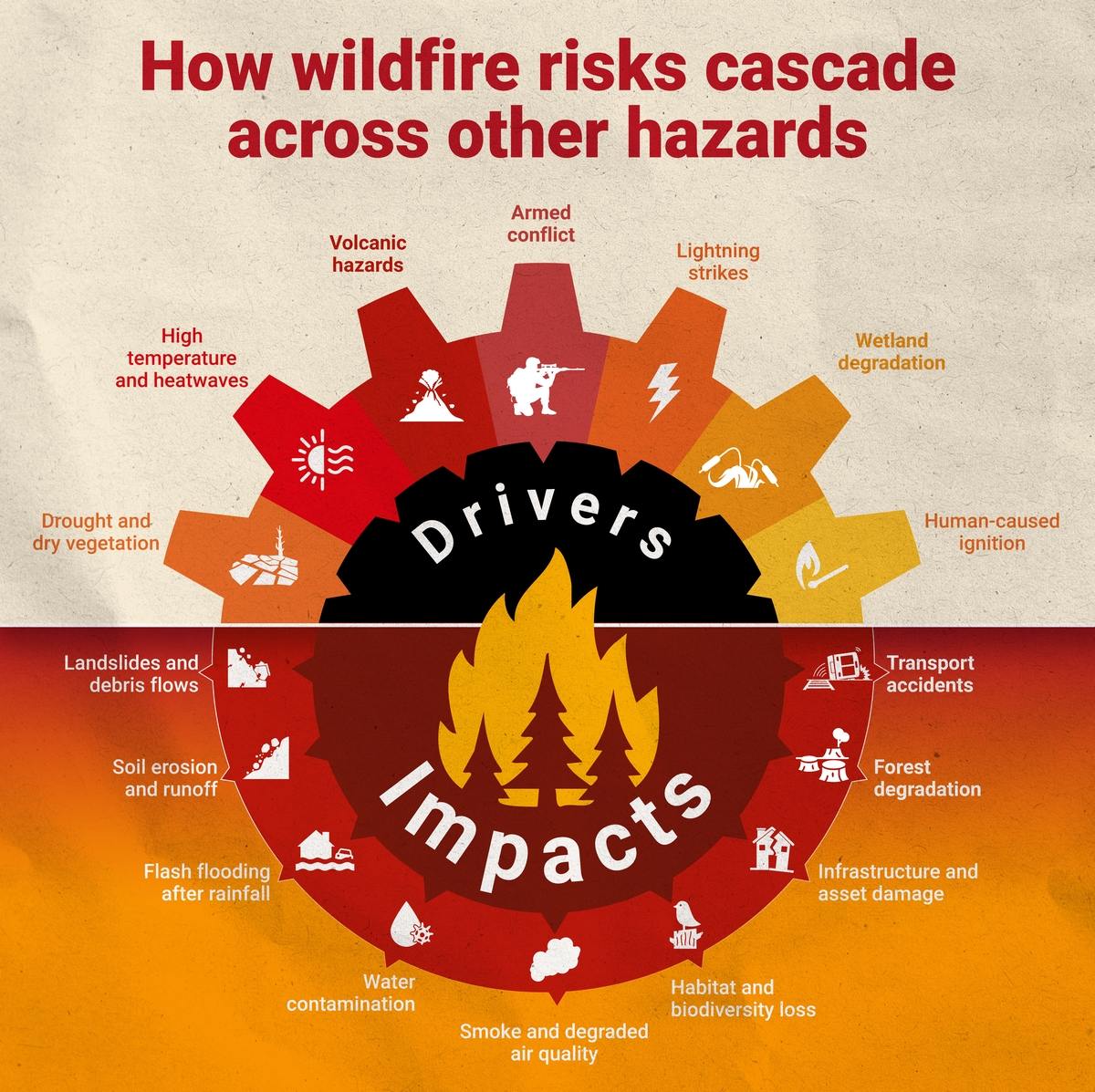
Global climate variability can initiate cascading national impacts as Indonesia shows. El Niño conditions produced prolonged drought, which dried vegetation and sharply increased fire susceptibility. The result was a fivefold increase in burned area. These fires can then cascade further into air-quality emergencies, economic losses, transport disruption, and ecosystem damage, showing how climate signals translate into multi-sector crises.
]]
]]
How to assess cascading risk?
Assessment of cascading risk requires tools that map triggers and consequences across systems to visualise secondary emergencies and complex chains. Methods also include modelling interdependencies between sectors and identifying critical infrastructure links for risk assessment and recovery planning.
Sometimes risk models can be too static to support decision-making during fast-evolving crises. GeoAI-enabled approaches offer a more dynamic alternative by combining real-time meteorological information, satellite imagery, infrastructure telemetry and AI-based vulnerability analysis. This allows authorities to identify where failures are most likely to occur, how they may cascade across sectors, and which communities or facilities are most at risk. For example, a power outage can be modelled in real time to anticipate impacts on hospitals, telecommunications and water supply systems, enabling emergency managers to act before secondary crises emerge.
Effective risk assessment therefore needs to focus not only on whether infrastructure can withstand hazards, but also on how disruptions propagate through interconnected systems and affect people and essential services.
How to reduce cascading risk?
Reducing cascading risk also requires stronger governance and coordination across sectors. Governments, infrastructure operators and meteorological agencies need mechanisms for real-time data sharing and joint operational planning. Critical services such as healthcare facilities should prepare for prolonged disruptions through backup energy systems, fuel reserves and contingency planning. By shifting from static assessments to dynamic, system-wide risk management, countries can improve preparedness, maintain essential services during disasters and strengthen resilience against increasingly complex and interconnected risks.
This reflects a broader shift from risk awareness to risk-informed action, where disaster management is guided by dynamic, interconnected analysis rather than isolated sector assessments.
Further recommended risk-reduction directions, include:
- adopting system-wide resilience approaches;
- identifying infrastructure interdependencies in national risk assessments;
- strengthening preparedness planning for interconnected failures.
Multi-hazard early warning systems
Multi-hazard early warning systems are critical for managing cascading hazards because they detect threats across multiple risk sources and communicate coordinated alerts before impacts spread through interconnected systems. Effective systems integrate monitoring, forecasting, risk knowledge, and communication across sectors so authorities can anticipate compound and sequential events rather than reacting to isolated hazards. This systems-based approach allows decision-makers to prepare for secondary impacts—such as floods triggering landslides or storms causing infrastructure failures—reducing the likelihood that an initial hazard escalates into a complex cascading disaster.