
Compound risk
Compound risk is the risk that two or more hazards or risk drivers interact (e.g. wildfire and heat or storms and heat), either simultaneously or consecutively, producing impacts greater than the sum of individual events, and complicating response and recovery. (IPCC, 2021)

Compound events may occur at the same time, in close succession, or concurrently in different regions. They are more complex and can have more devastating consequences compared to single extreme events. Multiple stressors can exceed the coping capacity of a system more quickly than individual stressors occurring in isolation.
Next to climate change, other factors such as urbanisation are increasing the likelihood of such events.
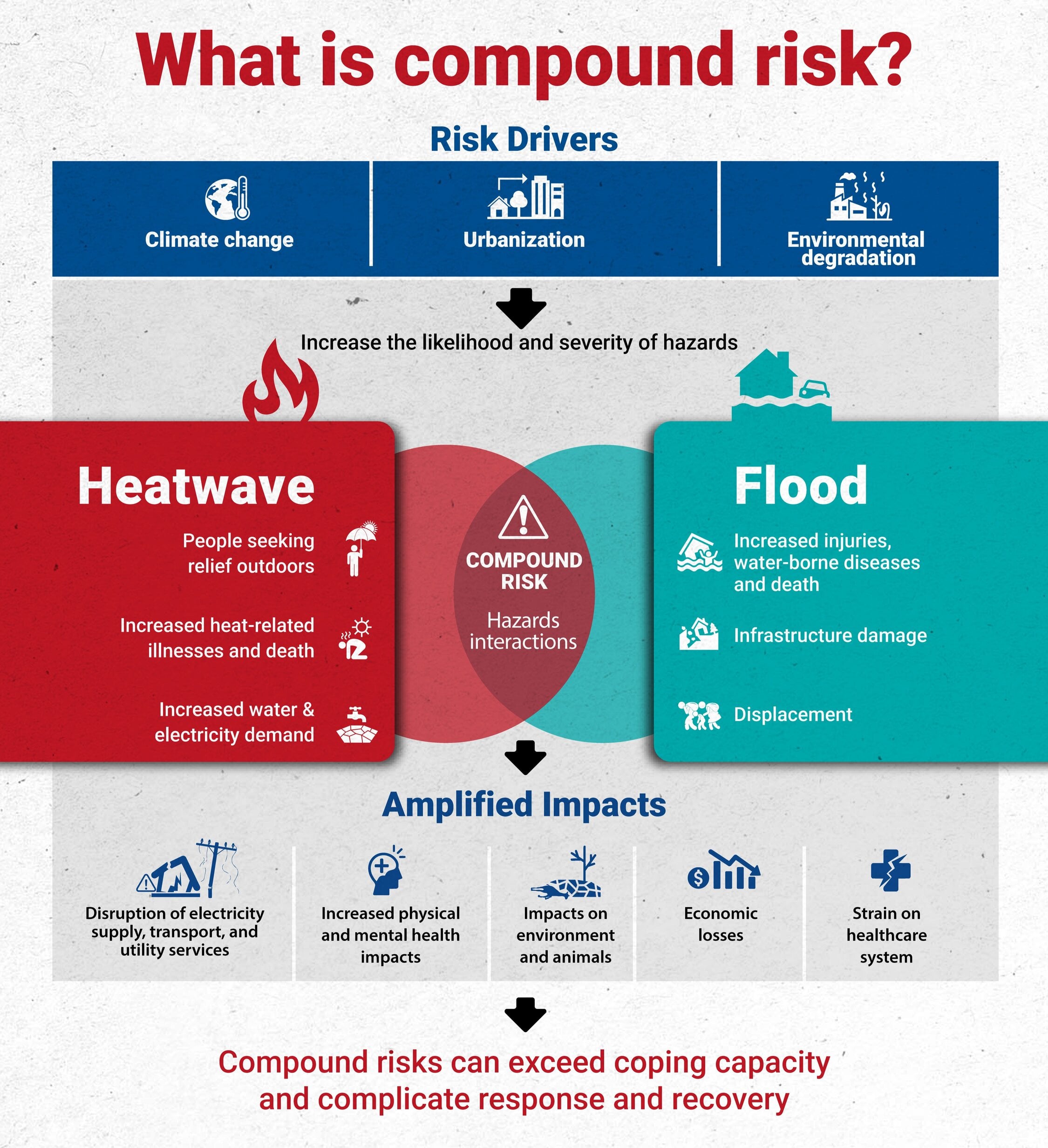
What is compound risk?
Why understanding compounding risk matters?
Scientific assessments show that interacting hazards can significantly increase impacts on infrastructure, ecosystems, and societies. These interactions make disasters harder to predict and manage because traditional risk assessments often evaluate hazards separately rather than accounting for combined effects.
How do compound events work?
Compound events occur when two or more extreme hazards take place simultaneously or in close succession. Compound heatwave and flood events, for example, were once considered relatively rare but are becoming more frequent as the climate changes. These events create risks that exceed the impacts of heatwaves or floods occurring independently.
Compound heatwave and flood events can manifest in three forms:
Australia (heatwave → flood)
In January and February 2019, Queensland, Australia, experienced extreme heat followed by heavy rainfall and flooding. The disaster led to the deaths of approximately 500,000 cattle and caused economic losses estimated at more than USD 1.2 billion. Extreme heat can contribute to atmospheric instability and increase moisture availability, creating conditions that favour intense rainfall and flooding.
Japan (flood → heatwave)
In 2018, western Japan experienced severe flooding followed shortly afterwards by an intense heatwave. The floods damaged homes, disrupted electricity networks and reduced access to safe drinking water, increasing vulnerability to the subsequent extreme heat. Such sequences can occur when cyclonic systems are followed by persistent warm and humid air masses.
The Mediterranean (heatwave + flood)
In August 2021, parts of the Mediterranean experienced extreme temperatures approaching 50 °C alongside coastal flooding linked to extreme sea levels. This illustrates how heatwaves and flooding can occur simultaneously, compounding impacts on infrastructure, health and emergency response systems. While the highest risk of compound heatwave and coastal flood events is concentrated in tropical regions, similar events are increasingly being observed in other parts of the world.
The following cases further illustrate the impacts of compound events:
Pakistan
In March 2022, Pakistan experienced one of the most severe heatwaves in its history. Temperatures exceeded 50 °C in some regions during prolonged periods of extreme heat. The heatwave dried soils, intensified water scarcity and placed severe pressure on the electricity grid, leading to widespread power outages as demand for cooling increased. Major urban centres, including Karachi, experienced acute water shortages.
The heatwave was followed by an exceptionally intense monsoon season, with rainfall reaching nearly 190 per cent of normal levels in July and August 2022. Reduced soil infiltration capacity, combined with accelerated glacial melt caused by extreme temperatures, increased pressure on already swollen river systems before the heaviest rains began. The resulting floods became the deadliest in Pakistan since 2010, affecting more than 33 million people and leaving approximately one third of the country underwater. Total damage and economic losses exceeded USD 30 billion.
The disaster demonstrated how compound hazards can erode people’s ability to cope with subsequent shocks, creating conditions in which later hazards produce far greater impacts.
Australia
The risks of compound events are increasing across Australia and are expected to intensify in the future. The devastating 2019–2020 megafires demonstrated how prolonged heat and below-average rainfall over several years can create conditions conducive to extreme bushfires. These fires occurred while some areas were already experiencing drought and heatwaves, compounding impacts across communities and infrastructure systems.
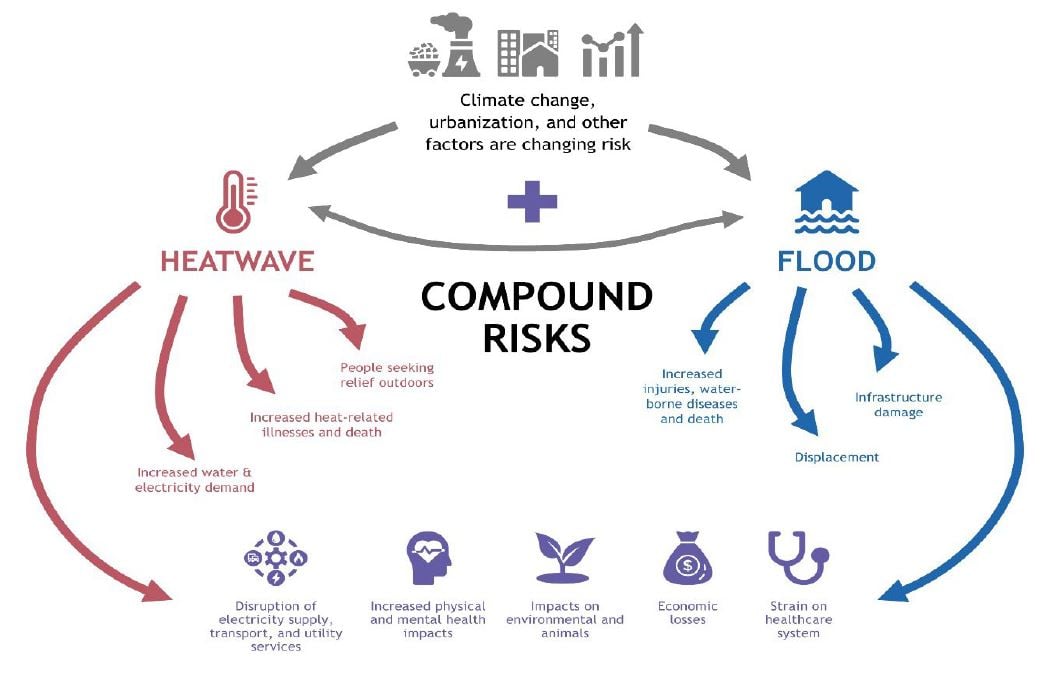
Drawing on the 2019–2020 heatwaves and megafires, a possible cascading-risk scenario was examined. In a combined heatwave and bushfire event, power workers – including electricians and technicians – may be unable to safely repair damaged electricity infrastructure because of extreme heat, fire conditions and smoke exposure. At the same time, increased demand for cooling would place additional strain on the electricity network. The combination of infrastructure damage, workforce constraints and surging demand could overwhelm the power system, triggering widespread blackouts that may persist for several days.
United States
A study used projections of tropical cyclones, sea level rise and heatwaves, together with power system resilience modelling, to assess historical and future compound risks involving tropical cyclones, blackouts and heatwaves in Louisiana, United States. The study found that, under historical climate conditions (1980–2005), a compound event comparable to Hurricane Ida in 2021 – involving approximately 35 million customer-hours of simultaneous power outages and heatwave exposure – had an estimated return period of around 278 years.
Under the SSP5-8.5 emissions scenario, the return period is projected to decrease to 16.2 years by 2070–2100, representing a roughly 17-fold increase in frequency. Under the SSP2-4.5 scenario, the return period decreases to 23.1 years, equivalent to an approximately 12-fold increase in frequency. The study identifies heatwave intensification as the primary driver of increased compound risk, reducing the return period by around fivefold under SSP5-8.5 and threefold under SSP2-4.5.
Europe
More than 70 per cent of flood events in Europe are compound in nature, involving interactions between flooding and other hazards such as droughts, heatwaves or windstorms, according to a 2026 study. These events cause significantly greater impacts: over the study period, economic losses from compound floods were on average 2.8 times higher than those from floods alone, and every event among the top 1 per cent of losses was a compound event. The study also reveals a growing trend towards more complex hazard interactions, with flood events involving two or more additional hazards increasing by 186 per cent between the 1980s and the 2010s, compared with just 16 per cent for standalone floods.
The findings have important implications for risk management, early warning and financial planning. Incorporating compound hazards into regional risk assessments and civil protection planning could help identify the areas facing the greatest risks and support more targeted preparedness measures. For multi-hazard early warning systems, integrating information on interacting hazards could improve the ability to anticipate the most damaging events. The research also suggests that insurance and financial risk models may underestimate flood-related losses when hazards are assessed in isolation, highlighting the need for approaches that better reflect compound risk.
How to assess compound risk?
Studies have shown that specifically compound flood and heatwave events are projected to increase across most catchments worldwide, with the tropics projected to become a global hotspot.
Traditional risk assessment methods typically consider one hazard at a time, which can lead to an underestimation of risk. The physical drivers of extreme events may exhibit spatial and temporal dependencies and can interact in ways that amplify cascading and overall impacts.
Given the multi-faceted nature of compound risk, single-hazard approaches are likely to be insufficient. Comprehensive, multi-hazard approaches are therefore needed to better assess interconnected and cascading risks.
Quantifying the reliability and resilience of infrastructure systems under future compound hazards is essential for climate change adaptation. This requires an integrated risk assessment framework that brings together climatology, civil and electrical engineering, urban planning, and social sciences to better capture the interconnected nature of compound risks and their societal impacts, and to inform effective mitigation strategies. Conventional statistical methods may struggle to detect changes in compound risk, particularly in extreme events.
Physics-based modelling approaches that integrate climate and hazard projections with infrastructure and socio-economic system analysis can provide important insights into future risk dynamics. This multidisciplinary perspective is essential for capturing complex interactions among hazards and their cascading effects across infrastructure systems and society, thereby supporting the development of more robust and resilient strategies to mitigate compound hazard impacts.
Given uncertainties in climate projections and socio-economic development pathways, risk assessment methods must be continuously refined and updated as improved models and new data become available.
How to reduce compound risk
Building resilience to compound events depends on the hazards and vulnerabilities present in a given area. Reducing compound risk requires a combination of adaptation and risk reduction measures, including resilient infrastructure, nature-based solutions, early warning systems, risk-informed urban planning and public awareness campaigns. Governments, communities and individuals all play a role in reducing the compounding impacts of extreme weather and climate-related hazards.
In urban areas, policy and regulatory frameworks that integrate compound risks into planning processes are essential. Risk-informed urban development can help national and local governments align climate adaptation, disaster risk reduction and socio-economic development strategies. This can support more sustainable and cost-effective growth in hazard-prone areas while protecting critical infrastructure and essential services.
Addressing underlying vulnerabilities is also critical for managing compound risks effectively. Expanding access to healthcare, reducing poverty and inequality, and strengthening social cohesion can improve communities’ ability to cope with multiple shocks. Investments in inclusive and resilient development can therefore reduce both immediate disaster impacts and longer-term systemic risks.