
Disaster losses and statistics
While absolute economic losses are concentrated in high-income countries, the human cost of disasters falls overwhelmingly on low and middle-income countries.
On this page
- Under-reported small-scale disasters
- Indirect losses
- Additional resources
- Disasters statistics reports
- Disaster loss data sources
- Collecting disaster loss data resources
2025 snapshot
- 358 reported disasters* (CRED)
- 16,607 deaths* (CRED)
- 110.2 million people affected* (CRED)
- US$ 224bn in overall losses (Munich Re)
- US$ 116bn in uninsured losses (Munich Re)
- US$ 108bn in insured losses (Munich Re)
- 87.5 million people living in acute food security driven by weather extremes (FSIN)
- 13.6 million Internally Displaced People (IDMC)
- 29.9 million new internal displacements (IDMC)
- 171 million students had their schooling disrupted (UNICEF)
*The figures do not represent biological nor technological disasters. Explore the Hazard Information Profiles (HIPs) for a comprehensive list of hazards.
CRED, EM-DAT disaster data inclusion criteria
EM-DAT disaster records related to natural and technological hazards meet at least one of the following inclusion criteria:
- At least ten deaths (including dead and missing).
- At least 100 affected (people affected, injured, or homeless).
- A call for international assistance or an emergency declaration.
| Figures | 2025 | 2024 | 2023 | 2022 | 2021 | 2020 | 2019 |
| Overall losses in US$ b (Munich Re) | 224 | 320 | 250 | 270 | 280 | 210 | 166 |
| Uninsured losses in US$ b (Munich Re) | 116 | 180 | 155 | 150 | 160 | 128 | 109 |
| Insured losses in US$ b (Munich Re) | 108 | 140 | 95 | 120 | 120 | 82 | 57 |
| Recorded events (CRED) | 358 | 393 | 399 | 387 | 407 | 380 | 505 |
| Deaths (CRED) | 16,607 | 16,753 | 86,473 | 30,704 | 18,274 | 17,664 | 27,199 |
| People affected in million (CRED) | 110.2 | 167.2 | 93.1 | 185 | 103.5 | 97.6 | 109.2 |
| Internally Displaced People by disasters in million (IDMC) | 13.6 | 9.8 | 7.7 | 8.7 | 5.9 | 7 | 5.1 |
| New internal displacements by disasters in million (IDMC) | 29.9 | 45.8 | 26.4 | 32.6 | 23.7 | 30.7 | 24.9 |
| People in million living in acute food insecurity driven by weather extremes (FSIN) | 87.5 [16 countries affected] | 96.1 [18 countries affected] | 71.9 [18 countries affected] | 56.8 [12 countries affected] | 23.5 [8 countries] | 15.7 [15 countries] | 33.8 [25 countries] |
| Students in million that had their schooling disrupted (UNICEF) | 171 | 242 | - | - | - | - | - |

The invisible toll of disasters
The estimated insured losses from disasters are a staggering US $95 billion — but they represent just the tip of the iceberg.
There has been a startling rise in acute food insecurity (in which lack of food poses an immediate threat to life and livelihoods) between 2020. While conflict and fragility have been a major driver of this trend, the number of people facing acute food insecurity has also risen sharply, more than doubling from 30 million in 2018 to nearly 72 million in 2023.
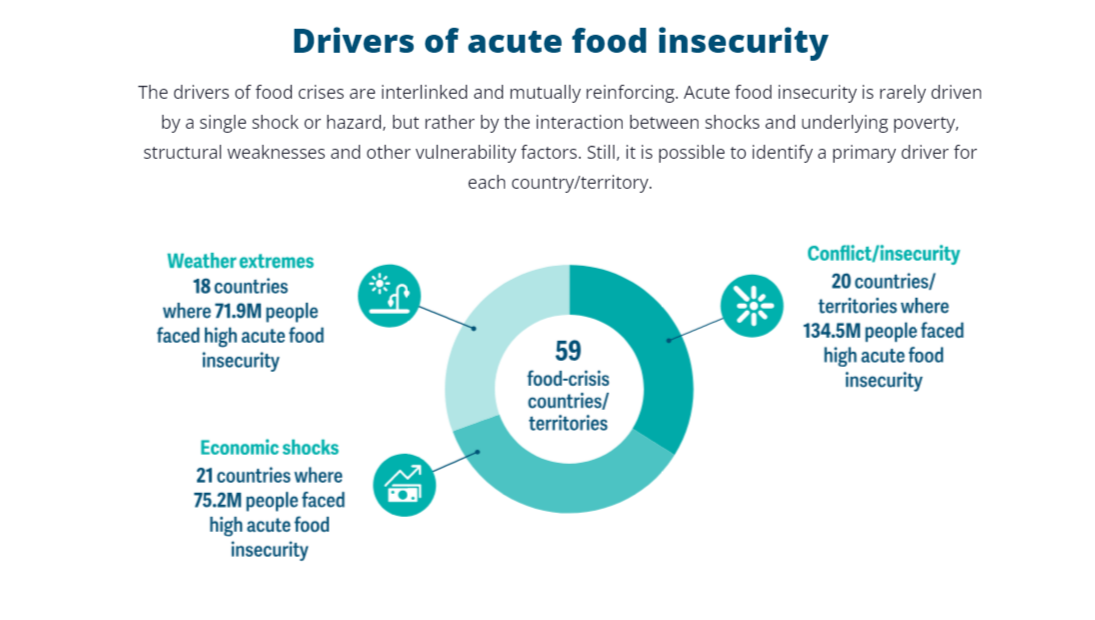
Global Report on Food Crises 2024 (FSIN, 2024)
Over the last 30 years, an estimated USD 3.8 trillion worth of crops and livestock production has been lost as a result of disaster events, corresponding to an average loss of USD 123 billion per year or 5 percent of annual global agricultural GDP. Lower-income and lower-middle-income countries sustained the highest losses due to extreme events, up to 10 percent of their agricultural GDP. Losses in SIDS account for about 7 percent of their agricultural GDP (FAO, 2023).
14.9 million excess deaths were associated with the COVID-19 pandemic in 2020 and 2021. Excess mortality includes deaths associated with COVID-19 directly (due to the disease) or indirectly (due to the pandemic’s impact on health systems and society).
Yet, these reported losses only represent the tip of the iceberg.

"You cannot manage your disaster risk if you are not measuring your losses."
Mami Mizutori, UN Special Representative of the Secretary-General for Disaster Risk Reduction
Under-reported small-scale and slow-onset disasters
Tens of thousands of small-scale disasters occur each year throughout the world because of flooding, landslides, fires and storms. These events are not reported in international databases. Yet, their impact can be just as damaging as large disasters, causing death, injury and loss of livelihoods. An analysis of records in 104 countries found that between 2005 and 2017, small and medium, localized and frequent disasters caused 68% of all economic losses. These losses are a major driver of poverty as they tend to be absorbed by low-income households and communities, small businesses, and local and national governments.
Similarly, losses from slow-onset hazards such as droughts are not always fully accounted for. Their effect often accumulates slowly over an extended period and their impacts are difficult to measure. When slow-onset disasters are added to the Asia-Pacific region’s riskscape, annualized economic losses more than quadruple to USD $675 billion or around 2.4 percent of the region’s GDP (compared to previous estimates).

Indirect and intangible losses
Direct losses refer to the physical or structural impact caused by the disaster such as the destruction of infrastructure resulting from high winds, flooding or ground shaking. Indirect effects are the subsequent or secondary results of the initial destruction, such as business interruption losses. A full consideration of all direct, indirect, and intangible losses would produce much higher loss estimates than the more easily quantified and commonly seen records of direct loss.
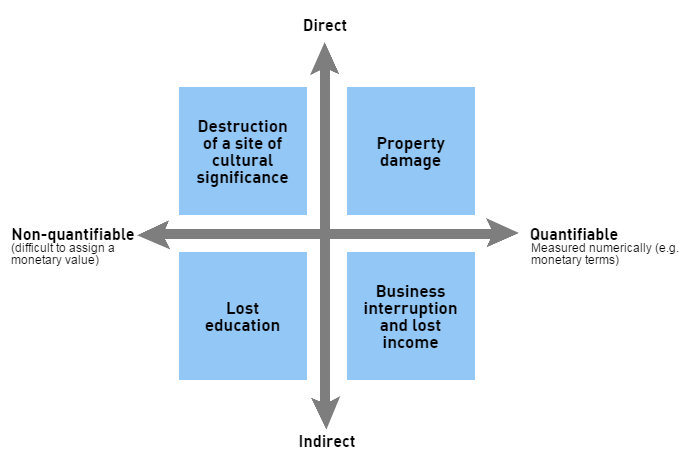
Lost productivity
Severe disasters have lasting effects on productivity. Analysis from the World Bank finds that during 1960-2018, climate disasters reduced annual productivity by an average of 0.5 percent. After three years, severe climate disasters lower labor productivity by about 7 percent, mainly through weakened total factor productivity.
Severe biological disasters can also cause persistent damage to productivity. Four epidemics since 2000 (SARS, MERS, Ebola, and Zika) had significant and persistent negative effects on productivity. They lowered productivity by 4 percent after three years.
Supply chains disruptions
The impact of local disasters can also be felt across the global economy. After Hurricane Maria struck Puerto Rico in 2017, a major wholesale medical supply company in San Juan was unable to maintain production. As a result, hospitals across the United States faced a critical shortage and a 600% increase in the cost of intravenous bags.
Research has found that intensifying river floods caused by global warming will affect the European Union and the United States predominantly by indirect losses passed down along the global trade and supply network. In the US, In the US, direct losses from riverine floods are expected to be around 30 billion US dollars, whereas indirect losses could reach 170 billion US dollars in the next 20 years.
Lost investment
Disasters also divert funding from investments to finance the rebuilding costs. To really understand the economic costs of a disaster, growth accounting considers the productive use of capital and innovation. In the US for instance, hurricanes caused $306 billion in damages in 2017 and $91 billion in 2018. As a result, productive investment fell about $400 billion in total in those years.
Mental health
Disasters can also impact mental health. People whose homes are damaged by storms or flooding are significantly more likely to experience mental health issues such as depression and anxiety. In the UK, the estimated mental health cost from flooding events ranges from £1,878 to £4,136 per adult, depending on the magnitude of the flood.
Lost education
Children and youth affected by disasters often miss school, owing to displacement, the destruction of facilities or the use of school buildings as temporary shelters. School closures not only undermine education, they also hamper the provision of essential services in vulnerable communities. The COVID-19 pandemic has caused the most severe disruption in the world’s education systems in history. According to UNESCO, nearly 1.6 billion learners in more than 190 countries, 94% of the world’s student population, were affected by the closure of educational institutions at the peak of the crisis.
Playlist: Measuring and tracking disaster losses
Additional resources
- Disaster statistics reports
Disaster statistics reports
- Disaster losses data
Disaster losses data
- Disaster loss data sources
Disaster loss data sources
Sendai Framework Monitor The Sendai Framework Monitor (SFM) is an online reporting tool where Member States officially submit data on disaster impacts, as well as progress in disaster risk reduction. This is done against a set of 38 indicators, measuring progress towards the seven Sendai Framework global targets, several of which are shared with SDGs (in particular 1, 11 and 13).
Targets A and B track impact of disasters on human populations, while Targets C and D track economic, social, and infrastructure losses and damages attributed to disasters. Target E, F and G monitor countries’ progress in developing national and local disaster risk reduction strategies, strengthening financing and global cooperation, and enhancing early warning systems coverages and capabilities.
While reporting is voluntary, Member States are officially notified to report. As of 2023, there are 159 countries reporting on Sendai Framework Monitor, outputs of which form part of formal UN reports on SDGs and the Sendai Framework that the UN Secretary-General reports to the UN General Assembly.
Data disparities exist across the seven Sendai Framework global targets: some of the targets, for example those on the human impacts of death, missing people and affected population, have seen significant improvement in data coverage in recent years. The improved analytical portal and country specific customized indicator list are set to further enhance the scope, quality and richness of SFM.
More information on SFMGlobal Internal Displacement Database The Global Internal Displacement Database (GIDD) operated by the Internal Displacement Monitoring Centre (IDMC) provides estimates on internal displacement at the country level. It aims to provide comprehensive information on internal displacement worldwide. Data on displacement associated with sudden-onset natural hazard-related disasters is available since 2008.Munich Reinsurance The Nat Cat service is maintained by the Research and Development Department of Munich Reinsurance (Munich Re), in Munich, Germany. It provides information about major disasters provoked by natural and technological hazards that have occurred around the world since 1965.Swiss Reinsurance A major global reinsurance company, Swiss Reinsurance (Swiss Re), maintains specific data on natural hazards and catastrophes since the 1970s. Some of this information is provided through its SIGMA publication, published eight times a year. Swiss Re also publishes an annual review, which summarises annual data on disaster incidence and analyses, trends in risk, exposure and commercial insurance considerations in several languages.EM-DAT EM-DAT aggregates data on the occurrence and impact of disasters in the world from 1900 to the present day. The database is managed by the Centre for Research on the Epidemiology of Disasters (CRED), drawing from various sources, including UN agencies, non-governmental organisations, insurance companies, research institutes and media.
EM-DAT register data on events that capture media and humanitarian attention and met at least one of 3 criteria (more than 10 deaths, more than 100 people affected, or an international assistance call or emergency declaration) . Blind spots remain in regions outside English and French speaking zones and regional bias may occur as recording depends on the international media or humanitarian partners coverage an attention. Majority of records lack data on economic impact, and sector-disaggregation on economic losses is missing especially in low-income countries. To know more on the variable, structure of the data and sources the EM DAT documentation has been recently updated and made easily accessibleDesInventar Sendai DesInventar Sendai is an open-source disaster inventory system that enables countries to record sub-national disaggregated event by event data on disaster losses and damages on human ( mortality, morbidity, etc.) and economic impact indicators (damage per sector).
Initiated in the 1990s by researchers and upgraded in 2017 by UNDRR to Desinventar Sendai, most of the databases are now government-owned and countries have utilized for decades to record official data sourced from local governments, post disaster assessments and sectorial department records.
DesInventar is helpful to analyze trends (frequency per hazard, type of impacts, etc.) at national and sub-national levels or to get a detail picture on the impacts of an event. Results can be accessed as a summary snapshot, or through simple query-based options by geography, hazard, or impact.
However, the database is not well suited for cross-country comparisons or global aggregates since countries update data at different times, including retroactively. Country database managers have used over years different custom hazard classifications and followed country-specific definition of disaster, metadata standards and recording protocols, therefore multi-country aggregation and comparison is a complex process not recommended to those not familiar with the structure of data and governance of the country-specific databases. Based on emerging needs, UNDRR is partnering with UNDP and WMO to develop a new system for tracking losses and damages.
View the UNDRR-maintained database
View Latin America countries updates- Collecting disaster loss data
Collecting disaster loss data


