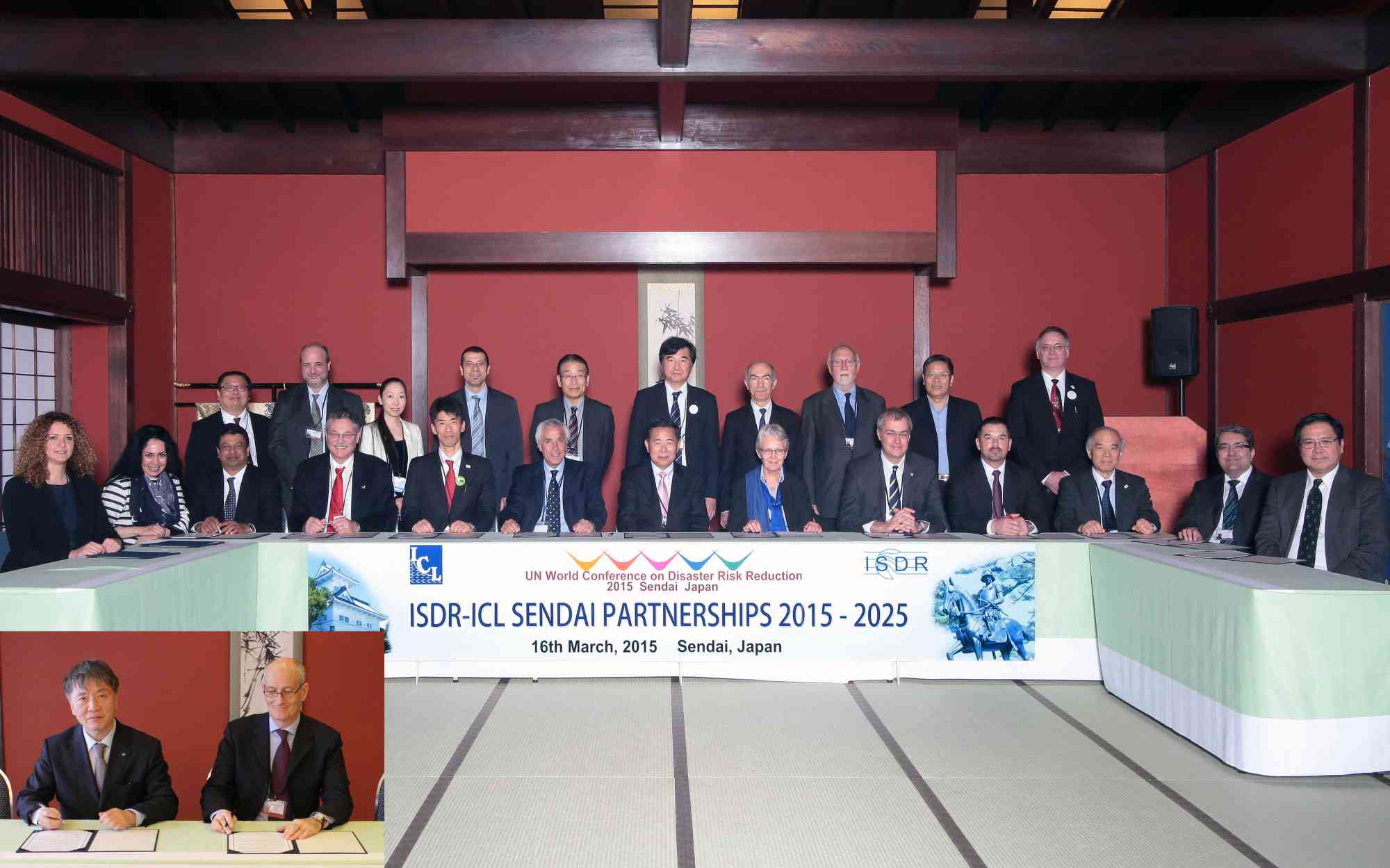
Sendai Landslide Partnerships 2015-2025
The partnerships is a voluntary commitment to the Sendai Framework for Disaster Risk Reduction. It was proposed by ICL and signed by 22 global stakeholders to reduce landslide disaster risk.
Description
Mission of the ICL is to promote landslide research and capacity building including education for landslide disaster risk reduction, notably in developing countries. Sendai Landslide Partnerships 2015-2025 for global promotion of understanding and reducing landslide disaster risk (SLP2015-2025) was adopted during the Third UN World Conference on Disaster Risk Reduction in Sendai, Japan and signed by the leaders of 22 global stakeholders including the UN Special Representative of the Secretary-General for Disaster Risk Reduction. The partnerships have authorized and encouraged the mission of the ICL and its voluntary commitment to the Sendai Framework.
The evidences of activities of the SLP2015-2025 are presented by the following publications. 1) Wahlström M (2015) Preface, Landslides Vol.12 (4), 2) Sassa K (2015) ISDR-ICL Sendai Partnerships 2015–2025, Landslides Vol.12 (4), 3) Sassa K (2017) Progress of ISDR-ICL Sendai Partnerships 2015–2025, Landslides Vol.14 (3), Sassa K, Mikoš M, Yin Y (2017) Open access book Vol.1 ISDR-ICL Sendai Partnerships 2015-2025, Springer (584 pages), Sassa K (2018) The Fifth World Landslide Forum—implementing and monitoring the ISDR-ICL Sendai partnerships 2015–2025, Landslides 15 (3).
The goal of this commitment is to foster partnerships among non-government and non-profit scientific organizations for the global promotion of understanding and reduction of landslide disaster risk. This goal supports the implementation of the Sendai Framework (priorities 1, 2 and 4). This commitment has the following objectives: produce physical and digital knowledge materials (such as books, manuals, journal articles, presentations, etc.) as well as organize events (such as triennial World Landslide Forum). Deliverables include Publication of monthly Journal “Landslides”, publication of full color books on landslides at triennial WLFs (5 books, 2017, 8 books planed in 2020), Landslide Teaching tools (2 books in 2018).
We hope this Partnerships succeed the further commitment until 2025 and develop to a new global and long-term cooperation platform for landslide disaster risk reduction: Kyoto 2020 Commitment for global promotion of understanding and reduction of landslide disaster risk.
Did the Sendai Framework change or contribute to changes in your activities/organization? If so, how?
The Sendai Framework is a global initiative supported by many global stakeholders and almost all governments. “The Sendai Landslide Partnerships 2015-2025 aligns with the spirit of the Sendai Framework. While the Sendai Framework was being adopted, the Sendai Landslide Partnerships 2015-2025 was also adopted and signed, which contributed to the edition and publication of a full color open access book “ISDR-ICL Sendai Partnerships 2015-2015” and two volumes of “ISDR-ICL Landslide Interactive Teaching tools” for capacity development.” ICL aims to develop the Sendai Landslide Partnerships 2015-2025 to a wider and long-term global cooperation alliance “Kyoto Landslide Commitment 2020” continuing until 2030 or beyond.
What led you to make this commitment/initiative?
What was your position before making this Voluntary Commitment / prior to the Sendai Framework?
The Japan Landslide Society published three colors (red, blue and black) printed newsletter “Landslide News” since 1987 for 15 years. This newsletter was later expanded to the publication of the world’s first full color academic journal “Landslides: Journal of the ICL” in 2004. Landslides has progressed from quarterly journal in 2004 to monthly journal in 2018. Members of advisory members of the Editorial Board of Landslides are from signatory organization of the Letter of Intent adopted at a thematic session on Landslides at WCDR in Kobe, 2005 and the 2006 Tokyo Acton Plan on Landslides. Those advisors motivated ICL to propose the Sendai Partnerships 2015-2025. The ICL created a new category of 20 % membership fee (ICL associates) to promote the partnerships in 2018. The number of ICL associates are 17 at present. The number of ICL members increased from 74 in March 2015 to 97 in January 2019. The partnerships was signed by 22 global stakeholders while the 2006 Tokyo Action Plan was signed by 7 global stakeholders.
Deliverables and Progress report
Deliverables
Deliverables are the end-products of the initiative/commitment, which can include issuance of publications or knowledge products, outcomes of workshops, training programs, videos, links, photographs, etc.
Volume 1 (Full color print, 586 pages) of the Forth World Landslide Forum Books "Advancing Culture of Living with Landslides" is a special issue for the Sendai Landslide Partnerships 2015-2025. It includes contribution from most signatory organizations of the Sendai Partnerships including UNDRR, UNESCO, WMO, UNU, ISC, Cabinet office of Japan and others as well as ICL member organizations and 3 forum lectures. The content is recent development after the Sendai conference. This volume is produced both as a printed version and online version in Open Access. Any chapter or the whole book can be downloaded free of charge: https://link.springer.com/book/10.1007/978-3-319-59469-9
This book has been downloaded 278,000 times by world-wide readers from May 2017 to January 2019.
The landslide teaching tools is a set of materials to disseminate the advanced scientific knowledge and technology for world-wide understanding and reducing landslide disaster risk. It includes Text tools, PPT tools for lectures and PDF tools for existing references and manuals. The contents are the following. Vol.1 Fundamentals, Mapping and Monitoring (603 pages): Fundamental: Landslide Types: Descriptions, Illustrations and Photos, Part 1: Mapping and Site Prediction, Part 2: Monitoring and Early Warning. Vol.2 Testing, Risk Management and Country Practices (835 pages): Fundamental: Landslide Dynamics for risk assessment, Part 3: Risk Assessment, Part 4: Risk Management and Country Practices. The tools has been downloaded 42,000 times by world-wide readers from February 2018 to January 2019.
The Kyoto 2020 Commitment for Global Promotion of Understanding and Reducing Landslide Disaster Risk (KLC2020) is a Commitment to the Sendai Landslide Partnerships 2015-2025, the Sendai Framework for Disaster Risk Reduction 2015-2030, the 2030 Agenda Sustainable Development Goals, the New Urban Agenda and the Paris Climate Agreement. 90 organizations signed the KLC2020 and launched on 5 November 2020.
A triennial World Landslide Forum is an opportunity to review the Sendai Landslide Partnerships (WLF4 in 2017, WLF5 in 2020 and WLF6 in 2023). The Conference part of the WLF5 has been postponed for one year to 2-6 November 2021 at the same venue (Kyoto International Conference Center). The publication part of WLF5 has been completed in 2020 and early 2021. WLF5 published three presentation types; 1) Thematic issues of Journal Landslides “Sendai Landslide Partnerships 2015-2015” in October and November 2020, 2) 6 volumes of full color books which include progress in sciences, technologies, practices, capacity buildings over the world in January 2021 (total 2,842 pages), 3) Electronic proceedings including abstracts and PPT for oral presentations (April 2021).
Porgress report
ICL originally planned to organize the Fifth World Landslide Forum (WLF5) and launch the Kyoto Landslide Commitment 2020 (KLC2020) on 2-6 November 2020, however due to the COVID-19 pandemic, the WLF5 has been postponed for one year.
However, the KLC2020 to develop the Sendai Partnerships to 2025, 2030, and beyond was launched on schedule in the 2020 ICL-IPL online Conference on 2-6 November 2020. 90 United Nations and International stakeholders, governments and ICL members approved and signed the commitment.
The ICL has started a new project “Development of early warning technology for the rain-induced rapid and long-traveling landslides in Sri Lanka” from 1 March 2020 to 31 March 2025 as a major activity under the Sendai Landslide Partnerships 2015-2025.
ICL has published the Launching session of the KLC2020 with its participants and list of 90 Signatories in the January issue of Journal “Landslides” in January 2021. ICL published the following 6 volumes of WLF5 Books in January 2021 in print and also electronic version: Vol. 1Sendai Landslide Partnerships and Kyoto Landslide Commitment, Vol. 2 From Mapping to Hazard and Risk Zonation, Vol.3 Monitoring and Early Warning, Vol.4 Testing, Modeling and Risk Assessment, Vol.5 Catastrophic Landslides and Frontiers of Landslide Science, Vol.6 Specific Topics in Landslide Science and Applications.
ICL has published E-Proceedings of WLF5 containing PPT presentation in April 2021. In the Journal Landslides, ICL published the oral presentation programme of WLF5 (Sassa, 2021, April) and the list of oral presentation speakers (Sassa, 2021, May).
Organizations and focal points
Implementing Organization(s)
Focal points
Partners
- International Science Council (ISC)
- International Union of Geological Sciences
- World Federation of Engineering Organizations
- International Union of Geodesy and Geophysics
- United Nations Office for Disaster Risk Reduction (UNDRR)
- World Meteorological Organization (WMO)
- Food and Agriculture Organization of the United Nations (FAO)
- United Nations Educational, Scientific and Cultural Organization (UNESCO)
- United Nations University (UNU)