My account
Menu
Your experience on PreventionWeb

Please help us improve PreventionWeb by taking this brief survey. Your input will allow us to better serve the needs of the DRR community.

See the survey

Published on
19 April 2024
Status
Active

Adopt-a-Municipality Project - Tiwi Albay

Expected duration
Nov 2021 - Oct 2024
SFVC commitment ID
20221031_001
Version
2.0
Upload your content

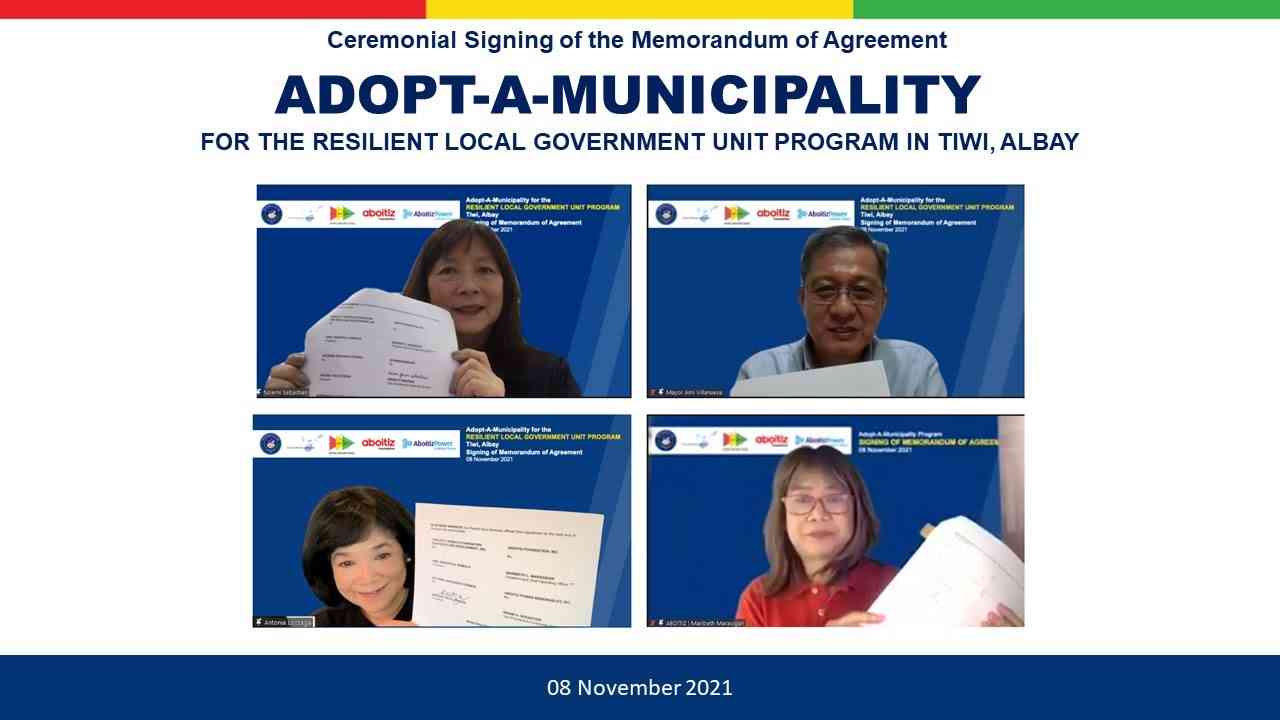
Aboitiz Foundation, the corporate social responsibility arm of the Aboitiz Group and AP Renewables Inc., partnered with the National Resilience Council and the Municipality of Tiwi, to develop a comprehensive, science-based approach to community disaster and climate change adaptation.

    Description

    The Aboitiz Group recognizes the complex and dynamic nature of risk and the Philippines’ unique patterns of development that require trans-disciplinary approaches and the proactive participation of different stakeholders. The critical gaps between science, policy, and practice are addressed by employing a whole-of-society approach involving the national and local government, private sector, scientific institutions, academe, and civil society.

    The Adopt-a-Municipality program is a three-year, two-track capacity-building program consisting of parallel modules for Leadership & Governance and Science & Technology. The program features milestones in knowledge development on disaster risk through science and technology, the formation and enhancement of leadership and governance skills, and competencies to reduce risks. A specific set of competencies will be transferred to the LGUs in order to graduate from this three-year program. The program is implemented in partnership with scientists and technical experts, local academic institutions, and multi-stakeholder networks that include the communities themselves. The Adopt-A-Municipality program represents an innovative pathway for corporations to collaborate directly with local governments, academic partners, and communities ー instead of the usual dole-outs ー to reduce the community’s exposure and vulnerability and transform climate and disaster risk landscapes.

    The Municipality of Tiwi has been identified as the pilot and priority area for this program implementation. Accordingly, NRC’s Resilient Local Government Unit Program and Resilience Scorecard will also be piloted in this area.

    Did the Sendai Framework change or contribute to changes in your activities/organization? If so, how?

    The project aims to advance the attainment of international commitments and agreements such as the Sendai Framework for Disaster Risk Reduction, Sustainable Development Goals, and Paris Climate Agreement; as well as, various plans and programs such as but not limited to the Philippine Development Plan, National Disaster Risk Reduction and Management Plan.

    This project is also one of the good practices gathered by ARISE, the Private Sector Alliance for Disaster the Private Sector Alliance for Disaster Resilient Societies, which raises awareness, shares knowledge, influences, and implements in relation to disaster risk reduction.

    What led you to make this commitment/initiative?

    What was your position before making this Voluntary Commitment / prior to the Sendai Framework?

    The Municipality of Tiwi in Albay is one of the communities frequently visited by strong typhoons that bring tremendous devastations to agriculture, economy, infrastructure, and the environment. The Adopt-A-Municipality program represents an innovative pathway for corporations to collaborate directly with local governments, academic partners, and communities ー instead of the usual dole-outs ー to reduce the community’s exposure and vulnerability and transform climate and disaster risk landscapes.

    Partnerships are at the core of the Aboitiz Foundation’s work. Adopt-A-Municipality is the first municipality-specific partnership model responding to the Philippines’ commitments under the Sendai Framework for Disaster Risk Reduction, the advancement of the Sustainable Development Goals.

    Deliverables and Progress report

    Deliverables

    Deliverables are the end-products of the initiative/commitment, which can include issuance of publications or knowledge products, outcomes of workshops, training programs, videos, links, photographs, etc.

    Adopt-a-health center program
    Intended date of delivery
    31 December 2023

    Refurbishing and repair of barangay health centers as well as provision of medicines, medical equipment, personal protective equipment and furniture to the LGU

    Link
    https://aboitizpower.com/news/corporate-social-responsibility/apri-strengthens-…
    Sustainable livelihoods for the locals of Tiwi
    Intended date of delivery
    31 December 2023

    Provision of sewing machines and fishing boats as well as livelihood restarter kits for women to help them recover from the economic losses brought by the pandemic

    Link
    https://malaya.com.ph/news_special_feature/powering-up-communities-for-cleaner-…
    Capacity building for LGU personnel
    Intended date of delivery
    31 October 2024

    Increase awareness of barangay officials in addressing disaster risk reduction management, particularly delving into Risk and Resilience concepts including coaching and mentoring

    Early warning systems
    Intended date of delivery
    31 October 2024

    Provisions of needed interventions such as flood early warning systems and CCTV cameras, among others

    Organizations and focal points

    Implementing Organization(s)

    • Aboitiz Foundation
    • National Resilience Council

    Focal points

    If a VC's contact information has been hidden, the SFVC team can forward a message.

    Partners

    • AP Renewables Inc.
    • National Resilience Council

    Explore further

    Sendai priorities
    Priority 1Understanding disaster risk
    Priority 2Strengthening disaster risk governance to manage disaster risk
    Priority 4Enhancing disaster preparedness for effective response, and to «Build Back Better», rehabilitation and reconstruction
    Sendai targets and indicators
    A-1 (Compound)Number of deaths and missing persons attributed to disasters, per 100,000 population
    B-1 (Compound)Number of directly affected people attributed to disasters, per 100,000 population
    D-1 (Compound)Damage to critical infrastructure attributed to disasters
    D-5 (Compound)Number of disruptions to basic services attributed to disasters (compound indicator)
    E-2 (Compound)Percentage of local governments that have adopted and implemented local disaster risk reduction strategies in line with national strategies
    G-3Number of people per 100,000 that are covered by early warning information through local governments or through national dissemination mechanisms
    G-4Percentage of local governments having a plan to act on early warnings
    G-6Percentage of population exposed to or at risk from disasters protected through pre-emptive evacuation following early warning
    Hazards Avalanche Cold Wave Cyclone, Hurricane and Typhoon Drought and Desertification Earthquake Epidemic and Pandemic Flood Heatwave and Extreme Heat Insect infestation Landslide NBC - Nuclear, Biological, Chemical Storm surge Technological hazard Tornado Tsunami Volcano Wildfire
    Themes Capacity development Community-based DRR Critical infrastructure Preparedness Early warning Governance Health and health facilities Private sector Risk identification and assessment Social impacts and social resilience
    Country and region Philippines
    Sustainable Development Goals SDG10: Reduced inequalitities SDG11: Sustainable cities and communities SDG13: Climate action
    Budget scale
    USD 100,000 to < 500,000
    Scope
    National (or local) - Philippines
    Scale of beneficiaries
    More than 10,000 people
    Estimated number of beneficiaries
    12,500 people
    Secured budget size
    80%
    Umbrella initiative(s)
    UNDRR Private Sector Alliance for Disaster Resilient Societies (ARISE); ARISE: Cross-cutting - Awareness raising and education
    Related links
    News Article: ABOITIZ, NRC PARTNERS WITH TIWI TO BUILD UP THE TOWN’S DISASTER R…

    Is this page useful?

    Yes No
    Report an issue on this page

    Thank you. If you have 2 minutes, we would benefit from additional feedback (link opens in a new window).

    PreventionWeb is the global knowledge sharing platform for disaster risk reduction (DRR) and resilience.

    • Newsletter
    • Submit your content
    • Blog pitches
    • Submission and publishing policy
    • About PreventionWeb
    • Contact us

    Hazards

    • Avalanche
    • Cold Wave
    • Cyclone, Hurricane and Typhoon
    • Drought and Desertification
    • Earthquake
    • Epidemic and pandemic
    • Flood
    • Heatwave, extreme heat and heat stress
    • Insect infestation
    • Land subsidence
    • Landslide
    • Nuclear, biological, chemical (NBC)
    • Sea level rise
    • Technological hazard
    • Thunderstorm
    • Tornado
    • Tsunami
    • Volcano
    • Wildfire

    Regions

    • Africa
    • Americas
    • Asia
    • Europe
    • Oceania

    Themes

    Understanding & managing risk

    • Preparedness
    • Early warning
    • GIS and mapping
    • Data and information management
    • Risk identification and assessment
    • Small Island Developing States
    • Earth Observation

    Natural environment

    • Climate change
    • Environment and ecosystems
    • Food security and agriculture
    • Water

    Cross-cutting

    • Systemic risk
    • Recovery

    Human development

    • Capacity development
    • Children and youth
    • Civil society / NGOs
    • Community-based DRR
    • Cultural heritage
    • Gender
    • Human mobility
    • Inclusion
    • Social impacts and resilience

    Science, knowledge & advocacy

    • Disaster risk communication
    • Traditional and Indigenous knowledges
    • Science-policy-practice interface

    State, governance & economy

    • Financing DRR
    • Fragility and conflict
    • Governance
    • Insurance and risk transfer
    • Private sector

    Infrastructure & critical services

    • Critical infrastructure
    • Education and school safety
    • Health and health facilities
    • Structural safety
    • Urban risk and planning
    Loading