International Recovery Platform (IRP)
The International Recovery Platform (IRP) is a global partnership working to strengthen knowledge, and share experiences and lessons on building back better in recovery, rehabilitation, and reconstruction. It is a joint initiative of United Nations organizations, international financial institutions
Description
The Sendai Framework for Disaster Risk Reduction 2015-2030 represents a commitment by the UN Member States to prioritize building back better in recovery, rehabilitation and reconstruction from disasters. The adoption of building back better in Priority Four of the Sendai Framework demonstrates broad recognition that recovery presents opportunities to rebuild communities and livelihoods with greater resilience and reduced vulnerabilities, and to integrate disaster risk reduction across the sustainable development agenda in recovery. As a result, building back better as a guiding principle has been advocated in recovery from many recent disasters. However, much work remains to be done to turn this vision into a reality. Although for most decision makers, it is less of a question of whether to build back better, it remains a question for most about how communities can prepare for, finance, and ultimately deliver on building back better for recovering communities.
The International Recovery Platform (IRP) is a thematic platform and knowledge network seeking to identify gaps and constraints experienced in post disaster recovery and to serve as a catalyst for the development of tools, resources, and capacity for resilient recovery. IRP supports progress against Priority 4 of the Sendai Framework for Disaster Risk Reduction 2015-2030, enhancing disaster preparedness for effective response and to “Build Back Better” in recovery, rehabilitation and reconstruction.
It works toward supporting greater advancements in the field of resilient recovery and building back better by (i) periodically bringing together a broad range of senior policy makers and practitioners to exchange experiences and facilitate discussion on resilient recovery challenges and build-back-better opportunities at the annual International Recovery Forum; (ii) advocating for closer cooperation with development partners, regional intergovernmental organizations, regional organizations, and regional platforms for disaster risk reduction in promoting and building capacity for achieving effective build-back-better outcomes; and (iii) sharing of information through its interactive website (https://www.recoveryplatform.org).
Did the Sendai Framework change or contribute to changes in your activities/organization? If so, how?
After a decade as an international source of knowledge on good recovery practice, IRP was recognized in the Sendai Framework as an example of an "international mechanism for sharing experience and lessons associated with build-back-better". IRP has developed its strategic framework to align its work with the Sendai Framework, taking on a specialised role in support of Priority 4. It leads discussions around the issue of building back better in international forums. IRP promotes collaboration and cooperation among global and regional partners on the subject of building back better in recovery, rehabilitation, and reconstruction. IRP seeks to promote shared understanding of a common strategic approach for build back better among IRP partners.
What led you to make this commitment/initiative?
What was your position before making this Voluntary Commitment / prior to the Sendai Framework?
Following the adoption of the Sendai Framework for Disaster Risk Reduction in 2015, IRP has renewed its commitment and sharpened the focus of its mission, to identify and strengthen knowledge and information on building back better in recovery, rehabilitation, and reconstruction. As IRP continues to advance its work in support of Priority 4 of the Sendai Framework, the Sendai Framework Voluntary Commitments platform has become an important venue for sharing IRP’s work. It is a key conduit for IRP to connect with, learn from, and collaborate with new partners.
Deliverables and Progress report
Deliverables
Deliverables are the end-products of the initiative/commitment, which can include issuance of publications or knowledge products, outcomes of workshops, training programs, videos, links, photographs, etc.
The IRP website (www.recoveryplatform.org) is a knowledge hub for disaster recovery tools, guidelines, news and events. In the service of IRP’s knowledge management mission, IRP systematically identifies recovery-related resources and disseminates them through its website. IRP digital publications are published through the IRP website.
The Covid-19 global pandemic has caused the worst global health crisis in more than a
generation. IRP was requested to develop knowledge products which can support countries and communities to recover when they are ready. Knowledge products will need to support recovering communities to build back better from this unprecedented health disaster. IRP has proposed the development of a series of knowledge products to support recovery from the COVID-19 pandemic crisis. The first product is a recovery toolkit, that applies existing disaster recovery tools to support recovery in the early days of the ongoing crisis. The second product is a recovery policy brief, offering guiding principles and key actions to address the unique challenges and opportunities for recovery presented by this global pandemic.
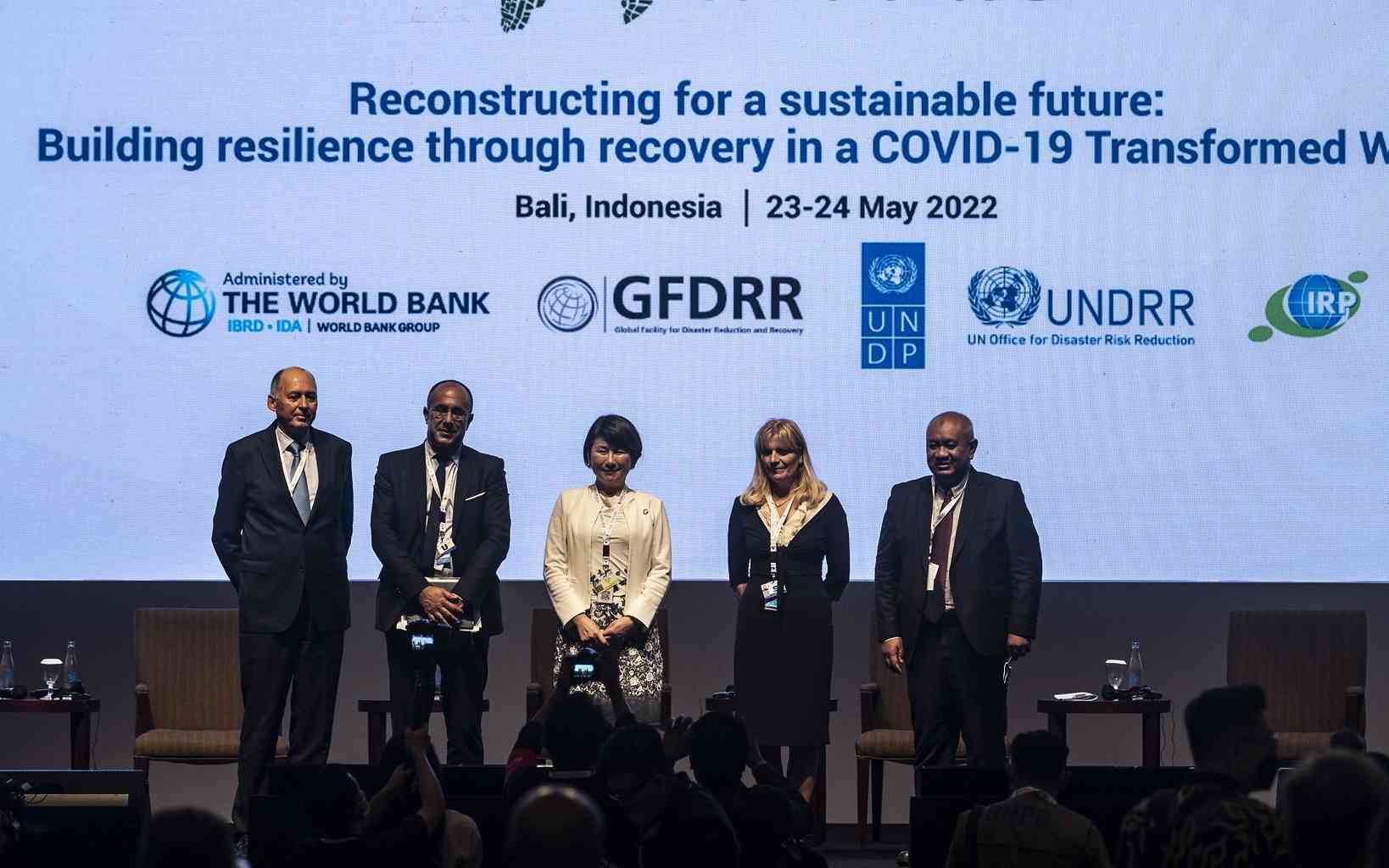
For the first time, the World Reconstruction Conference (WRC) will be held under the umbrella of the International Recovery Platform, in partnership with UNDRR, UNDP, and the World Bank. The WRC, held every 2-3 years, is the largest global convening focused on disaster recovery, bringing together all recovery stakeholders to discuss critical issues in post-disaster recovery. This iteration of the WRC will be held under the theme, “Reconstructing for a sustainable future: Building resilience through recovery in a COVID-19 Transformed World”, focused on addressing the unprecedented socio-economic recovery needs as a pathway to rebuilding a resilient and sustainable society in the post Covid-19 world.
IRP was requested to support the Midterm Review of Implementation of the Sendai Framework 2015-2030 with respect to its assessment of progress and challenges with implementation of the build back better component of Priority 4. IRP will contribute several inputs to the MTR. It will hold its flagship event, the IRP Forum, to provide a platform for countries and experts to discuss the recovery-related questions of the midterm review. The knowledge report from the Forum will be submitted to the MTR secretariat as an input to the review process. IRP will also conduct video interviews with its Steering Committee members to further interrogate the key recovery-related questions of the MTR. Finally, IRP will systematically review the BBB literature published since the adoption of the Sendai Framework, and will submit the results as a review paper as an input to the MTR.
At the request of the G20 Secretariat under the leadership of the Government of India, as well as the IRP Steering Commitee Chairs, IRP will publish two knowledge products as contributions to the working group discussions held in March, May, and July 2023. The knowledge products will address good practices in financing recovery and building back better, and a detailed review of the current state of knowledge and frontier issues related to building back better in recovery.
The International Recovery Forum, established in 2005, convenes a broad range of senior policy makers and practitioners to exchange experiences and facilitate discussion on challenges to resilient recovery, and opportunities for building back better. It is a forum designed to generate new ideas and collaborative initiatives through dialogue and debate, supported by experiences in disaster recovery and the latest evidence. The Forum is coordinated annually in Kobe, Japan, by the International Recovery Platform (IRP) Secretariat, in close consultation with the IRP Steering Committee.
The outcomes of the annual Forum will be reported and published in the “The IRP Herald”, which is distributed and presented throughout the year at international conferences and in digital form on the IRP website.
The International Recovery Platform Herald (IRP Herald) is the periodic newsletter of the International Recovery Platform. The IRP Herald reports on IRP activities and serves as the knowledge report for the annual International Recovery Forum, as well as recovery-related content from other major conferences.
Porgress report
IRP continues to advance its work to strengthen recovery knowledge and practice, in support of Sendai Framework Priority 4. Since the onset of the pandemic, IRP has worked to support recovery planning and implementation from the impacts of the pandemic and other hazards. IRP as a platform has developed three knowledge products supporting COVID-19 recovery efforts. Additionally IRP held its annual International Recovery Forum in 2021, seeking to support countries and communities to meet the challenges of simultaneously managing response and recovery from the pandemic, while confronting the challenge of natural and man-made hazards. The IRP Forum 2022 featured discussions of progress and challenges to date in implementing Priority 4, as well as forward-looking perspectives for implementation in the latter half of the Sendai Framework’s mandate. IRP has also launched a renewed website in support of its knowledge management mission.
In support of its mission to strengthen disaster recovery knowledge and practice, IRP has launched a renewed website. The renewed website continues to serve as the premier repository of resources on disaster recovery and building back better, and has been designed to offer a more expansive library with improved curation and learning opportunities. IRP has produced three knowledge products supporting recovery from the impacts of the COVID-19 pandemic. The IRP Forums held in 2021 and 2022 have significantly expanded engagement in IRP's work with more than twice as many participants from as many as 65 countries in 2022. IRP also had the privilege of contributing to events in three of UNDRR's Regional Platforms for Disaster Risk Reduction in 2021.
Organizations and focal points
Implementing Organization(s)
Focal points
Partners
- United Nations Development Programme (UNDP)
- International Labour Organization (ILO)
- United Nations Office for Disaster Risk Reduction (UNDRR)
- United Nations Office for Project Services (UNOPS)
- 内閣府 Cabinet Office (Japan)
- United Nations Human Settlements Programme (UN-HABITAT)
- Centro de Coordinación para la Prevención de los Desastres en América Central
- Asian Development Bank (ADB)
- World Health Organization (WHO)
- Asian Disaster Reduction Center
- United Nations Centre for Regional Development
- World Bank, the
- United Nations Educational, Scientific and Cultural Organization (UNESCO)
- United Nations Environment Programme (UNEP)
- 兵庫県 Hyogo Prefectural Government