Support Urban Risk Reduction and Resilience Building
Support Urban Risk Reduction and Resilience Building by undertaking research and practice, supporting education, and forming partnerships that will advance risk reduction and resilience building in urban areas that are prone to natural hazards, the impacts of climate change and crises.
Description
The Center for Urban Disaster Risk Reduction and Resilience will commit to undertake research and practice, support education, and form partnerships that will advance risk reduction and resilience building in urban areas that are prone to natural hazards, the impacts of climate change and crises.
Such research, education, practice and partnerships will include:
a) Integrated and Stand-Alone Strategies for Disaster Risk Reduction and Climate Change Adaptation, as well as Resilience Building in Urban Areas;
b) Education and Research on the Urban Context to Promote Sustainable, Equitable and Resilient Urban Development.
From 2015 to 2019, as part of its commitment CUDRR+R has produced a number of knowledge products, undertaken projects, developed a research library for knowledge exchange, and established partnerships.
Going forward, by 2021, CUDRR+R aims to continue working on the field with new research initiatives and capacity building activities.
Did the Sendai Framework change or contribute to changes in your activities/organization? If so, how?
Yes. The Sendai Framework and the Making Cities Resilient Campaign provided for a robust structure to define the prerequisites for urban risk reduction and resilience building. For example, Priority 2 (strengthening disaster risk governance) supports establishing mechanisms and incentives to update and improve compliance of laws and regulations for land use, urban planning, building codes. Priority 3 (investing in disaster risk reduction) promotes assessments of land-use policy development, including urban planning, land degradation). In addition, the recognition of stakeholder partnerships and the value of capacity building supported our activities with cities in Latin America for climate-resilient urban development.
What led you to make this commitment/initiative?
What was your position before making this Voluntary Commitment / prior to the Sendai Framework?
The commitment gave us a chance to revisit our previous commitment to SFDRR and review what has been accomplished and what changes need to be undertaken going forward. Our commitment is also based on the encouragement by the Sendai Framework to reduce exposure and vulnerability as well as to increase accountability for disaster risk creation at all levels. In particular, it calls for dedicated actions on “the consequences of poverty and inequality, climate change and variability, unplanned and rapid urbanization,” among others. An example is the need for the revision of the 10 Essentials of Making Cities Resilient to facilitate the implementation of SFDRR at local level. Moreover, there is a clear call for enhancing governance (including local governments) for disaster response, rehabilitation and reconstruction to “Build Back Better.” CUDRR+R's participation at the Global Alliance for Urban Crises calls into the need for developing a new understanding for disaster response and reconstruction to be integrated into pre-disaster planning as discussed in SFDRR.
Deliverables and Progress report
Deliverables
Deliverables are the end-products of the initiative/commitment, which can include issuance of publications or knowledge products, outcomes of workshops, training programs, videos, links, photographs, etc.
CUDRR+R supported UNISDR and the Making Cities Resilient Campaign to develop a study on assessing local government powers for disaster risk reduction to support the implementation of SFDRR at local level.
CUDRR+R supported the Making Cities Resilient Campaign to develop the Handbook for Local Government Leaders: How to Make Cities Resilient. The Handbook discusses the New Ten Essentials that were developed in line with the SFDRR; how these essentials and indicators can be implemented to support cities for risk reduction and resilience building.
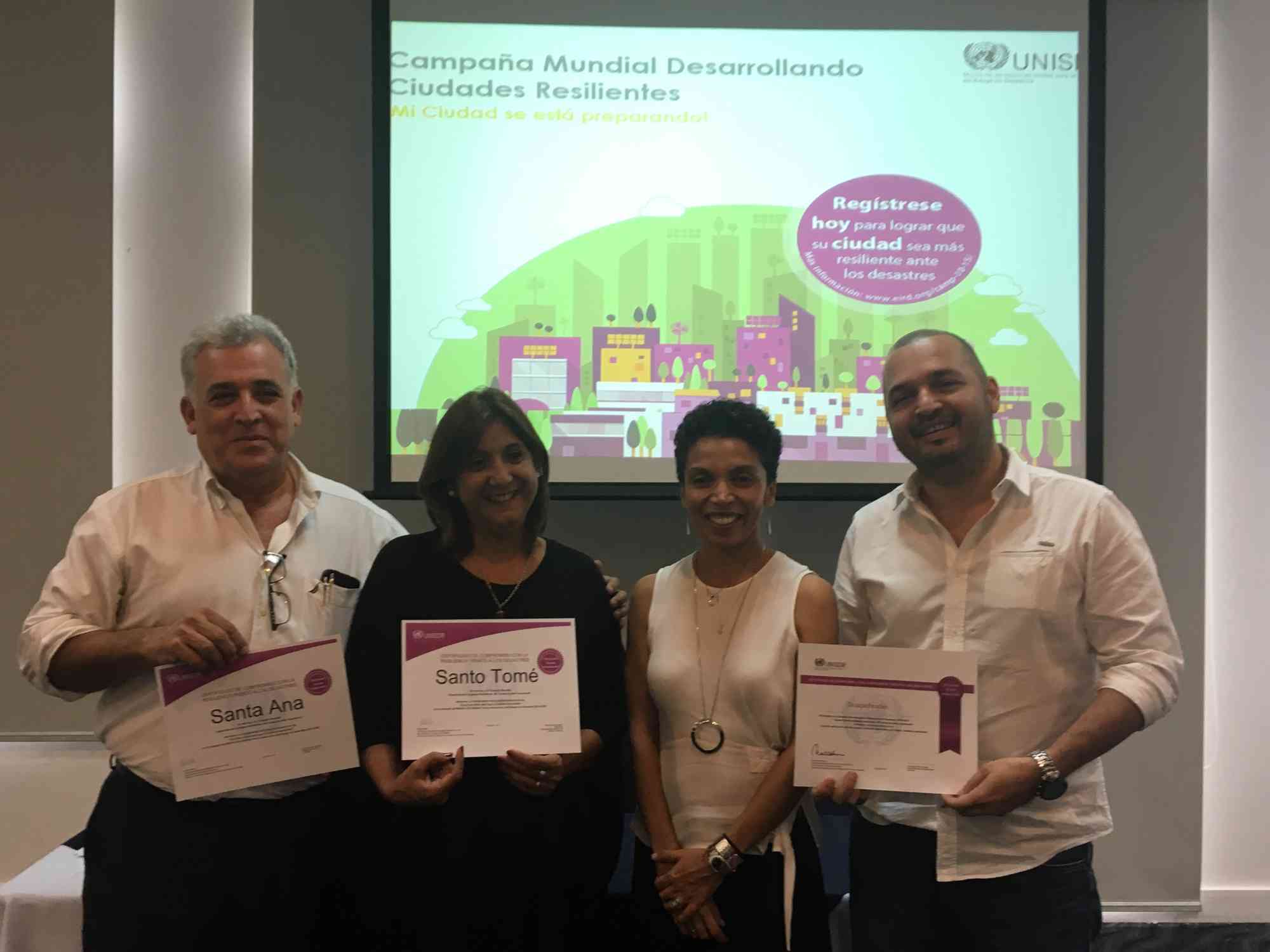
CUDRR+R along with partners, IIED-AL and ALTERRA developed a participatory decision-making for climate resilient development and applied it in the cities of Dosquebradas, Colombia; Santa Ana, El Salvador; and Santo Tome, Argentina. The primary objective of the project was to develop and apply a practical participatory methodology and tools to support climate resilient and inclusive urban development in the rapidly growing small- to medium-sized cities of Latin America. During the project, a participatory process has been developed and implemented in different stages, taking advantage of the potentials and opportunities of each city and responding to the limitations and needs presented by their contexts and the processes in progress. Different trajectories sought to transform the way urban development can be considered, within the context of equitable risk reduction and resilience building, in all three. Project cities also signed onto the Making Cities Resilient Campaign (see photo).
CUDRR+R has been working on developing a library catalog for urban planning and risk research. The library will serve as a reference catalog for students and researchers and will be updated on a regular basis to reflect the state of the art in disaster risk reduction, resilience building, and sustainable development. The library will also cover readings that provide a base for urban theory, including philosophy and architectural and urban history. While the initial upload is based on the physical references at CUDRR+R library, it will be extended to digital references in the future.
Porgress report
CUDRR+R is committed to undertake research and practices and develop partnerships for urban risk reduction and resilience building in urban areas. To that end, since the last progress report, we have completed the ongoing deliverable (library research catalogue); produced a Learning Module on Resilient Cities and Territories for UCLG; published knowledge and articles; participated in conferences and workshops.
In addition, recently, together with its partners Aberdeen and Gordon Universities in the UK and Bogazici and Ozyegin Universities in Turkey, CUDRR+R won funding from the UK Royal Academy of Engineers for their project on “Low-carbon seismic resistant building in Istanbul.”
The following activities summarize achievements (please see the attached document for more details):
- Contributing to two Words into Action Guides
- Participation at the Global Platform
- Participation at the UN Climate Summit and UCCRN events
- Workshop on Local-Level Data at University College London (UCL)
- Article at New Cities
- Symposium on Resilience
- New Project on Low-Carbon Seismic Resistant Building
Organizations and focal points
Implementing Organization(s)
Focal points
Partners