MYRIAD-EU: Multi-hazard and Systemic Framework for Enhancing Risk-Informed Management and Decision-making
MYRIAD-EU catalyses a paradigm shift towards a multi-risk, multi-sector, systemic approach to risk management. Our research programme aims to enable the development of forward-looking disaster risk management pathways that assess trade-offs and synergies across sectors, hazards, and scales.
Description
Whilst the last decade saw huge scientific advances in understanding natural hazard risks, most research and policy still addresses risk from a single-hazard, single-sector, perspective. This presents obstacles for addressing real-world challenges faced by risk managers and other decisionmakers. Firstly, multiple hazards can have interrelated effects on risk. Secondly, disaster risk management (DRM) measures taken to reduce risk from one hazard may increase risk from another hazard. Thirdly, these interrelated effects have impacts across sectors. The aforementioned challenges exist within the context of an increasingly interconnected world, increased pressure for space, and climate change, in which the magnitude and frequency of single and multi-hazards are changing at an unprecedented rate. A paradigm shift is needed to successfully address these kinds of complex questions and challenges.
The vision of the MYRIAD-EU team is to catalyse this paradigm shift required to move towards a multi-risk, multi-sector, systemic approach to risk management. Our research programme aims to enable the development of forward-looking disaster risk management pathways that assess trade-offs and synergies across sectors, hazards, and scales. To do this, we will co-develop a framework for multi-hazard, multisector, systemic risk management, and state-of-the-art products and services to operationalise the framework.
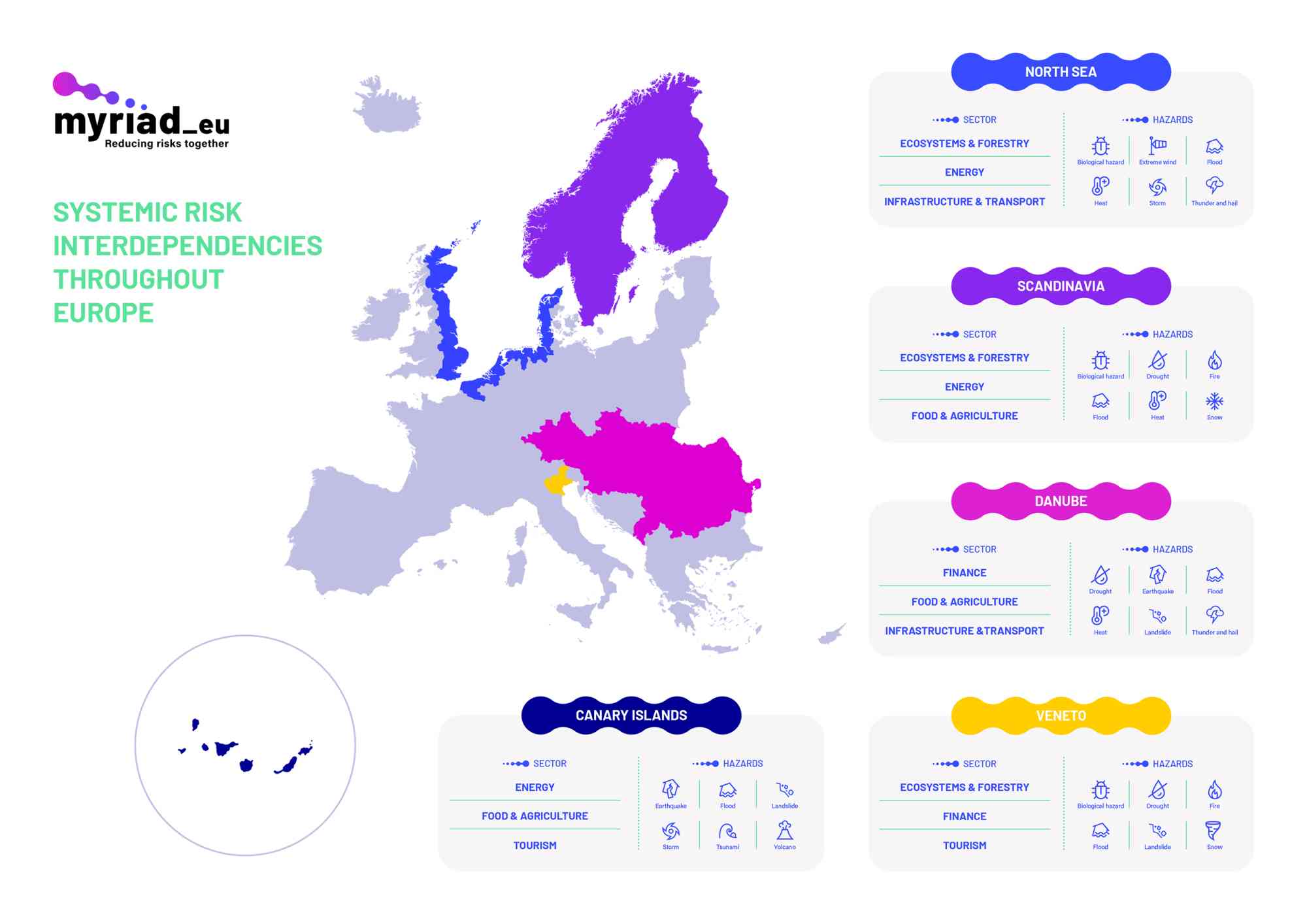
To test our framework, products and services, we plan to implement them with stakeholders in five Pilots: North Sea, Canary Islands, Scandinavia, Danube, Veneto. Through the showcasing our research program at the Sendai Framework Voluntary Commitments platform by UNDRR, we also will appreciate linking with existing multi-risk projects, networks, and activities.
Did the Sendai Framework change or contribute to changes in your activities/organization? If so, how?
The Sendai Framework, a global roadmap to reduce disaster risk by 2030, created a shift from managing disaster to managing risks. Under this premise, it underlines the importance of promoting “investments in innovation and technology development in long-term, multihazard and solution-driven research in disaster risk management to address gaps, obstacles, interdependencies and social, economic, educational and environmental challenges and disaster risks.” Furthermore, it calls on the public and private sectors, civil society organizations as well as academia, scientific and research institutions to work more closely together and address the before mentioned challenges. Our research is aligned with the Sendai Framework.
What led you to make this commitment/initiative?
What was your position before making this Voluntary Commitment / prior to the Sendai Framework?
Risks due to natural hazards have increased dramatically in Europe, due to deep changes in climate, land use and socio-economic evolution since the 20th century. Improved disaster risk management and reduction requires an integrated approach to better forecast, prevent and adapt to multiple hazards, their interactions and impacts. Innovative and comprehensive methodologies, models and tools that assess multi-hazard risks and associated cascading effects and take due account of future drivers (such as climate change), have the potential to represent the leverage to help risk managers and decision-makers prioritise mitigation/adaptation actions, resilient preparedness and response, and develop sustainable and resilient development pathways.
For this purpose, we plan to explore the following questions: How can risk be better managed by considering interrelated effects?; How can we better account for these dynamic feedbacks between risk drivers?; and How can we account for these trade-offs and synergies across sectors, regions, and hazards?
Deliverables and Progress report
Deliverables
Deliverables are the end-products of the initiative/commitment, which can include issuance of publications or knowledge products, outcomes of workshops, training programs, videos, links, photographs, etc.
The proposal MYRIAD-EU was funded by EU-Horizon 2020.
We aim to catalyse a paradigm shift towards a multi-risk, multi-sector, systemic approach to risk assessment & management.
Case studies are carefully selected to provide a spread of different spatial scales, geographical locations, and institutional settings across the E.U., combinations of hazards (geological, hydrological, meteorological, biological), and a combination of sectors (for example: tourism, food, energy, infrastructure, ecosystems, and finance). For each case study, impacts will be identified that may occur within the region, but also outside the region across the rest of Europe.
Case studies are carefully selected to provide a spread of different spatial scales, geographical locations, and institutional settings across the E.U., combinations of hazards (geological, hydrological, meteorological, biological), and a combination of sectors (for example: tourism, food, energy, infrastructure, ecosystems, and finance). For each case study, impacts will be identified that may occur within the region, but also outside the region across the rest of Europe.
Case studies are carefully selected to provide a spread of different spatial scales, geographical locations, and institutional settings across the E.U., combinations of hazards (geological, hydrological, meteorological, biological), and a combination of sectors (for example: tourism, food, energy, infrastructure, ecosystems, and finance). For each case study, impacts will be identified that may occur within the region, but also outside the region across the rest of Europe.
Case studies are carefully selected to provide a spread of different spatial scales, geographical locations, and institutional settings across the E.U., combinations of hazards (geological, hydrological, meteorological, biological), and a combination of sectors (for example: tourism, food, energy, infrastructure, ecosystems, and finance). For each case study, impacts will be identified that may occur within the region, but also outside the region across the rest of Europe.
Case studies are carefully selected to provide a spread of different spatial scales, geographical locations, and institutional settings across the E.U., combinations of hazards (geological, hydrological, meteorological, biological), and a combination of sectors (for example: tourism, food, energy, infrastructure, ecosystems, and finance). For each case study, impacts will be identified that may occur within the region, but also outside the region across the rest of Europe.
Porgress report
MYRIAD-EU has achieved all expected results of the first reporting period, with all planned deliverables and milestones achieved. For further details, please see the document attached to the 'achievements at a glance' section.
Please see the attached document.
Organizations and focal points
Implementing Organization(s)
Focal points
If a VC's contact information has been hidden, the SFVC team can forward a message.Partners
- Mediterranean Climate Change Adaptation Awards
- Bucharest University of Economic Studies
- Centro de Investigaciones Científicas y Tecnológicas de Extremadura
- Forum of European National Highway Research Laboratories
- HOTREC Hospitality Europe
- Risklayer
- Arctik Communication for Sustainability
- Aon PLC
- Universidad de La Laguna
- TNO
- Deltares
- Max Planck Institute for Biogeochemistry
- Wetlands International
- British Geological Survey
- Center for International Climate Research
- International Institute for Applied Systems Analysis