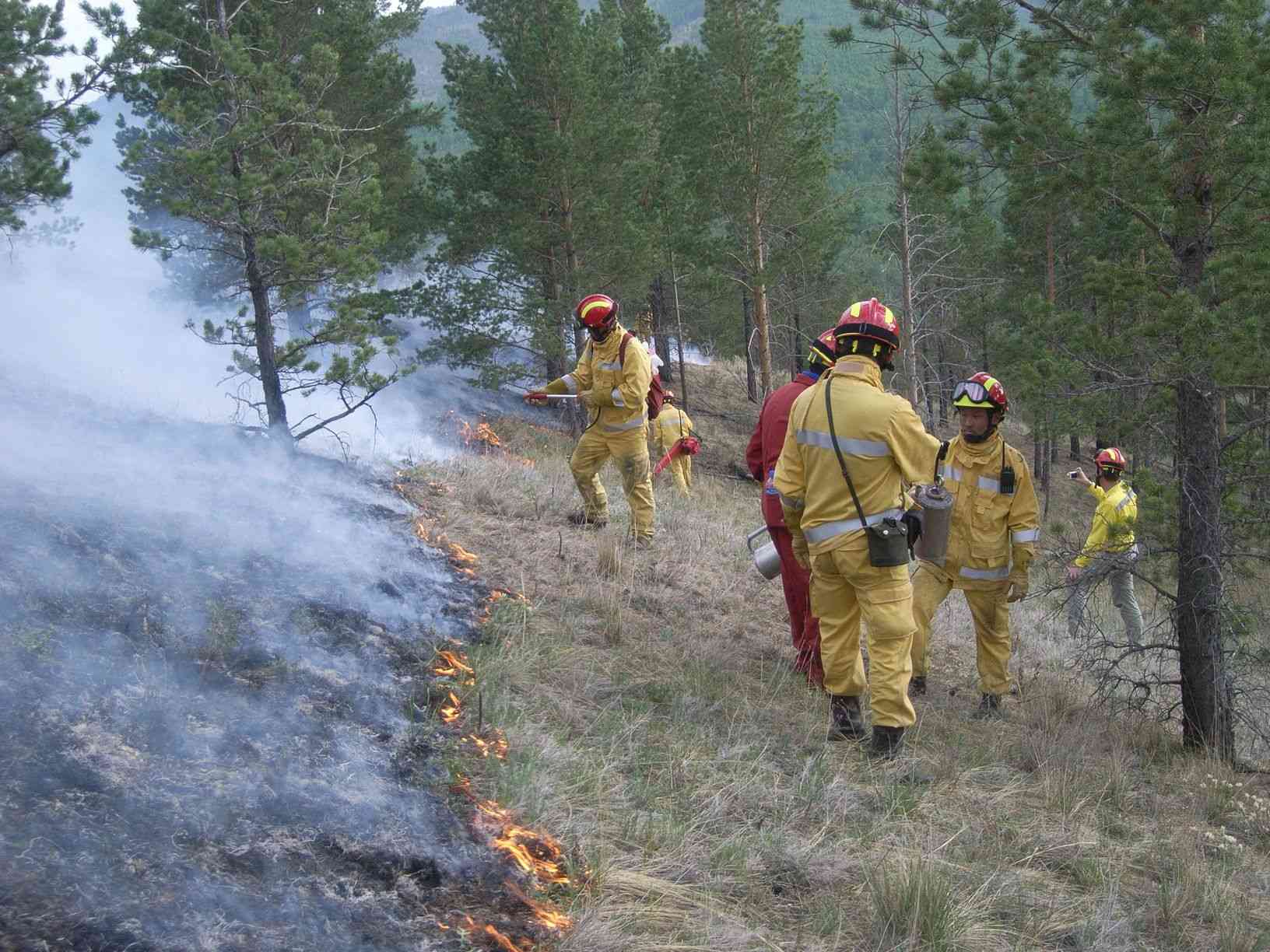
International Wildfire Preparedness Mechanism (IWPM)
The mission of the IWPM is to support, on request, agencies and countries to build national capacity and resilience to wildfire through the exchange of best practice in landscape fire management
Description
An enabling international environment is vitally important for providing nations around the world with the knowledge and skills that are necessary to develop and implement more effective and more coordinated approaches to wildfire (landscape fire) prevention, preparedness and response. While there is evidence of some excellent recent examples of international collaboration and cooperation on wildfire issues, the UNECE/FAO Regional Forum on Cross-boundary Fire Management (United Nations, Geneva, 28-29 November 2013) and its follow-up consultations identified that the international exchange of knowledge on wildfire could be significantly improved through the creation of an International Wildfire Preparedness Mechanism (IWPM). It was proposed at the Geneva Forum that the IWPM should be created as soon as possible to act as a central knowledge exchange gateway for wildfire professionals across the World. The IWPM was formed in July 2014 and is currently hosted by the Global Fire Monitoring Center (GFMC), which performs the role of an interim secretariat. The IWPM provides a platform/framework from which to cascade knowledge, good practice, experience and expertise throughout the global wildfire community for the benefit of all. The IWPM has been developed in tandem with the International Fire Aviation Guidelines and the International Manual of Common Rules for Fire Aviation. For implementation of its mandate the IWPM offers countries and international organizations to conduct national and regional Round Table on Fire Management in which governmental and non-governmental stakeholders or mandated representatives of multilateral and other international organizations define relevant policies and implementation strategies; provision of technical assistance, training, scientific-technical workshops, and access to information, tools and guidelines on the GFMC online repository (GFMC website with around 160,000 web pages and documents). The IWPM relies on the active contributions of the Regional Wildland Fire Networks and the Regional Fire Monitoring Centers and Regional Fire Management Resource Centers, that are operating under the Global Wildland Fire Network (GWFN) and the UNISDR Wildland Fire Advisory Group (WFAG).
Did the Sendai Framework change or contribute to changes in your activities/organization? If so, how?
The concept of the Sendai Framework confirmed that the earlier contribution of the Global Wildland Fire Network (GWFN) (founded in 2001 and operational since 2004) is increasingly needed to assist nations, the UN system, multilateral organizations and other international institutions. This refers especially to the fact that the Sendai Framework shifted the focus from managing disasters to preventing risk. This increases the relevance of our work, which is addressing the underlying causes of increasing wildfire disaster risks and the environmental and societal vulnerability by emphasizing prevention and preparedness, notably through participatory approaches at local / community level.
What led you to make this commitment/initiative?
What was your position before making this Voluntary Commitment / prior to the Sendai Framework?
The Global Wildland Fire Network (GWFN) was founded in 2001 based on the decision of the UNISDR Interagency Task Force (IATF) (https://www.unisdr.org/2005/task-force/tf-working-groups4-eng.htm) and operational since 2004. Starting in 2005 the GWFN contributed to the implementation of the Hyogo Framework for Action (HFA) 2005-2015: Building the Resilience of Nations and Communities to Disasters. Since the Sendai Framework is the successor instrument to the HFA for implementing policies and action in DRR, the earlier positioning of the GWFN as a contribution to the HFA has consequently being updated and this Voluntary Commitment reflects our renewed support to the implementation of the Sendai Framework.
Deliverables and Progress report
Deliverables
Deliverables are the end-products of the initiative/commitment, which can include issuance of publications or knowledge products, outcomes of workshops, training programs, videos, links, photographs, etc.
The GFMC has developed the “Tools for Advising / Supporting Nations and the UN in Capacity Building in Landscape Fire Management and Wildfire Disaster Risk Reduction”. Based on the previous experiences 9 tools were published online by the GFMC and the UN Environment / OCHA Environmental Emergencies Center (EEC):
– GFMC Tool 1 – Global Wildland Fire Information System
– GFMC Tool 2 – Regional Wildland Fire Networks under the aegis of the Global Wildland Fire Network
– GFMC Tool 3 – International advisory services for fire management
– GFMC Tool 4 – Global Wildland Fire Early Warning System
– GFMC Tool 5 – International support tools for wildfire emergency response
– GFMC Tool 6 – Establishment & services of Regional Fire Management Resource Centers
– GFMC Tool 7 – Round Tables on Fire Management
– GFMC Tool 8 – Systematic application of outreach work in community-based fire management
– GFMC Tool 9 – Capacity building in the application of Integrated Fire Management principles
In July 2018 a wildfire affected a suburb of Athens, resulting in the death of 100 people and numerous injuries and high losses of private assets. In August 2018 the Prime Minister of Greece entrusted the GFMC to set up and lead a committee to investigate the underlying causes of wildfire risks in the country and to develop recommendations for reforms and policy measures in order to increase the resilience of the natural, cultural and urban-industrial landscapes of Greece and the people living therein against wildfires. The report was delivered in February 2019 and recommended to establish a scientific, advisory and coordinating organization for landscape fire management, mandated to develop a national cross-sectoral fire management plan and observe the principles of
- Strengthening Ecosystem-based approaches and Green DRR Infrastructure
- Scholarliness, Transdisciplinarity and Innovation
- Holisticness, Integration and Inclusion
- Coherence, Cohesiveness and Coordination
This deliverable aims at encouraging countries to develop National Fire Management Policies. As more countries are assisted, specific outputs will be provided. The results will be presented as reports and/or press releases
Porgress report
After mid-2024, the SVC partners continued to support building the Global Fire Management Hub and contributed to the first Fire Hub Plenary, which was attended by more than 600 from 85 countries, 250 organizations and& agencies responsible for landscape fire management. Among the 3 initial Fire Hub Working Groups, the WG “International Interoperability” will build on the work of the SVC IWPM:
- Fire Hub Plenary – Session International Interoperability: https://www.fao.org/webcast/detail/global-fire-management-hub-plenary-2025-day3-morning-session/en
At the first meeting of WG-II at GFMC in October 2025, the ToRs of WG-II were finalized:
- https://gfmc.online/wp-content/uploads/Fire-Hub-WG-Interoperability-ToR.pdf
In March 2026, a meeting “Interoperability, Cooperation, and Mutual Assistance for Preparedness and Response to Forest Fires in Latin America and the Caribbean” was hosted by the Amazon Cooperation Treaty Organization (ACTO):
- https://gfmc.online/wp-content/uploads/ACTO-FAO-Interoperability-Meeting-09-13-March-2026-Agenda.pdf
At UNGA-79, the Report of the UNSG on the Implementation of the Sendai Framework on 01 August 2024 made reference to the Fire Hub.
The G20 WG DRR in 2024 launched the “Compendium on Nature Based Solutions and Eco-System Based Approaches for DRR“, in which the case of GFMC respectively was selected as “good practice case”.
Examples for the contribution of the SVC to multilateral organizations: OSCE Asian Conference Towards Stronger Partnerships for Sustainable Peace and Security (https://gfmc.online/wp-content/uploads/OSCE-2024-Asian-Conference-15-16-October-2024-Agenda.pdf) or work in SE Europe in 2025.
The Group of Seven (G7) referred to the Fire Hub in the “Kananaskis Wildfire Charter” (2025) (https://g7.canada.ca/assets/ea689367/Attachments/NewItems/pdf/g7-summit-statements/wildfire-en.pdf).
At UNFCCC COP 30, 66 countries, FAO, UNEP, UNDP and ITTO in 2025 committed to a voluntary Call to Action on Integrated Fire Management and Wildfire Resilience.
Organizations and focal points
Implementing Organization(s)
Focal points
If a VC's contact information has been hidden, the SFVC team can forward a message.Partners
- Regional Western Africa Fire Management Resource Center
- Regional Eastern Africa Fire Management Resource Center
- Regional Eurasia Fire Monitoring Center
- Regional Fire Management Resource Center – South America Region
- Regional Fire Management Resource Center – South East Asia Region
- Regional Eastern European Fire Monitoring Center
- Regional Southeast Europe / Caucasus Fire Monitoring Center
- Regional Central Asia Fire Management Resource Center