My account
Menu
Your experience on PreventionWeb

Please help us improve PreventionWeb by taking this brief survey. Your input will allow us to better serve the needs of the DRR community.

See the survey

Published on
6 September 2021
Status
Completed

Building Resilience Through Capacity Development of DRR Young Scientist in Nepal

Expected duration
Jan 2019 - Dec 2021
SFVC commitment ID
20190209_001
Version
6.0
Author
Suman Chapagain
Upload your content

Himalayan Risk Research Institute (HRI) is building a platform for DRR young scientists including students, researchers and young professionals. This aims to enhance the skillset, facilitate, promote and build a scientific approach to DRR activities in Nepal.

    Description

    Motivating, facilitating, promoting and advocating the works of young scientists and researchers is one of the essential components to building a scientific base for DRR activities in Nepal. This platform will work in this sector by coordinating with DRR professionals and young members from government and non-government organizations, national and international research institutes and universities and local governments. The knowledge and skill set of the young scientists and professionals will be enhanced through skill transfer mechanisms such as training, summer schools, exposure visits, field research, collaborations and workshops. Regular such programs will be carried out. The government bodies and mainly the local governments who have aimed for building resilient communities will further be connected within this platform. The young scientists will be conducting researches, build databases and share findings which will help the local governments to form their action plans. Thus, young scientists will get their skills enhanced while the local government will achieve their aims.

    Did the Sendai Framework change or contribute to changes in your activities/organization? If so, how?

    The priorities set by the Sendai Framework for Disaster Risk Reduction has helped us identify targets and develop organizational strategies for disaster risk reduction in Nepal.

    What led you to make this commitment/initiative?

    What was your position before making this Voluntary Commitment / prior to the Sendai Framework?

    Many organizations in Nepal are contributing to disaster risk reduction through the implementation of DRR activities. But there is a huge gap in the scientific databases, research-based approaches and coordination of international research and local application. HRI was established to conduct research of hazards and disasters in Nepal. The interest and activities shown by individual young professionals during past emergencies led us to build the idea to connect those young individuals through the network. Thus, HRI now aimed to contribute to the disaster risk reduction in Nepal by mainstreaming and connecting young scientists based in Nepal and in abroad universities and research institutes and transfer knowledge.

    Deliverables and Progress report

    Deliverables

    Deliverables are the end-products of the initiative/commitment, which can include issuance of publications or knowledge products, outcomes of workshops, training programs, videos, links, photographs, etc.

    Research: Porous road delevopment policy in Nepal is increasing landslide risk
    Intended date of delivery
    31 October 2018

    A research was carried out in Sindhupalchowk district of Central Nepal to understand the relation of road development and landslide risk. We found that the expansion of un-engineered roads was actually multiplying the chances of landslides and thus increasing the risk. Further, a major trunk road of China's Belt and Road initiative is planned to be constructed in this region and this may lead to an explosion of such un-engineered roads which then subsequently will lead to further landslide disasters. So, we concluded this policy has to be revised by the Nepal government.
    A journal paper was published on this work with collaboration with international experts.
    McAdoo, B. G., Quak, M., Gnyawali, K. R., Adhikari, B. R., Devkota, S., Rajbhandari, P. L., and Sudmeier-Rieux, K.: Roads and landslides in Nepal: how development affects environmental risk, Nat. Hazards Earth Syst. Sci., 18, 3203-3210, https://doi.org/10.5194/nhess-18-3203-2018, 2018.

    Link
    https://www.nat-hazards-earth-syst-sci.net/18/3203/2018/
    Awareness on COVID-19
    Intended date of delivery
    30 April 2020

    As a part of Social Awareness Campaign, HRI in collaboration with U-INSPIRE Nepal, Institute of Himalayan Risk Reduction and Nepal Engineers' Association had developed COVID-19 safety awareness video and national situation video and shared through the social media. The main objective was to reduce the risk through awareness. The video was prepared in English as well as the local language (Nepali).

    File
    VideoSlides.png (432.89 KB)
    Link
    https://www.youtube.com/watch?v=G9Db-K7DanI
    Coordination with the local government
    Intended date of delivery
    31 August 2021

    The proposal will be developed on research projects that can contribute to enhancing disaster resiliency and supporting to the development planning of local governments.

    File
    Follow-up and scoping for a flood resiliency project (446.67 KB)
    Earthquake Awareness on the occasion of National Earthquake Safety Day 2020
    Intended date of delivery
    31 December 2021

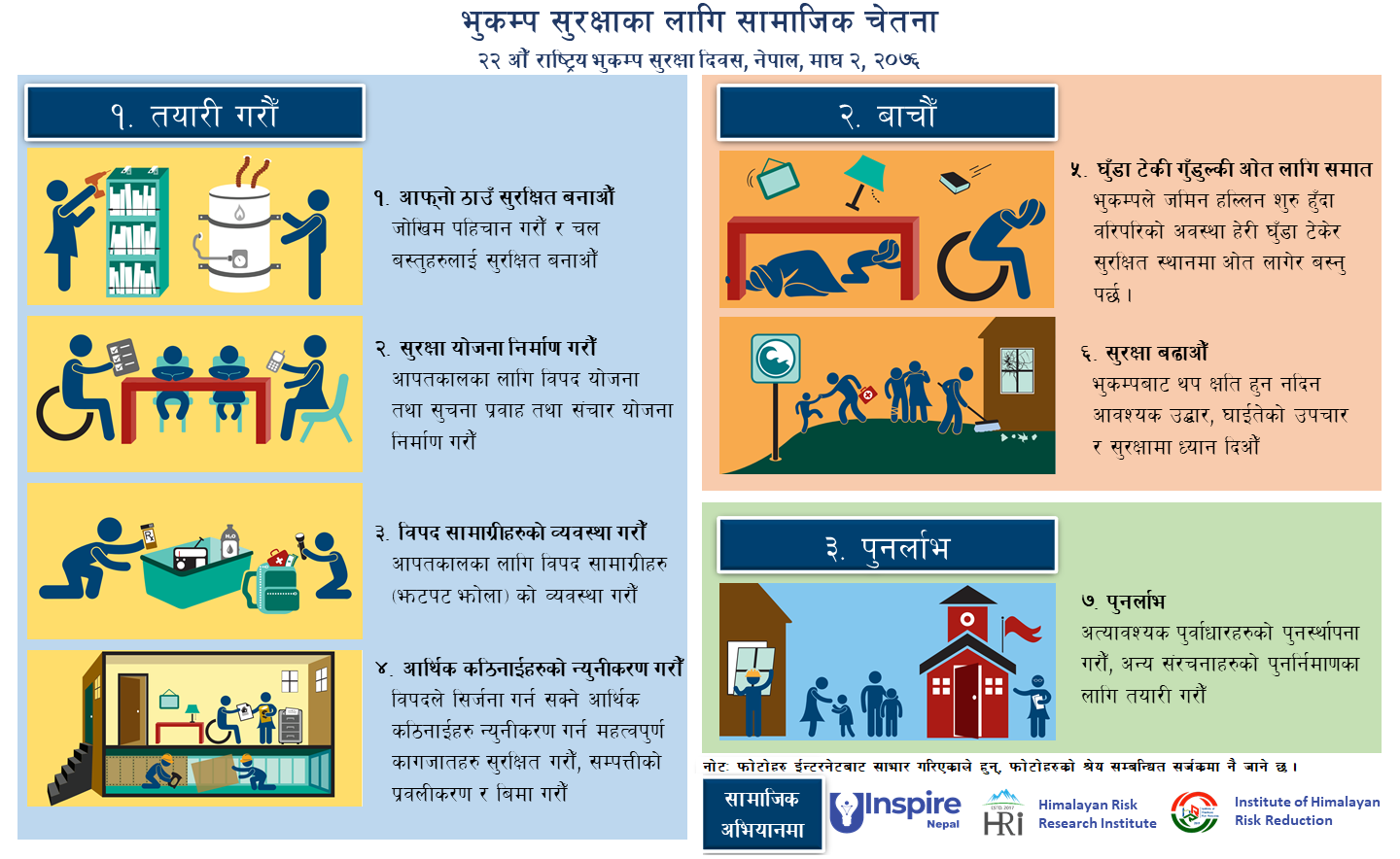
    As a part of Social Awareness Campaign, HRI in collaboration with U-INSPIRE Nepal and other partner organization had developed an IEC material and shared through social media. The main objective was to reduce the risk through awareness.
    File
    ESD 2020.png (335.01 KB)
    Engagement of HRI young scientists in DRR research
    Intended date of delivery
    31 December 2021

    HRI young scientists will be engaged in research activities. Technical support and guidance will be provided by the HRI. They will be provided with opportunities to take part in international seminar, workshop, training, and publication.

    File
    Program Summary: Know Your Mountains (631.44 KB)
    Link
    https://hri.org.np/2021/07/18/know-your-mountains/
    HRI Young Scientist Network for DRR in Nepal is formed
    Intended date of delivery
    31 December 2021

    The network will be formed and orientation on program aims, objectives and vision will be conducted.

    Research is conducted and skill is enhanced
    Intended date of delivery
    31 December 2021

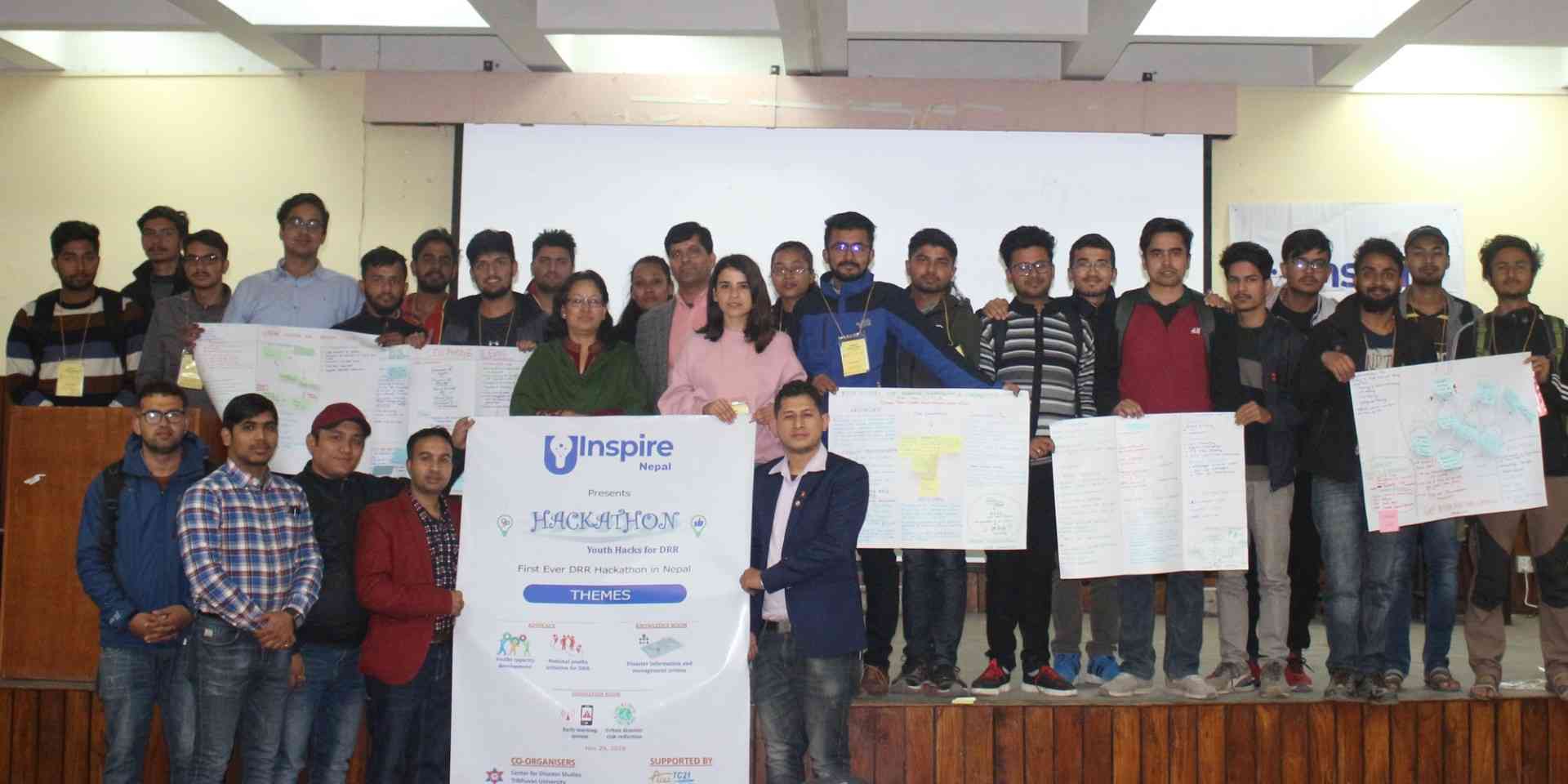
    The significant number of research would be conducted, shared with local governments and skills of young scientists would be enhanced. The knowledge and information will be disseminated throughout the network. The gaps and challenges will be identified. The lessons learnt will be prepared and the way forward will be planned. The necessary scientific publications would be done. The program like seminar, workshop, conference or hackathon would be conducted targeting the youths from various disciplines.

    File
    HACKATHON REPORT.pdf (1.23 MB)
    Link
    https://hri.org.np/2019/11/20/hackathon-youth-hacks-for-drr/

    Porgress report

    Progress date
    1 March 2021
    Summary

    HRI is a youth-led organization established with an aim to support youth from science, engineering, technology, and innovation in DRR research. In two years of commitment in SFVC, the HRI has initiated all the commitments for which notable outcomes are being witnessed. However, to involve more youth from the local communities, HRI had initiated the HRI young scientist program in 2018 and a social awareness campaign in 2020. The first activity under this campaign was conducted during National Earthquake Safety day in March 2020. However, the relevancy of such campaigns was noticed during the COVID-19 pandemic. To coordinate with the local government in DRR research, HRI had conducted a scoping study for the emergency water supply project in a rural municipality in Sunsari district in eastern Nepal.

    Achievements at a glance

    HRI has initiated each of seven commitments made on the SFVC platform. HRI had initiated commitments voluntarily, however, some more organization were interested to collaborate with the HRI for the conduction of such commitments. At present, the commitments of HRI are also taking the form of a pilot project to some other organizations.

    Supporting documents
    SFVC Progress Report.pdf (1.82 MB)
    Organizations and focal points

    Implementing Organization(s)

    • Himalayan Risk Research Institute

    Focal points

    Main focal point
    Suman Chapagain (Researcher, Natural Hazards Section, Himalayan Risk Research Institute)

    Partners

    • U-INSPIRE Nepal
    • Institute of Himalayan Risk Reduction
    • Nepal Engineers' Association

    Explore further

    Sendai priorities
    Priority 1Understanding disaster risk
    Priority 4Enhancing disaster preparedness for effective response, and to «Build Back Better», rehabilitation and reconstruction
    Sendai targets and indicators
    C-4Direct economic loss in the housing sector attributed to disasters
    D-1 (Compound)Damage to critical infrastructure attributed to disasters
    D-3Number of destroyed or damaged educational facilities attributed to disasters
    D-4Number of other destroyed or damaged critical infrastructure units and facilities attributed to disasters
    D-6Number of disruptions to educational services attributed to disasters
    D-7Number of disruptions to health services attributed to disasters
    D-8Number of disruptions to basic services attributed to disasters
    F-7Number of international, regional and bilateral programmes and initiatives for disaster risk reduction-related capacity-building in developing countries
    F-8Number of developing countries supported by international, regional and bilateral initiatives to strengthen their disaster risk reduction-related statistical capacity
    G-5Number of countries that have accessible, understandable, usable and relevant disaster risk information and assessment available to the people at the national and local levels
    Hazards Cold Wave Drought and Desertification Earthquake Epidemic and Pandemic Flood Heatwave and Extreme Heat Landslide Wildfire
    Themes Capacity development Children and Youth Civil Society/NGOs Critical infrastructure Education and school safety GIS and mapping Data and information management Risk identification and assessment Science-policy-practice interface Urban risk and planning
    Country and region Nepal
    Sustainable Development Goals SDG4: Quality education SDG6: Clean water and sanitation SDG9: Industry, innovation and infrastructure SDG11: Sustainable cities and communities
    Scope
    National (or local) - Nepal
    Secured budget size
    20%
    Donors
    Private Institutions
    Individual Donors
    Government Projects
    Local Government Projects
    Development Partners' Support
    Umbrella initiative(s)
    U-INSPIRE Alliance; Science & Technology Roadmap; Social Awareness Campaign in Nepal (Collaboration with Institute of Himalayan Risk Reduction - IHRR)
    X (Twitter)
    https://twitter.com/HRI_Nepal
    Videos

    Is this page useful?

    Yes No
    Report an issue on this page

    Thank you. If you have 2 minutes, we would benefit from additional feedback (link opens in a new window).

    PreventionWeb is the global knowledge sharing platform for disaster risk reduction (DRR) and resilience.

    • Newsletter
    • Submit your content
    • Blog pitches
    • Submission and publishing policy
    • About PreventionWeb
    • Contact us

    Hazards

    • Avalanche
    • Cold Wave
    • Cyclone, Hurricane and Typhoon
    • Drought and Desertification
    • Earthquake
    • Epidemic and pandemic
    • Flood
    • Heatwave, extreme heat and heat stress
    • Insect infestation
    • Land subsidence
    • Landslide
    • Nuclear, biological, chemical (NBC)
    • Sea level rise
    • Technological hazard
    • Thunderstorm
    • Tornado
    • Tsunami
    • Volcano
    • Wildfire

    Regions

    • Africa
    • Americas
    • Asia
    • Europe
    • Oceania

    Themes

    Understanding & managing risk

    • Preparedness
    • Early warning
    • GIS and mapping
    • Data and information management
    • Risk identification and assessment
    • Small Island Developing States
    • Earth Observation

    Natural environment

    • Climate change
    • Environment and ecosystems
    • Food security and agriculture
    • Water

    Cross-cutting

    • Systemic risk
    • Recovery

    Human development

    • Capacity development
    • Children and youth
    • Civil society / NGOs
    • Community-based DRR
    • Cultural heritage
    • Gender
    • Human mobility
    • Inclusion
    • Social impacts and resilience

    Science, knowledge & advocacy

    • Disaster risk communication
    • Traditional and Indigenous knowledges
    • Science-policy-practice interface

    State, governance & economy

    • Financing DRR
    • Fragility and conflict
    • Governance
    • Insurance and risk transfer
    • Private sector

    Infrastructure & critical services

    • Critical infrastructure
    • Education and school safety
    • Health and health facilities
    • Structural safety
    • Urban risk and planning
    Loading