ABU Media Summit on Climate Action and Disaster Preparedness
ABU has been at the forefront of issues on Climate Change and Disaster Risk Reduction. Through the summits, this commitment aims at: strengthening the collaboration of broadcasting organizations; encourage the production and dissemination of relevant content; and promote information-sharing networks
Description
Through the years, ABU has been at the forefront of media efforts to save and improve the lives of people by supporting Disaster Risk Reduction (DRR). Risks and their consequences can become more frequent and violent because of Climate Change (CC). The ABU Media Summits on Climate Change and Disaster Preparedness aim at strengthening the collaboration, production, and dissemination of CC and DRR related content by broadcasting organizations.
There is overwhelming scientific evidence that activities relating to the human presence on planet Earth are causing changes to the atmosphere and environment upon which the global population relies for its very existence and survival. It is vital that the current international conversation on the subject be strengthened and enhanced. The media, especially radio and television, has a vital role in reaching out to citizens and developing a two-way communication process in ensuring a greater understanding of climate change issues. Similarly, broadcasting has a critical responsibility in informing a broader public of disaster preparedness issues and is the first media of choice when civil disaster relief agencies, humanitarian support organizations and community service bodies seek to inform the public during times of crisis and emergency. Climate change affects people of all nations with no differentiation, just as disasters recognize no national borders, nor do they discriminate between rich and poor nations.
Broadcasters have a responsibility to initiate dialogue and to highlight to viewers and listeners the challenges which can affect them and their families, not only in known areas of danger but also where environmental challenges may occur in the future. Each summit has a special focus and produces specific outputs such as the 2014 Jakarta Statement, 2016 Krabi Media Action Plan, 2017 Dhaka Declaration, 2018 Fiji Action Plan, and 2019 Kathmandu Media Action Plan.
Did the Sendai Framework change or contribute to changes in your activities/organization? If so, how?
The Sendai Framework for Disaster risk Reduction creates a roadmap for reducing disaster losses by 2030. In this roadmap, the Sendai Framework encourages media and broadcasting organizations to work “in close cooperation with national authorities; adopt specific disaster risk reduction communications policies; support, as appropriate, early warning systems and life-saving protective measures; and stimulate a culture of prevention and strong community involvement in sustained public education campaigns and public consultations at all levels of society, in accordance with national practices.” We believe the summits create an adequate space where dialogue can happen towards joint and improved action in the region.
What led you to make this commitment/initiative?
What was your position before making this Voluntary Commitment / prior to the Sendai Framework?
ABU has been at the forefront of media efforts to address CC and DRR. The Sendai Framework supports our efforts by providing specific roles and paths of action. For example, it states that we need to "strengthen the utilization of media, including social media, traditional media, big data and mobile phone networks, to support national measures for successful disaster risk communication, as appropriate and in accordance with national laws." The summits attempt to build upon these calls for action and deliver specific commitments.
Deliverables and Progress report
Deliverables
Deliverables are the end-products of the initiative/commitment, which can include issuance of publications or knowledge products, outcomes of workshops, training programs, videos, links, photographs, etc.
In keeping with the outcomes of the inaugural ABU Media Summit on Climate Change, ICTs and Disaster Risk Reduction and previous conferences, workshops and other events, a commitment was made calling upon all broadcast media stakeholders, especially journalists and program makers in the Asia-Pacific region to act on CC and DRR. More details in the link below.
Following the Jakarta Statement of Commitment, which was the outcome of the inaugural ABU Media Summit in 2014, and in consistency with the four priority areas highlighted in the Sendai Framework for Disaster Risk Reduction and the Voluntary Commitment statement from the Media Stakeholders Group in Sendai 2015, the participants of the 2nd ABU Media Summit on Climate Change and Disaster Risk Reduction agreed to the Krabi Media Action Plan. More details in the link below.
The delegates to the 3rd ABU Media Summit on Climate Change and Disaster Risk Reduction, thanked the Summit hosts, the Government of the People’s Republic of Bangladesh and the Asia-Pacific Broadcasting Union, for hosting this important international event. Recognising the outcomes of previous regional meetings, namely the inaugural media summit in Jakarta, Indonesia (2014), the next in Sendai, Japan (2015) and the gathering in Krabi, Thailand (2016) as well as reinforcing the three global commitments (SFDRR, SDG and Paris Agreement) and the last AMCDRR (2016) declarations, the participants reinforced our commitment to the task of conveying life-saving disaster risk reduction information to the people of our nations, as well as sharing knowledge for action on climate change issues and sustainable developments goals. Following two days of important discussions and exchanges, the Dhaka Declaration was committed. More details in the link below.
International events, such as the ABU Media Summits and the ABU Pacific Media Partnership Conferences, provide a valuable space for professional broadcasters to educate their peers on new techniques, training opportunities, networking and new technologies that help deliver timely programming to assist listeners, viewers and online recipients to better prepare for major natural disasters.
The Pacific Media Partnership Conference is not only a platform for information transfer but also encourages an appreciation of new global broadcasting practices in areas such as gender and diversity, thus enabling the reflection by national broadcasters of a greater range of voices and communities.
Following three days of rich, meaningful and collegial dialogue during the 4th ABU Media Summit on Climate Change and Disaster Risk Reduction, the Fiji Action Plan was committed. More details in the link below.
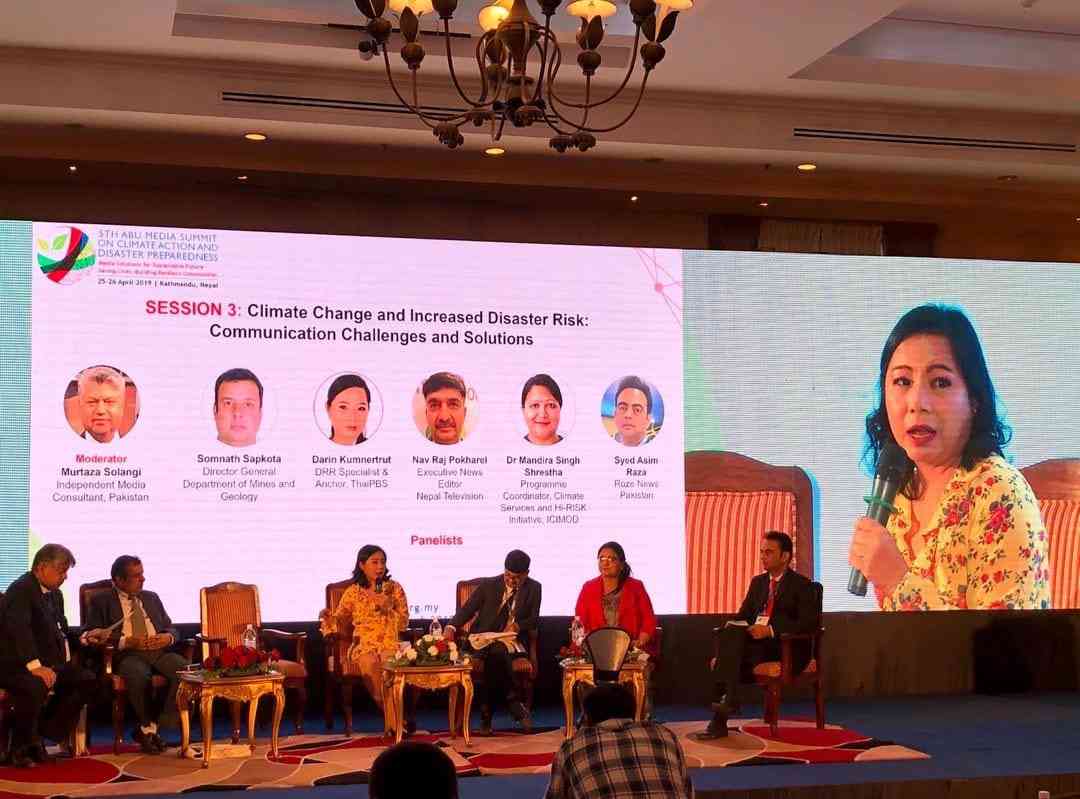
The delegates of the 5th ABU Media Summit on Climate Change and Disaster Preparedness: Media solutions for a sustainable future recognize the outcomes of previous regional summits in Jakarta, Indonesia (2014), Global News Forum in Sendai, Japan (2015), Krabi, Thailand (2016), Dhaka, Bangladesh (2017), and Nadi, Fiji (2018) as well as reinforcing global commitments such as a the Sendai Framework for Disaster Risk Reduction, the United Nations Framework Convention on Climate Change (UNFCCC) 2015 Paris Agreement, and UNESCO's Declaration of Ethical Principles in Relation to Climate Change 2017, we reinforce our commitment to the task of conveying life-saving disaster risk preparedness information to the people of our nations, as well as sharing knowledge for action on climate change issues and the UN's Sustainable Development Goals. Therefore, after two days of rich, meaningful and collegial dialogue the Kathmandu Media Action Plan was committed.
The 6th ABU Media Summit addressed the urgency of the situation, the need to act now. A line of high-level speakers provided participants with an overview of the COP26 conference outcomes, next steps and most importantly how media professionals can engage their audiences for climate action and disaster prevention.
The 7th ABU Media Summit on Climate Action and Disaster Prevention took place in Maldives bringing together broadcasters, experts, and government officials to address the pressing issues of climate change and disaster risk reduction. The summit featured keynote addresses, panel discussions, and sessions aimed at fostering collaboration among media outlets in the Global South and linking broadcasters with other stakeholders in Climate Change adaptation and Disaster prevention to build resilient communities. It concluded with participants adopting a joint call for action acknowledging the broadcasting industry’s crucial role in climate change communication and disaster prevention.
Organizations and focal points
Implementing Organization(s)
Focal points
If a VC's contact information has been hidden, the SFVC team can forward a message.