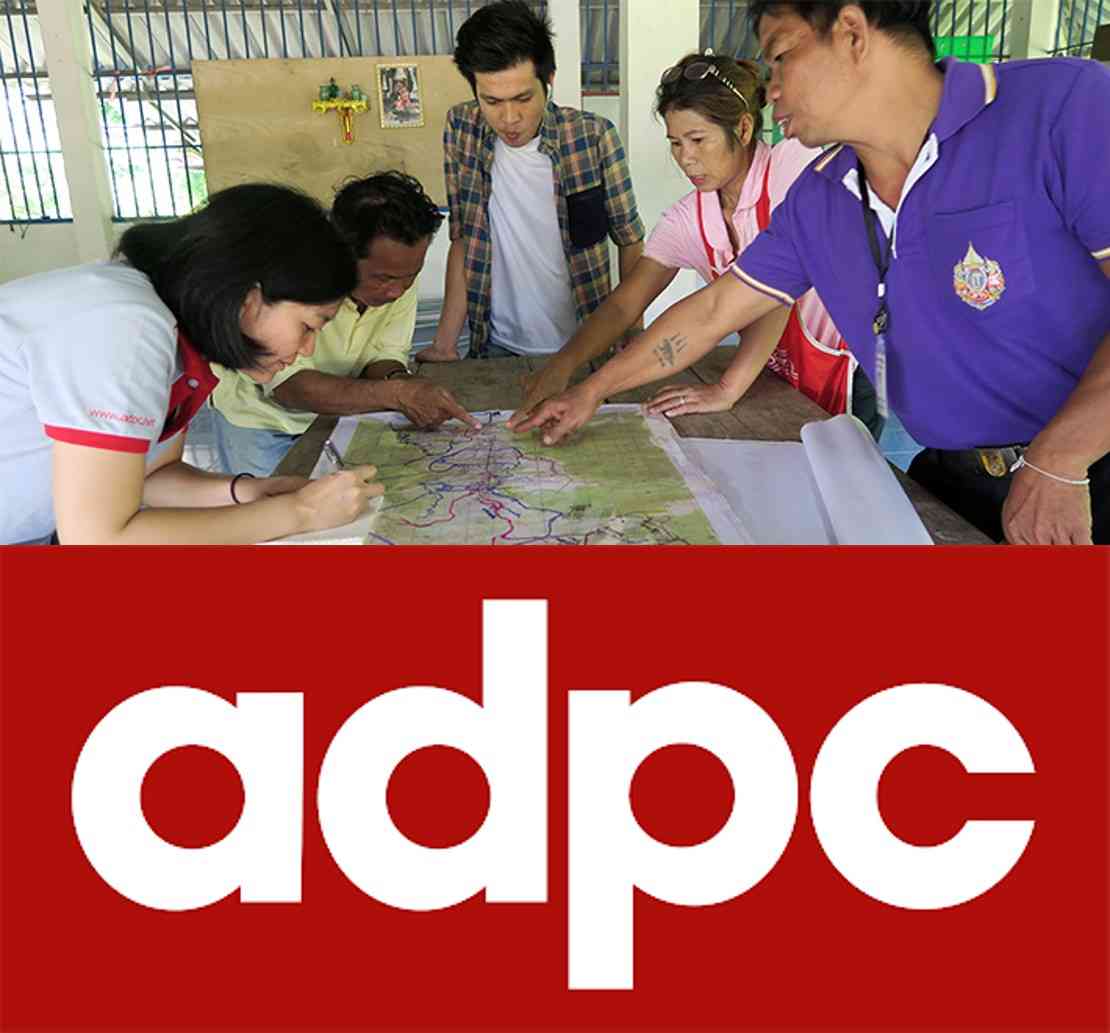
Building Resilience to Disasters and Climate Change Impacts in Asia and the Pacific
ADPC is an autonomous international organization committed to build the resilience of people and institutions to disasters and climate change impacts in Asia and the Pacific. We provide technical services across social and physical sciences to support sustainable solutions.
Description
ADPC was established in 1986, it provides comprehensive technical services to countries in the Asia and the Pacific region across social and physical sciences to support sustainable solutions for risk reduction and climate resilience. ADPC supports countries and communities in building their DRR systems, institutional mechanisms and capacities to become resilient to numerous hazards, such as floods, landslides, earthquake, cyclones, droughts, etc.
Working across a broad range of specialist areas, ADPC develops and implements cross-sectoral projects/programs on the strategic themes of risk governance, urban resilience, climate resilience, health risk management, preparedness for response and resilient recovery (six strategic themes). Our strategic themes are complemented and underpinned by the cross-cutting themes of gender and diversity, regional and transboundary cooperation as well as poverty and livelihoods. These themes interconnect to form a holistic approach to disaster risk management. They are intersecting and multi-disciplinary, and reflect the call to the international community by different global and regional frameworks to work across sectors, audiences, and disciplines to address all aspects of disaster risk at all levels. The ADPC Academy designs and delivers specialist capacity-building and training courses at all levels and also enhances the capabilities of national training centers on DRR.
As a result, ADPC supports the implementation of the Sendai Framework for Disaster Risk Reduction 2015–2030, the Sustainable Development Goals (SDGs), the New Urban Agenda, the United Nations Framework Convention on Climate Change, the agenda defined at the World Humanitarian Summit in 2016, and other relevant international frameworks.
ADPC is governed by its nine founding member countries: Bangladesh, Cambodia, China, India, Nepal, Pakistan, the Philippines, Sri Lanka, and Thailand. The Bangkok headquarters and country offices in Myanmar, Bangladesh, and Sri Lanka host experts who work towards inclusive development across our strategic as well as cross-cutting themes.
Did the Sendai Framework change or contribute to changes in your activities/organization? If so, how?
The Sendai Framework for Disaster Risk Reduction created a shift form managing disasters to managing risk. The work of ADPC is aligned with this spirit. Furthermore, through our thematic areas, multidisciplinary and comprehensive approach, we fulfill the call by the Sendai Framework for relevant policies, plans, practices and mechanisms aiming at coherence across sustainable development and growth, food security, health and safety, climate change, environmental management and disaster risk reduction agendas. We believe that disaster risk reduction is essential to achieve sustainable development.
What led you to make this commitment/initiative?
What was your position before making this Voluntary Commitment / prior to the Sendai Framework?
ADPC aims to foster a more integrated approach to how we operate. We are informed by the post-2015 development agenda, supporting the implementation of global frameworks, including the Sendai Framework for Disaster Risk Reduction and the Sustainable Development Goals, and commitments under the Paris Agreement on Climate Change and World Humanitarian Summit.
ADPC's strength lies in networking and coordinating with partners at the national and sub-national levels. Over the past nearly 30 years, ADPC has worked hand-in-hand with a diverse range of partners from the United Nations to government agencies and line-ministries, multi- and bilateral donors, community-based organizations, universities, technical agencies and international non-governmental agencies. As disaster preparedness and risk reduction becomes more of an interest with corporations in the region, ADPC is actively engaging the private sector for joint project implementation.
Deliverables and Progress report
Deliverables
Deliverables are the end-products of the initiative/commitment, which can include issuance of publications or knowledge products, outcomes of workshops, training programs, videos, links, photographs, etc.
ADPC makes available a number of knowledge products.
Visitors can browse by type (annual reports, status reports, technical papers, news, minutes, etc.), department, etc.
The Brian Ward Memorial Lecture is a series of lectures held annually to honor the memory of Brian Ward for his vision of a safer Asia, and outstanding personal dedication and commitment to the field of disaster risk reduction. The lecture features distinguished guests who shares their experiences in disaster risk reduction and implores them to contribute advice for the future of the field in Asia-Pacific. The guest lecturers are chosen each year from leading practitioners and decision makers in disaster risk reduction.
The ADPC Academy provides training in specialized fields of disaster preparedness for governments, intergovernmental and nongovernmental organizations. The capacity building courses offered by the ADPC Academy cover key areas in disaster risk reduction and climate change adaptation through diverse and customized approaches. We regularly update training curricula in alignment with the priorities of regional and global development frameworks.
For the latest information on ADPC's activities, users can visit the link below.
A curated list of ongoing and archived projects under this strategic theme is available in the link below.
A curated list of ongoing and archived projects under this strategic theme is available in the link below.
A curated list of ongoing and archived projects under this strategic theme is available in the link below.
A curated list of ongoing and archived projects under this strategic theme is available in the link below.
A curated list of ongoing and archived projects under this strategic theme is available in the link below.
A curated list of ongoing and archived projects under this strategic theme is available in the link below.
A curated list of ongoing and archived projects under this strategic theme is available in the link below.
A curated list of ongoing and archived projects under this strategic theme is available in the link below.
A curated list of ongoing and archived projects under this strategic theme is available in the link below.
In addition to public sector services, ADPC supports the private enterprises' engagement with government agencies in disaster risk reduction activities. Public-Private Partnerships (PPP) offers a framework and practiced method for this cooperation, which involves government agencies and private sector entities that share aims and responsibilities, with mutual benefits to both parties. By entering into a public-private partnership, a business can have a guaranteed financial benefit, and the local government can reduce its public spending.
ADPC makes available a number of knowledge products.
Visitors can browse by type (annual reports, status reports, technical papers, news, minutes, etc.), department, etc.
The RCC is a platform promoting disaster and climate-resilient development through regional dialogue, peer advocacy and exchange of expertise among policy makers and international organizations across Asia and the Pacific.
Organizations and focal points
Implementing Organization(s)
Focal points
Partners
- Asian Infrastructure Investment Bank
- United Nations Development Programme (UNDP)
- Global Network of Civil Society Organisations for Disaster Reduction (GNDR)
- United Nations Economic and Social Commission for Asia and the Pacific (UN-ESCAP)
- United Nations Office for Disaster Risk Reduction (UNDRR)
- United Nations Office for Outer Space Affairs (UNOOSA)
- Food and Agriculture Organization of the United Nations (FAO)
- Asian Development Bank (ADB)
- World Health Organization (WHO)
- World Bank, the
- World Food Programme (WFP)