
Delivery of Regional Resilience Strategies in Queensland
Development of locally led, co-designed regional resilience strategies to support the coordination and prioritisation of future resilience building and mitigation projects across Queensland.
Description
By 2022, every region across Queensland will be part of a locally-led and regionally-coordinated blueprint to strengthen disaster resilience. Key project deliverables, the Regional resilience strategies and local resilience action plans, will help to keep Queenslanders safe by providing a coordinated approach to identify and prioritise disaster resilience actions.
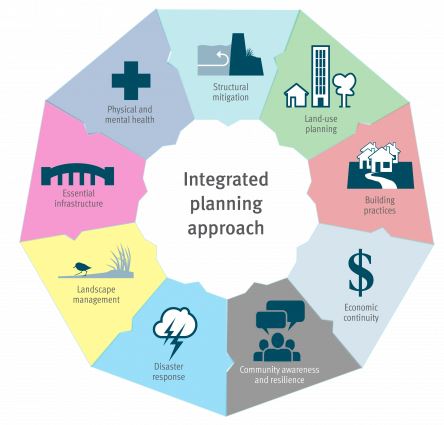
The regional resilience strategies recognise the important role that all Queenslanders play in building resilience by incorporating integrated planning approaches that involve a range of professions and stakeholder groups.
Key components of the integrated approach that are considered in the development and planning phase of each regional resilience strategy include: physical and mental health, structural mitigation, land-use planning, building practices, economic continuity, disaster response, landscape management, essential infrastructure, community awareness and resilience.
Regional resilience strategies will be developed through a process of locally-led appreciative enquiry, resulting in the co-design of project objectives and outcomes. This project will employ integrated resilience planning across economic, human and social, built form and environmental lines of resilience.
Although developed at a regional level, regional resilience strategies will be flexible and scalable, to adapt to changing contexts and tailoring to specific community needs. This project will facilitate capacity building to support local and regional capabilities, coordinated at a regional level and supported by the State government. It will also develop prioritised resilience solutions that are matched to appropriate resources and funding opportunities.
Each regional resilience strategy will be supported by local resilience action plans that will guide implementation of resilience pathways via actions. The key objectives for a local resilience action plan are:
• addresses local needs within the context of the regional strategic imperatives;
• draws regional connections and commonalities;
• increases local government capacity and capability;
• supports local government with day-to-day activities;
• identifies risk-informed projects; and
• identifies integration pathways.
Did the Sendai Framework change or contribute to changes in your activities/organization? If so, how?
The Sendai Framework helped set the policy context for the development of the Queensland Strategy for Disaster Resilience, which includes regional resilience strategies as a resilience and disaster risk reduction capacity-building initiative for local governments across Queensland.
What led you to make this commitment/initiative?
What was your position before making this Voluntary Commitment / prior to the Sendai Framework?
The initiative was established as part of the Resilient Queensland, the implementation plan of the Queensland Strategy for Disaster Resilience.
As a State that experiences frequent and severe natural disasters, resilience planning will enable communities to be aware of their disaster risks and recover faster following a disaster event.
Deliverables and Progress report
Deliverables
Deliverables are the end-products of the initiative/commitment, which can include issuance of publications or knowledge products, outcomes of workshops, training programs, videos, links, photographs, etc.
Partner with the Remote Area Planning and Development Board (RAPAD) to deliver the Central West Regional Resilience Strategy, local resilience action plans, and a suite of catchment maps to capture extensive local knowledge of the dynamics of the Cooper, Diamantina and Georgina catchment landscapes.
The purpose of the Strategy is to focus on new possibilities through aligning the objectives of economic development, resilience and climate adaptation in order to help the region reduce its exposure to the effects of climate variability and uncertainty.
Partner with six local councils to deliver the Fitzroy Regional Resilience Strategy and local resilience action plans.
The purpose of the Strategy is to provide a consistent and coordinated approach to manage flood warning infrastructure throughout the region that will enhance community safety and resilience.
Partner with the Wide Bay Burnett Regional Organisation of Councils (WBBROC) to deliver the Mary Regional Resilience Strategy and local resilience action plans.
The purpose of the Mary Regional Resilience Strategy is to develop a consistent and coordinated approach to managing natural disasters that will enhance community safety and resilience across the Mary River region.
By 2022, every region across Queensland will be part of a locally-led and regionally-coordinated blueprint to strengthen disaster resilience. Key project deliverables, the Regional resilience strategies and local resilience action plans, will help to keep Queenslanders safe by providing a coordinated approach to identify and prioritise disaster resilience actions.
Porgress report
The Queensland Government is committed to strengthening disaster resilience so communities are better equipped to deal with the increasing prevalence of natural disasters.
The Queensland Government can report completion of the ‘Delivery of Regional Resilience Strategies in Queensland' (Commitment ID 20210223). This involved development of locally led, co-designed regional resilience strategies to support the coordination and prioritisation of future resilience building and mitigation projects statewide.
The program has delivered all scope, on time and to budget. All 77 Local Government Authorities (LGAs) in Queensland are now part of a locally-led, regionally-coordinated and state-facilitated blueprint to strengthen disaster resilience.
Regional Resilience Strategies have been delivered across 14 regions to identify:
- resilience trends, stresses and shocks
- core resilience needs
- resilience challenges and opportunities
- strategic pathways.
Queensland’s Regional Resilience Strategies are published at: https://www.qra.qld.gov.au/regional-resilience-strategies.
75 of 77 LGAs now have Local Resilience Action Plans which identity specific resilience actions, level of priority, and potential avenues for funding including more than 4400 resilience actions statewide.
More than 250 regional engagements to facilitate the co-design process with stakeholders.
More than 500 regional stakeholders contributed to the development of the strategies and action plans.
Organizations and focal points
Implementing Organization(s)
Focal points
