My account
Navigation loading…
Your experience on PreventionWeb

Please help us improve PreventionWeb by taking this brief survey. Your input will allow us to better serve the needs of the DRR community.

See the survey

Published on
18 October 2021
Status
Progress not updated

Building a preventive culture among school children from vulnerable communities in Mexico

Expected duration
Oct 2014 - Jul 2021
SFVC commitment ID
20190304_005
Version
2.0
Upload your content

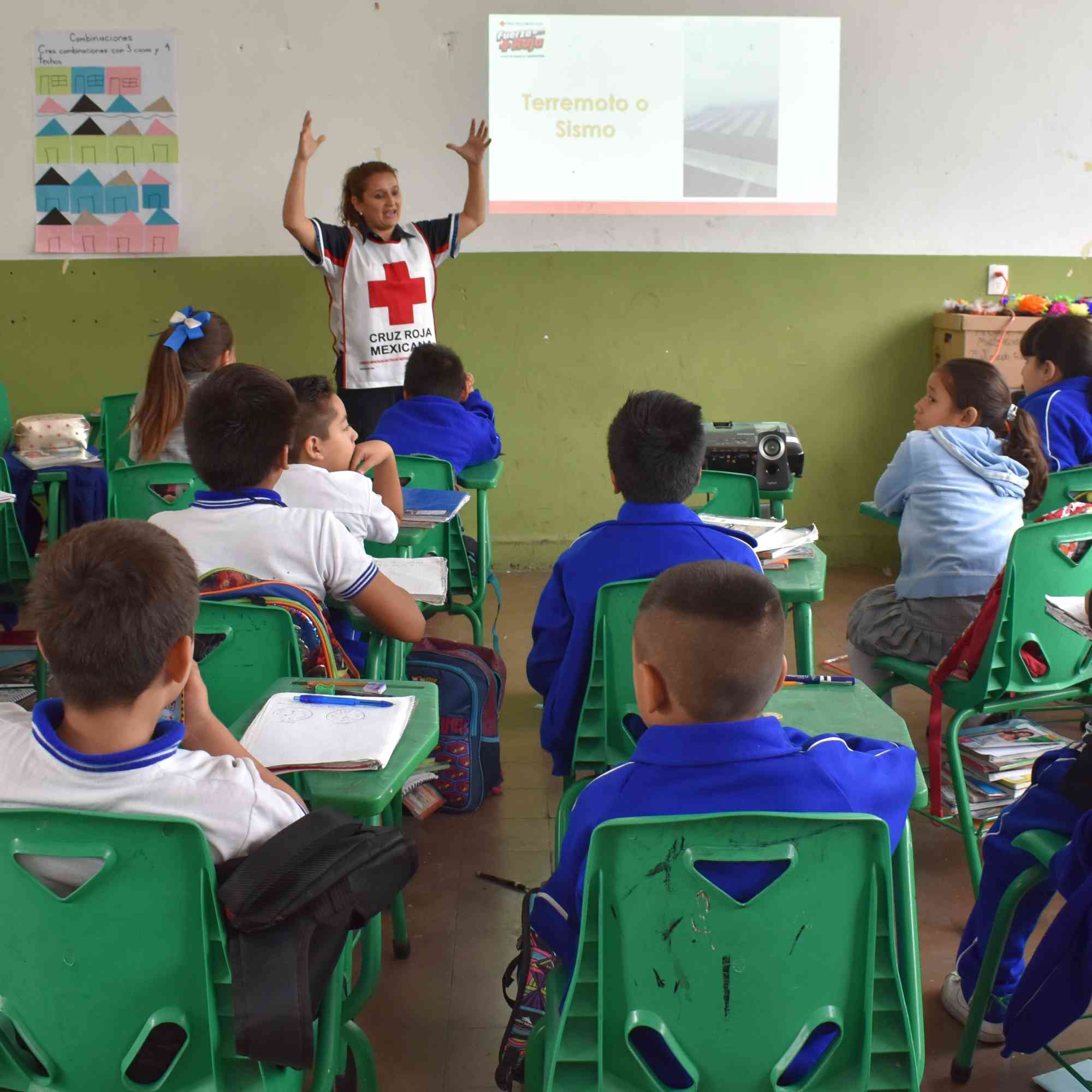
Children are at high risk of being affected by natural disasters. With this in mind, it is essential for them to acquire the knowledge and the necessary tools to protect themselves and take preventive action before, during and after a disaster takes place.

    Description

    Cruz Roja Mexicana (Mexican Red Cross) is a humanitarian institution of private assistance, which is part of the International Federation of Red Cross and Red Crescent Societies (IFRC), dedicated to preventing and alleviating human suffering to improve the living conditions of people and communities, promoting a culture of self-protection through voluntary action.

    The objective of this commitment is to provide training to the population and build a culture of resilience that will help decrease the risks associated with disasters.

    Children and teachers are trained to develop their preventive abilities in the event that natural hazards occur. At the end of the training, children are equipped to conceive action plans that will enable them to take security measures and detect vulnerable zones in their communities.
    Four modules are taught:
    1.Community education, organization and risk reduction strategies
    2.Protected schools
    3.Family preparedness plan
    4.Community based first aid training

    Did the Sendai Framework change or contribute to changes in your activities/organization? If so, how?

    Yes, the Sendai Framework for Disaster Risk Reduction promotes understanding disaster risk and enhancing disaster preparedness for effective response. The Mexican Red Cross in Nuevo Leon is committed to reduce the number of civilian casualties during a natural disaster. Children are the primary participants because we want to develop a prevention-based culture where those who have higher risk of being affected know how to act accordingly under these circumstances.

    What led you to make this commitment/initiative?

    What was your position before making this Voluntary Commitment / prior to the Sendai Framework?

    The Red Cross has as a goal to reduce the number of deaths, injuries and impact from disasters. We identified the need to tackle this global problematic, taking actions that will save lives and create resilient communities in the state of Nuevo Leon is a priority. The Sendai Framework has allowed us to set specific goals and encourage participation between local governments and civil society. Furthermore, the Sendai Framework states that “children and youth are agents of change and should be given the space and modalities to contribute to disaster risk reduction, in accordance with legislation, national practice and educational curricula.”

    Deliverables and Progress report

    Deliverables

    Deliverables are the end-products of the initiative/commitment, which can include issuance of publications or knowledge products, outcomes of workshops, training programs, videos, links, photographs, etc.

    50,000 children trained
    Intended date of delivery
    31 July 2019

    The goal for 2019 is to reach 50,000 children that will be agents of change and will lead their families and communities to take preventive actions in the event that natural disasters occur.

    Link
    https://cruzrojamonterrey.org/prevencion.php
    Trained school teachers
    Intended date of delivery
    31 July 2021

    Equipping teachers with adequate training that can further be passed on to their pupils for years to come.

    Link
    https://blog.cruzrojamonterrey.org/?p=4569
    Organizations and focal points

    Implementing Organization(s)

    • Mexican Red Cross Society - Delegation of Nuevo León

    Focal points

    If a VC's contact information has been hidden, the SFVC team can forward a message.

    Partners

    • Secretaría de Educación - Gobierno del Estado de Nuevo León

    Explore further

    Sendai priorities
    Priority 1Understanding disaster risk
    Priority 2Strengthening disaster risk governance to manage disaster risk
    Priority 3Investing in disaster risk reduction for resilience
    Priority 4Enhancing disaster preparedness for effective response, and to «Build Back Better», rehabilitation and reconstruction
    Sendai targets and indicators
    B-1 (Compound)Number of directly affected people attributed to disasters, per 100,000 population
    B-3Number of people whose damaged dwellings were attributed to disasters
    B-5Number of people whose livelihoods were disrupted or destroyed, attributed to disasters
    G-3Number of people per 100,000 that are covered by early warning information through local governments or through national dissemination mechanisms
    G-6Percentage of population exposed to or at risk from disasters protected through pre-emptive evacuation following early warning
    Hazards Cold Wave Cyclone, Hurricane and Typhoon Drought and Desertification Earthquake Flood Heatwave and Extreme Heat Landslide Storm surge Tornado Volcano Wildfire and Bushfire
    Themes Children and Youth Climate change Preparedness Education and school safety Environment and ecosystems Risk identification and assessment
    Country and region Mexico
    Sustainable Development Goals SDG3: Good health and well-being SDG4: Quality education
    Budget scale
    USD 100,000 to < 500,000
    Scope
    National (or local) - Mexico
    Scale of beneficiaries
    More than 10,000 people
    Estimated number of beneficiaries
    40,000 people
    Secured budget size
    100%
    X (Twitter)
    https://twitter.com/cruzroja_mty
    Videos
    Related links
    Webpage
    Facebook
    Instagram
    Link to program's page (Acción Roja)

    Is this page useful?

    Yes No
    Report an issue on this page

    Thank you. If you have 2 minutes, we would benefit from additional feedback (link opens in a new window).

    PreventionWeb is the global knowledge sharing platform for disaster risk reduction (DRR) and resilience.

    • Newsletter
    • Submit your content
    • Blog pitches
    • Submission and publishing policy
    • About PreventionWeb
    • Contact us

    Hazards

    • Avalanche
    • Cold Wave
    • Cyclone, Hurricane and Typhoon
    • Drought and Desertification
    • Earthquake
    • Epidemic and pandemic
    • Flood
    • Heatwave, extreme heat and heat stress
    • Insect infestation
    • Land subsidence
    • Landslide
    • Nuclear, biological, chemical (NBC)
    • Sea level rise
    • Technological hazard
    • Thunderstorm
    • Tornado
    • Tsunami
    • Volcano
    • Wildfire

    Regions

    • Africa
    • Americas
    • Asia
    • Europe
    • Oceania

    Themes

    Understanding & managing risk

    • Preparedness
    • Early warning
    • GIS and mapping
    • Data and information management
    • Risk identification and assessment
    • Small Island Developing States
    • Earth Observation

    Natural environment

    • Climate change
    • Environment and ecosystems
    • Food security and agriculture
    • Water

    Cross-cutting

    • Systemic risk
    • Recovery

    Human development

    • Capacity development
    • Children and youth
    • Civil society / NGOs
    • Community-based DRR
    • Cultural heritage
    • Gender
    • Human mobility
    • Inclusion
    • Social impacts and resilience

    Science, knowledge & advocacy

    • Disaster risk communication
    • Traditional and Indigenous knowledges
    • Science-policy-practice interface

    State, governance & economy

    • Financing DRR
    • Fragility and conflict
    • Governance
    • Insurance and risk transfer
    • Private sector

    Infrastructure & critical services

    • Critical infrastructure
    • Education and school safety
    • Health and health facilities
    • Structural safety
    • Urban risk and planning
    Loading