
Yemen’s front lines of resilience: How local action is saving lives from floods and conflict
This article is based on an Ignite Stage presentation at the 2025 Global Platform for Disaster Risk Reduction. The Ignite Stage offers fast-paced, impactful talks from diverse voices working at the forefront of disaster risk reduction.
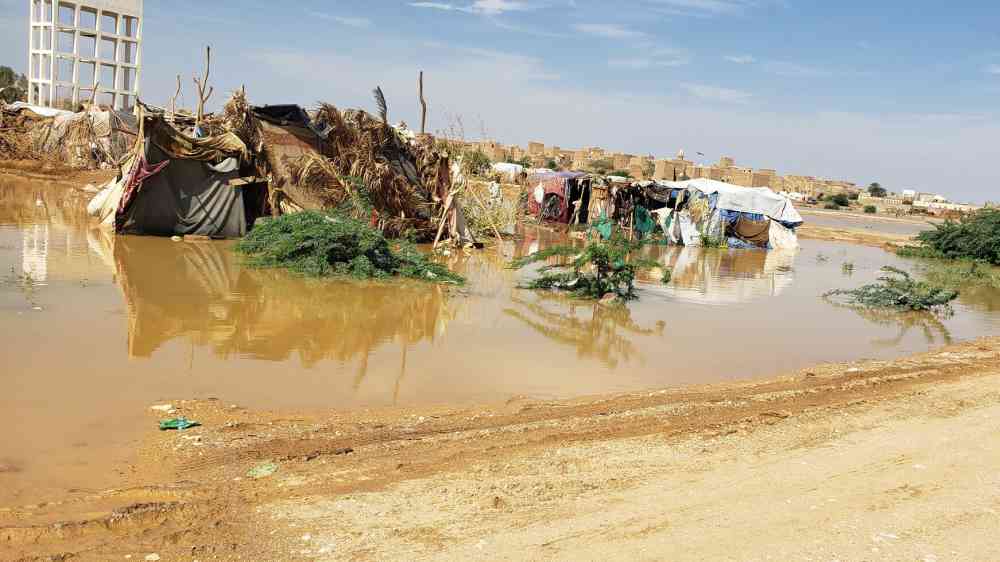
Yemen continues to face one of the world's most complex humanitarian emergencies and enduring conflict, now in its ninth year, overlaid by escalating climate shocks. More than 4 million Yemenis remain displaced, living in informal settlements often established in geographically exposed areas, such as dry riverbeds (wadis), floodplains and unprotected slopes.
Seasonal flash floods compound the vulnerability of populations already at risk. Entire shelters are inundated. Livelihoods and stored food are destroyed. Children are disproportionately affected by waterborne diseases and psychosocial trauma. While emergency assistance is vital, the recurring nature of these events underscores a systemic gap: humanitarian response is not being complemented by adequate risk reduction efforts.
Recent data from the Global Camp Coordination and Camp Management (CCCM) Cluster confirms that over 571 displacement sites across Yemen are situated in high-risk flood zones. Without anticipatory action and flood risk mitigation, these sites will continue to experience avoidable losses. As a humanitarian and development practitioner, I believe this is no longer acceptable: preparedness cannot wait for peace.

Jamal Bahaj presenting at the Ignite Stage, Global Platform for Disaster Risk Reduction 2025, Geneva, Switzerland.
Localising risk reduction: From assessment to action
At Yemen Al-Khair for Relief and Development (YARD), we have long understood that building resilience in Yemen's complex context requires local leadership, evidence-based planning and community engagement.
In early 2024, YARD, in collaboration with UNDRR, UNHCR and Yemen Shelter/CCCM Cluster, conducted comprehensive flood vulnerability assessments across displacement sites in Sana'a, Ibb, Hajjah, Al-Jawf and Sa'ada governorates. The assessments revealed a critical lack of flood mitigation infrastructure, including:
- No functional drainage systems.
- Shelters constructed on unregulated and flood-prone terrain.
- No early warning mechanisms or evacuation planning in place.
With strategic support from UNDRR, YARD was able to scale up its interventions by integrating eco-disaster risk reduction (DRR) approaches and nature-based solutions, ensuring that response efforts addressed both immediate risks and long-term climate resilience. These interventions laid the foundation for more sustainable, community-driven risk reduction in conflict-affected areas.
In response, our teams mobilized immediately. In Al-Mahzam Al-Sharqi internally displaced persons site, Al-Hazm District, Al-Jawf, we executed the design and excavation of a 2.5-kilometre engineered flood diversion channel. This infrastructure now reroutes surface water run-off away from residential clusters and into natural drainage pathways.
We also integrated eco-DRR measures into our interventions in Al-Hazm to ensure that the solutions were sustainable and climate-resilient. For example, in the flood diversion channel constructed at Al-Mahzam, we reinforced the channel's sides using locally available stones to prevent erosion, while maintaining the natural slope to facilitate the smooth flow of water into natural drainage outlets. Additionally, we built earthen and stone barriers around the site to redirect flood-water away from residential areas, which contributed to reducing long-term flood risks.
Across multiple districts in Al-Jawf, YARD further implemented transitional shelter construction, structural rehabilitation of flood-damaged homes and preventive maintenance of shelter infrastructure. These interventions were executed in close coordination with local authorities, site management actors and displaced communities.
Crucially, these efforts were not implemented for communities, but with them. We established community-based risk reduction committees, trained in early warning dissemination, basic hazard mapping and maintenance of mitigation assets. Their role is pivotal to ensuring the long-term sustainability and ownership of the protection systems.
These are not high-tech interventions, but they are technically sound, cost-effective and context appropriate.
Samaira's story: Local evidence of impact
The effectiveness of these measures is perhaps best illustrated through the experience of Samaira, a displaced mother of five residing in Al-Mahzam.
Before YARD's intervention, her family lived in a structurally compromised shelter at the camp's flood-facing edge. In spring 2024, following several days of heavy rainfall, a flash flood occurred just after midnight. As water rose rapidly, Samaira fled with her children to one of the few elevated structures nearby: the nearest school.
"I stayed up the whole night, afraid the flood would take us," she recalls. "We ran in the dark. I was certain we wouldn't survive."
That same month, YARD had completed both the 2.5 km flood diversion channel, and a protective sand berm along the camp perimeter. The infrastructure functioned as designed: diverting the flood-waters and limiting internal displacement.
"Now I sleep with peace of mind," Samaira told our team. "That trench and those barriers protect my children. I no longer fear the floods."
Following the event, YARD supported Samaira's family with elevated shelter reconstruction materials, and enrolled her in a community preparedness group. Today, she plays an active role in camp-wide risk awareness and maintenance of the drainage system.
Her story affirms what we have long argued: community-based DRR is achievable with modest resources and technical guidance, even in conflict environments.
Call to the global DRR community
Yemen's experience is a compelling case study on the need to mainstream DRR in humanitarian operations. It aligns with global frameworks such as the Sendai Framework for Disaster Risk Reduction and Early Warnings for All, yet implementation in fragile contexts remains limited.
As the international community prepares for the Global Platform for Disaster Risk Reduction (GP2025), Yemen must be recognized as both a priority and a partner. Local actors have demonstrated capacity and results. What we lack is sustained investment.
Priority actions to bridge the gap
- Donors: Integrate DRR into the core design of humanitarian financing. DRR is not an add-on - it is essential to protect humanitarian gains.
- Policymakers: Facilitate safe site planning and secure land tenure for displaced households. Embed risk-informed land-use planning in recovery and resettlement strategies.
- DRR and climate actors: Ensure conflict-affected countries are not excluded from climate adaptation and risk finance. Scale field-proven models through cross-sector technical partnerships.
Final words: Resilience is possible, but it requires commitment
Yemen's rains will return, as will its floods. But in Al-Mahzam and other camps, people are no longer helpless. Instead, they are now agents of their own protection.
The tools are simple. The stakes are high. The time to act is now.
For technical partnerships, replication support, or co-investment opportunities: Email | Website
Jamal Bahaj is the Executive Director of YARD in Yemen - Jamal is a seasoned Program and Development Specialist with over 8 years of experience in the humanitarian sector. He is the Managing Director of Yemen AlKhair for Relief and Development (YARD). With extensive expertise in program management, fundraising, and strategic planning, Jamal has played a pivotal role in implementing large-scale humanitarian projects, particularly in emergency response, WASH, education, protection, and livelihoods. Jamal has a deep understanding of Yemen’s complex humanitarian landscape and excels in navigating institutional frameworks to ensure effective aid delivery. Beyond his professional endeavors, Jamal is an advocate for capacity building and institutional growth, continuously working to enhance the impact and sustainability of humanitarian interventions in Yemen.
Editors' recommendations
- From risk to resilience: A new tool to build safer cities
- To build trust, start by listening: Introducing the Community Trust Index for early warning systems
- From warnings to action: How Makati is building a resilient future with MAWARI
- Risk communication for early action in Barbados: Findings, learnings and opportunities for scale
- Glacier-related disaster risk reduction: Enhancing resilience from mountains to valleys
- Glacier-related disaster risk reduction: Enhancing resilience from mountains to valleys
- CoastalSense: Empowering community with low-cost technology for coastal resilience
- Ni-Vanuatu women leading inclusive disaster risk reduction and response