
Ni-Vanuatu women leading inclusive disaster risk reduction and response

This article is based on an Ignite Stage presentation at the 2025 Global Platform for Disaster Risk Reduction. The Ignite Stage offers fast-paced, impactful talks from diverse voices working at the forefront of disaster risk reduction.
One of the greatest achievements I have witnessed while working in disaster risk reduction (DRR) is the power of diverse ni-Vanuatu women coming together to strengthen women's participation and leadership in humanitarian architecture and enable gender transformative change in the community.
A South Pacific Ocean island archipelago originally formed millions of years ago through volcanic eruptions, Vanuatu has been assessed as the country at most risk to natural hazards. Each month, there can be as many as six or seven hazards occurring within the country's area of responsibility, including flooding, earthquakes, landslides, inland and maritime strong winds, king tides, tropical cyclones and more.
In Vanuatu, women have traditionally been marginalized and oppressed on account of our gender. For decades we have been pushed to the kitchen, prevented from fully participating in society and claiming space in leadership. Women and girls with disabilities experience even greater barriers. They are forgotten by society, considered burdens. When natural hazards strike, these inequalities deepen, exposing women and girls to heightened vulnerability and harm.
But change is happening, and it is being led by ni-Vanuatu women as, first responders and front liners in time of crises.

Woman as first responders to Twin Cyclone in Port Vila, Vanuatu
Women I Tok Tok Tugeta
The Women I Tok Tok Tugeta (WITTT) network, established by ActionAid Vanuatu in 2015, has become a lifesaving network for our women and girls. Building strategic partnerships with government and the private sector is crucial for the WITTT network. It is more than a programme - it's a movement. It creates a safe space for ni-Vanuatu women and girls, including those with disabilities, to identify their own protection issues and find short- and long-term solution to their issues in order to be self-resilient. It allows them to share their good practices among themselves, and establishes an economic hub to address financial violence and decrease gender-based violence, something the majority of ni-Vanuatu women have faced.
The figures are powerful. WITTT has rapidly grown from 3,000 to 10,000 members, including women with disabilities who have established their own platform with 1000 members, WITTT Sunshine. Their leadership has been transformative, not just for them, but for their entire communities. Men are starting to recognize and respect their leadership. Chiefs, for the first time, are considering involving women in decision-making. One village now includes two WITTT community mobilizers in its council. Within such a patriarchal society, this is history in the making.
The WITTT network has also created another platform, which functions as a communication system for a multi-hazard early-warning system: Women Wetem Weta (WWW). Through WWW, diverse ni-Vanuatu women are now trained in early warning preparedness to address the impacts of climate crises and increase knowledge on DRR. It has proven that for every dollar we invest on early warning preparedness, we save 4 dollars on humanitarian action.
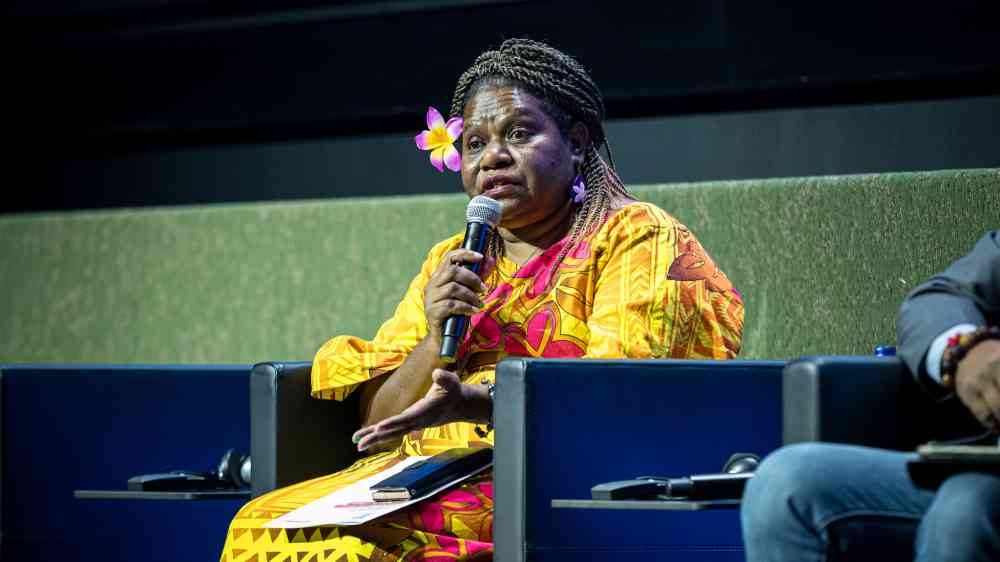
Flora Vano speaking to the audience at the 2025 Global Platform for Disaster Risk Reduction, in Geneva, Switzerland.
Lessons learned
Ni-Vanuatu women, including disabled women, are also being trained on nature-based solutions to build resilience to climate change and its associated hazards. Women are now using a range of agroecology techniques, including planting vetiver grass for stabilization of slopes and riverbanks, composting and crop rotation of suitable non-invasive species. Resilience is built through the establishment of demonstration plots and seed banks.
The success of the WITTT network offers powerful lessons for others working in DRR and community resilience. It shows what is possible when DRR is driven by a strong, inclusive feminist movement. When women are united, resourced and trusted to lead, they drive gender-transformative change.
WITTT has built a model that is not only effective but also sustainable. This is not a programme that is dependent on external actors - it is a movement rooted in local leadership, local knowledge and solidarity between ni-Vanuatu women. We ni-Vanuatu women are the knowledge holders. ActionAid will one day leave Vanuatu, but the WITTT network movement will continue to thrive, because we the local Indigenous women own it and lead it, all without leaving no one behind. We believe in resilience as a way of life.
Flora Vano is the Country Manager of ActionAid Vanuatu, an organisation that supports local women to become galvanising and powerful community leaders, particularly in times of crisis such as disasters. Flora joined the organisation in 2017 from a management role in the Tourism Sector. She joined to support the team in addressing the impacts of Tropical Cyclone Pam and has continued to date. Flora has played a critical role in setting up the Vanuatu country office as well as starting up programs led by local women providing leadership to the start-up of Women I TokTok Tugeta Forums, the platform and safe space for diverse, inclusive Ni-Vanuatu women to organise and strategise.
Editors' recommendations
- CoastalSense: Empowering community with low-cost technology for coastal resilience
- From warnings to action: How Makati is building a resilient future with MAWARI
- Yemen’s front lines of resilience: How local action is saving lives from floods and conflict
- From risk to resilience: A new tool to build safer cities
- To build trust, start by listening: Introducing the Community Trust Index for early warning systems
- Risk communication for early action in Barbados: Findings, learnings and opportunities for scale
- Glacier-related disaster risk reduction: Enhancing resilience from mountains to valleys