
From risk to resilience: A new tool to build safer cities
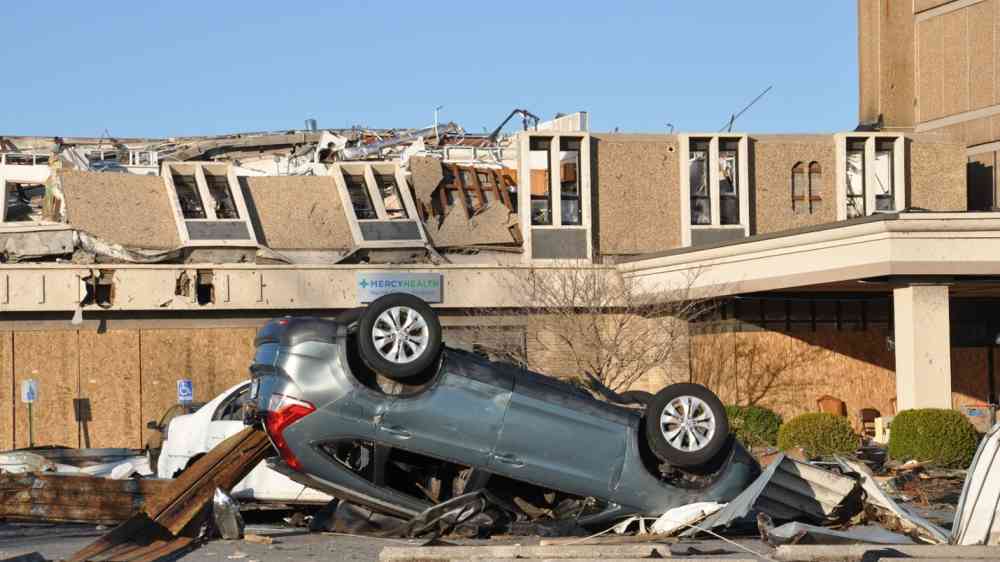
Mercy health centre after a tornado in Mayfield, Kentucky in December 2021.
This article is based on an Ignite Stage presentation at the 2025 Global Platform for Disaster Risk Reduction. The Ignite Stage offers fast-paced, impactful talks from diverse voices working at the forefront of disaster risk reduction.
What changed when I saw risk through a builder's eyes
The day was 11 December 11 2021. I was walking through a community in Mayfield, Kentucky after a major tornado. The school was still standing, but a health centre had barely its ground floor left.
What struck me wasn't the debris. Rather, it was how much worse it could have been, if not for the few buildings that had been retrofitted. They had better anchors and higher foundations, and stayed dry when others were inundated by the flood-water that accompanied the tornado. That was the moment I realized that resilience in the building sector isn't just about engineering - it's about saving lives and protecting futures.
At the International Finance Corporation (IFC), we've heard stories like this again and again. And we asked ourselves: what if we could help every developer, financier and planner see what we saw?
A gap in the blueprint: Where resilience is still missing
Green buildings have made real progress over the past decade. At IFC, our Excellence in Design for Greater Efficiencies (EDGE) green building programme has helped to certify thousands of energy- and resource-efficient buildings. But one crucial piece of the puzzle has lagged behind: resilience.
Too often, climate adaptation is treated as an afterthought. We know what happens next-flooded homes, collapsed hospitals, shuttered schools. In many low- and middle-income countries, construction is booming in hazard-prone areas, but there's little data to guide better decisions. Governments, banks, insurers and developers all speak different languages when it comes to risk.
And when disaster strikes, rebuilding eats up public budgets, insurance payouts and entire communities' savings.
So we built a programme: The Building Resilience Index
That's why we created the Building Resilience Index (BRI) - a free, digital tool to assess and disclose a building's exposure to hazards like floods, earthquakes and cyclones. Developed with support from the Governments of Australia and the Netherlands, BRI uses a standardized letter-grade system to show how resilient a building is.
The BRI isn't just for high-rises in capital cities. It works for schools, clinics, offices and homes. We piloted it in the Philippines, one of the world's most hazard-exposed countries. A major local bank is now using it to assess climate risk across its real estate portfolio. Local officials are considering how to integrate the BRI into zoning and permitting.
What makes it so powerful is that the BRI translates engineering assessments into plain language - so anyone, anywhere, can see the strengths and gaps in a building's design and location.
More than a score: Creating a common language for resilience
Resilience isn't built in isolation. With the BRI, we're bringing together:
- Financial institutions, which can now screen investments and reduce exposure to high-risk assets.
- Insurance companies, which can better price risk and encourage safer construction.
- Governments and regulators, which can align building codes with real-world risks.
- Developers, which can use BRI to demonstrate that their buildings are not just green, but safe.
- It's not just about a rating - it's about setting a market signal. When you can measure resilience, you can manage it. And when investors and insurers start asking for BRI scores, the whole system begins to shift.
Scaling resilience: Skills, systems and incentives
Of course, a tool is only as useful as the people using it. That's why we're working with training institutes, design professionals and local governments to build capacity across the value chain. We're helping:
- Architects and engineers to design with resilience in mind.
- City officials to use BRI to guide permitting and planning.
- Developers to access finance for retrofits or resilient new builds.
- Insurance firms to connect risk scores with premium models.
We also see huge potential in aligning BRI with green building certifications, environmental, social and governance (ESG) frameworks, and climate finance. When resilience becomes part of a project's DNA, it stops being a checkbox and starts being a competitive advantage.
What's next - and how you can be part of it
As we head into an era of accelerating hazards, the cost of delay is rising. But so is the opportunity. We believe that resilience is the next frontier for the building sector - and it must be led by collaboration.
The BRI is not just a product; it's a platform for dialogue. We invite cities, banks, insurers and builders to use it, test it, challenge it and help it grow.
Because we know one thing for sure: when we invest in resilience now, we save far more later, in lives, livelihoods and infrastructure that lasts.
Let's build that future together.
Ommid Saberi serves as the Global Lead for the Building Resilience Index Program and co-lead for IFC's EDGE Green Buildings Program. Additionally, he co-chairs the Finance Hub of the Global Alliance for Building and Construction. In his role, Ommid collaborates on various projects within the World Bank Group, including IFC investment and advisory initiatives. He has conducted extensive work with the property sector, as well as with funds and commercial banks, to redirect investments towards climate-smart and resilient projects. Notable examples of his work include green affordable housing projects in Africa, zero-carbon commercial assets, portfolio retrofits, green construction finance, and green mortgages, with a total value exceeding US$15 billion. Prior to joining IFC, Ommid provided advisory services on sustainability strategies for property development projects in the U.K., Middle East, and Asia. His work included the development of green building codes for multiple countries. Ommid has also served on regional government advisory panels as an expert in low-energy buildings and has held the position of Technical Director for Energy Conservation at the city scale.
Diep Nguyen-van Houtte is Senior Manager for Innovation and Business Development at the International Finance Corporation (IFC). In this role, she is also Chief Innovation Officer and Chief Operations Officer for key portfolios across industries at the IFC, including green and resilient buildings/real estate, green and resilient cities, energy efficiency, energy transition, methane reduction, and transport and industrial decarbonization. She also co-developed the Early Project Development line of business for Infrastructure and Natural Resources at IFC. Before joining IFC, Ms. Nguyen-van Houtte worked for 17+ years as Lead Technical Specialist and Chief Investment Officer at the World Bank. She has worked on more than 40 countries in multiple World BankGroup regions, and has provided or facilitated billions in financing to development projects in emerging markets.
Editors' recommendations
- From warnings to action: How Makati is building a resilient future with MAWARI
- To build trust, start by listening: Introducing the Community Trust Index for early warning systems
- Yemen’s front lines of resilience: How local action is saving lives from floods and conflict
- Risk communication for early action in Barbados: Findings, learnings and opportunities for scale
- Glacier-related disaster risk reduction: Enhancing resilience from mountains to valleys
- CoastalSense: Empowering community with low-cost technology for coastal resilience
- Ni-Vanuatu women leading inclusive disaster risk reduction and response