CoastalSense: Empowering community with low-cost technology for coastal resilience

This article is based on an Ignite Stage presentation at the 2025 Global Platform for Disaster Risk Reduction. The Ignite Stage offers fast-paced, impactful talks from diverse voices working at the forefront of disaster risk reduction.
Indonesia's coastal communities face mounting threats: natural hazards, climate change and outdated data. With over 53,000 villages at risk, how can locals protect their homes and ecosystems?
Home to the world's largest mangrove forests, Indonesia also faces severe hazards from mangrove deforestation caused by land conversion, logging and climate change impacts. These ecosystems are critical for coastal protection, biodiversity and carbon sequestration.
CoastalSense, an initiative by U-INSPIRE Indonesia, uses low-cost, community-led technology to deliver real-time data for disaster resilience, empowering villages to take charge of their future.
The power of youth and young professionals in DRR and climate resilience
U-INSPIRE Indonesia is a platform for youth and young professionals in the fields of science, engineering, technology and innovation. It aims to accelerate disaster risk reduction (DRR) policy and action at local, national and international levels, in line with the Sendai Framework.
The journey began in March 2018, when a group of young scientists and other professionals gathered at the UNESCO office in Jakarta. The meeting aimed to determine how they could make significant changes for DRR in their professional roles. The discussion led to the establishment of U-INSPIRE in May 2018.
U-INSPIRE's primary focus for 2024-2026 is to empower communities to take action and to generate valuable observation data sets at the village level. This ambitious goal requires collaboration across broad swathes of society. That's why U-INSPIRE's initiatives are intended to understood and replicated as easy as 1, 2, 3.
The data dilemma in Indonesia
Of the nearly 80,000 villages across the archipelago, 53,000 are at high or medium risk of disasters, including earthquakes (45,000 villages) and climate-related hazards like tsunamis (5,744 villages). However, the accurate, real-time data which is vital to protecting these communities, is often elusive.
There are three major challenges faced in Indonesia.
First, many government-owned observation sensors have been inactive for years due to high maintenance costs, especially for coastal monitoring sensors.
Second, during disasters, Internet connectivity is often disrupted, limiting access to crucial, time-sensitive information.
Third, outdated data means outdated responses - strategies that no longer align with current conditions on the ground.
CoastalSense: An innovative solution with community-led approach
Imagine a world where communities have the tools to protect their coastal areas from natural hazards and climate change.
CoastelSense, a homegrown initiative from U-INSPIRE Indonesia, aims to empower local communities and organizations in proactively managing the effects of climate and natural hazards. Using low-cost, locally operated technology, CoastalSense delivers real-time, village-level data on wave activity, weather patterns and environmental changes - without relying on the national electricity grid or Internet connectivity.
More than just technology, CoastalSense is a movement. It puts communities at the heart of disaster preparedness by:
- Centring local voices: Communities actively participate in decision-making, ensuring solutions reflect their needs.
- Driving action with data: Real-time insights enhance disaster preparedness and response strategies.
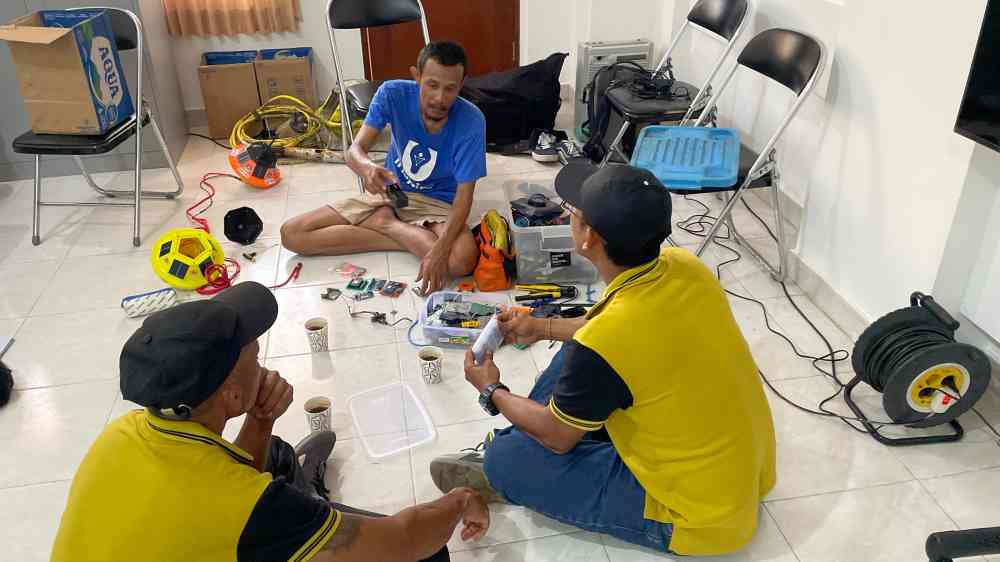
- Promoting the right to repair: Locals are equipped with tools and knowledge to build, maintain and repair sensors, fostering self-reliance.
The initiative also emphasizes collaboration. By partnering with local communities, curious makers, non-governmental organizations and universities, CoastalSense creates a vibrant ecosystem of stakeholders working together to protect Indonesia's coastal regions.

How does it work?
CoastelSense gathers village-level data with fine-grained detail, captured at intervals of seconds.
By capturing hyperlocal data, CoastalSense bridges the gap between missing information and informed decision-making. This solution contributes to more accurate risk analysis and helps shape better DRR and climate resilience strategies in vulnerable areas across Indonesia.
Join U-INSPIRE Indonesia and our CoastalSense journey, to empower communities and generate valuable data for informed decision-making.
Giovanni Cynthia Pradipta is passionate about DRR and geographic information systems, with a focus on applying these tools to understand risk and strengthen community-based resilience - particularly in earthquake- and tsunami-prone areas. She currently serves as the Lead of U-INSPIRE Indonesia.
Hilman Arioaji, a dynamic generalist and Co-Lead of U-INSPIRE Indonesia, is driven by a passion for DRR through innovative, low-cost Internet of Things solutions. His work empowers communities by developing accessible technologies that enhance coastal resilience, fusing technical expertise with a commitment to inclusive, community-driven impact.
Ida Bagus Oka Agastya has a background in geology, DRR and community engagement. He currently serves as the Coordinator of Human Resources at U-INSPIRE Indonesia.
Ni Nyoman Era Jumantini is passionate about environmental and disaster anthropology, with a background in community engagement. She focuses on empowering local communities through participatory approaches to DRR. She currently serves as the Internal Coordinator of U-INSPIRE Indonesia, contributing to youth-led innovation and collaboration in disaster resilience.
Editors' recommendations
- Glacier-related disaster risk reduction: Enhancing resilience from mountains to valleys
- Risk communication for early action in Barbados: Findings, learnings and opportunities for scale
- To build trust, start by listening: Introducing the Community Trust Index for early warning systems
- From risk to resilience: A new tool to build safer cities
- Yemen’s front lines of resilience: How local action is saving lives from floods and conflict
- From warnings to action: How Makati is building a resilient future with MAWARI
- Ni-Vanuatu women leading inclusive disaster risk reduction and response