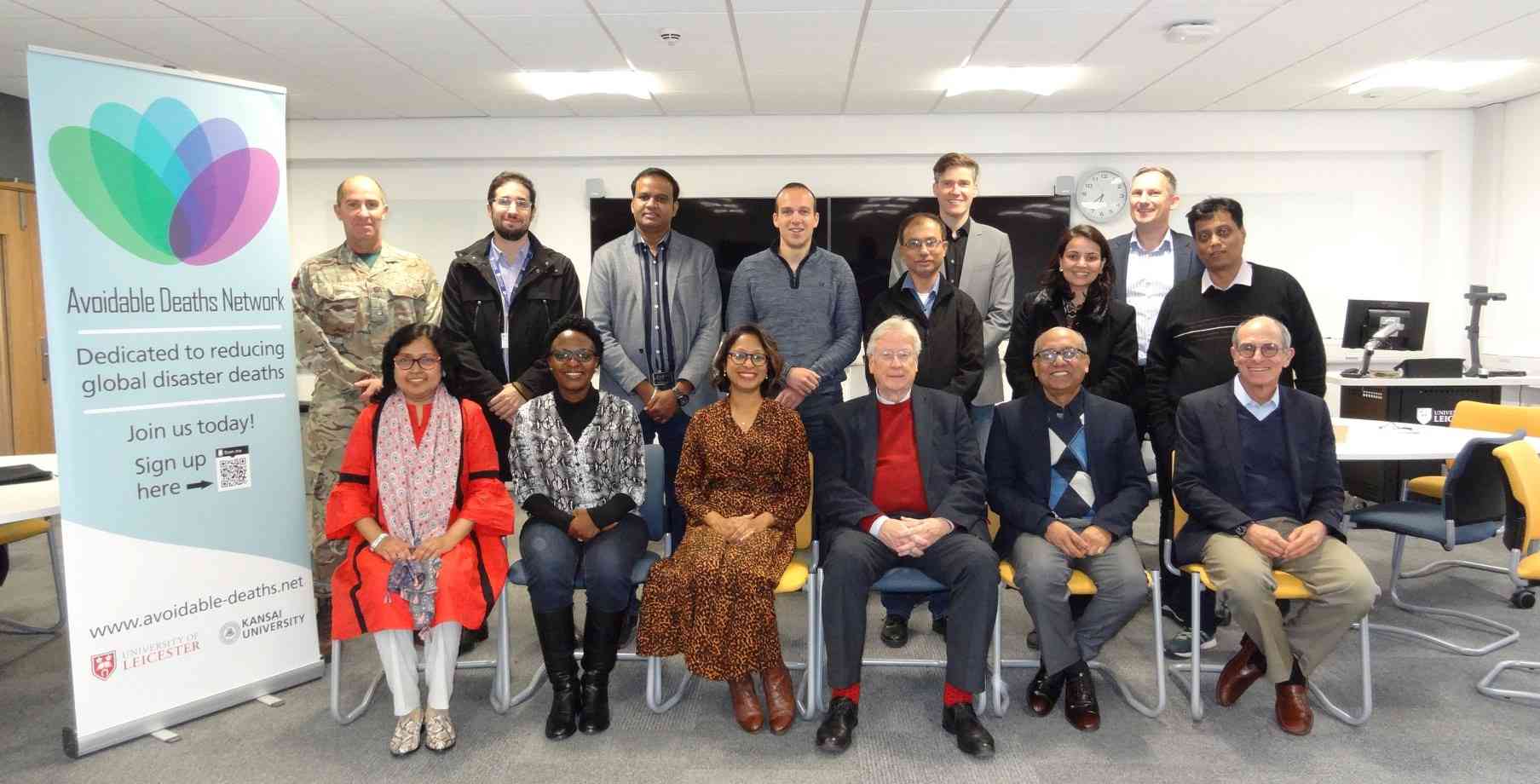
Avoidable Deaths Network (ADN)
ADN provides a dynamic forum for experts, practitioners, researchers and organisational partners to identify and promote theoretical and practical solutions to reducing avoidable disaster deaths.
Description
The Avoidable Deaths Network (ADN) is a diverse, dynamic, inclusive and innovative global membership network dedicated to avoiding human deaths from natural hazards, naturally triggered technological hazards and human-made disasters in low- and middle-income countries. The ADN is led by the Universities of Leicester and Kansai. The ADN was founded by Dr. Nibedita S. Ray-Bennett (Associate Professor in Risk Management, University of Leicester) and Dr. Hideyuki Shiroshita (Associate Professor in Disaster Education, Kansai University) in 2018, and was officially launched at the Global Alliance of Disaster Research Institutes (GADRI) in Kyoto on the 12th of March 2019.
Most deaths due to disasters are avoidable. Avoidable deaths are those amenable, preventable, or both- where each death is counted only once (Cook, 2019). Amenable or treatable deaths can be avoided due to timely and effective health care interventions. Timeliness involves reducing waits and sometimes harmful delays for both those who receive and those who give care while effectiveness refers to providing services based on scientific knowledge to all who could benefit and refraining from providing services to those not likely to benefit (avoiding underuse and overuse) (NAS, 2001). Preventable deaths can be avoided through public health measures, disaster management science and weather forecasting systems, improved human-built environment – among other measures. Both amenable and preventable deaths can be further avoided through robust and effective disaster risk governance.
Nonetheless, avoidable deaths continue to occur despite advancements in amenable, preventable and governance measures globally. However, they are most severely felt in low-and middle-income countries (Coppola, 2011; DFID, 2013; Ray-Bennett, 2017a, 2017b).
The ADN aims to promote interdisciplinary collaboration between the arts, humanities, social sciences, life sciences, natural sciences and engineering wherever possible, in order to generate empirically grounded solutions that can support government officials, UN systems and other institutions to reduce the incidence of deaths.
Did the Sendai Framework change or contribute to changes in your activities/organization? If so, how?
The formation of the ADN is timely and is directly related to the UN’s current ambitions. In 2015, the Sendai Framework for Disaster Risk Reduction 2015-2030 adopted seven Global Targets. AND particularly aims at contributing to the first two Targets are: (a) Substantially reduce global disaster mortality by 2030, aiming to lower average per 100,000 global mortality rate in the decade 2020-2030 compared to the period 2005-2015. (b) Substantially reduce the number of affected people globally by 2030, aiming to lower the average global figure per 100,000 in the decade 2020 -2030 compared to the period 2005-2015.
What led you to make this commitment/initiative?
What was your position before making this Voluntary Commitment / prior to the Sendai Framework?
Through its agenda of avoidable deaths, the ADN addresses the Sendai targets and other goals by gathering evidence to “build the knowledge of government officials at all levels, civil society, communities and volunteers, as well as the private sector, through sharing experiences, lessons learned, good practices and training and education on disaster risk reduction, including the use of existing training and education mechanisms and peer learning” (UNISDR, 2015, p. 15). The ADN is inspired by Dr. Nibedita S. Ray-Bennett’s monograph on Avoidable Deaths: A Soft-Systems Approach to Disaster Risk Management (Springer Nature, 2017). Dr. Nibedita S. Ray-Bennett and Dr. Hideyuki Shiroshita met at Northumbria University’s Disaster and Development Centre (DDC) in 2007. Since then, they have collaborated in a number of research projects.
Deliverables and Progress report
Deliverables
Deliverables are the end-products of the initiative/commitment, which can include issuance of publications or knowledge products, outcomes of workshops, training programs, videos, links, photographs, etc.
This report documents the activities undertaken by the members of the ADN from 1 August 2020 to 31 July 2021. Members consist of ADN’s Core Team, Advisory Board, Regional Coordinators and Interns.
This report documents the activities undertaken by the members of the ADN from 1 August 2021 to 31 July 2022. Members consist of ADN’s Core Team, Advisory Board, Regional Coordinators and Interns.
This report documents the activities undertaken by the members of the ADN from 1 August 2022 to 31 July 2023. Members consist of ADN’s Core Team, Advisory Board, Regional Coordinators and Interns.
Develop lifesaving tools, kits, interventions, innovative technologies, governance models and theories to reduce the burden of maternal mortality, snakebite mortality, drowning mortality during disasters, and tsunami mortality through evidence-based pioneering research on hazards, exposures, vulnerability and risks.
Develop capacities of disaster responders and other stakeholders, through continuing professional development courses, knowledge exchange events and an information repository.
Foster trans-disciplinary ideas, partnerships and solutions to reduce avoidable disaster deaths and people affected by disasters for sustainable development in low-and middle-income countries, through knowledge exchange events (conferences, symposiums and webinars).
Foster trans-disciplinary ideas, partnerships and solutions to reduce avoidable disaster deaths and people affected by disasters for sustainable development in low-and middle-income countries, through knowledge exchange events (conferences, symposiums and webinars).
Nurture future leaders for Avoidable Deaths and improve their leadership and employability skills, through expert mentoring and engaging Interns for activities related to 1-5.
Raise visibility and awareness of the Sendai Framework’s first two targets, through publications, and knowledge exchange events.
Strengthen connections between disaster responders, through leveraging existing and promoting novel networking platforms.
Develop capacities of disaster responders and other stakeholders, through continuing professional development courses, knowledge exchange events and an information repository.
Develop lifesaving tools, kits, interventions, innovative technologies, governance models and theories to reduce the burden of maternal mortality, snakebite mortality, drowning mortality during disasters, and tsunami mortality through evidence-based pioneering research on hazards, exposures, vulnerability and risks.
Nurture future leaders for Avoidable Deaths and improve their leadership and employability skills, through expert mentoring and engaging Interns for activities related to 1-5.
Raise visibility and awareness of the Sendai Framework’s first two targets, through publications, and knowledge exchange events.
Strengthen connections between disaster responders, through leveraging existing and promoting novel networking platforms.
Porgress report
From January to July 2025, ADN has contributed substantially to increasing the visibility and research around avoidable disaster deaths (Sendai Targets A & B). We delivered 12 knowledge-exchange sessions, five of which were at the UNOCHA’s Humanitarian Partnerships Week in Geneva. We published a research monograph, ‘Avoiding Disaster Deaths’ (Springer Nature), a journal article ‘Verbal Autopsy Instruments for ‘Causes and Circumstances’ Surrounding Drowning Deaths in LMICs’, concluded the ESRC-IAA and Commercialisation-funded project on prototyping two life-saving Facilities and Crisis Reproductive Health Kits, secured two new grants from ESRC, and continued progress with our other projects.
- Published the ADN’s Sixth Annual Report 2024/25.
- Throughout March, 20 countries celebrated the second year of the ADN’s global campaign ‘International Awareness Day for Avoidable Deaths’.
- Secured ESRC-AHRC SHAPE Catalyst fund for the ‘Facility and Mobile Reproductive Health Kits for Disasters and Crises’ (March 2025 - March 2026)
- Secured ESRC-Commercialisation fund to pilot the ‘Facility and Mobile Reproductive Health Kits for Disasters and Crises’ in Bangladesh (December 2025-December 2026)
- ADN became a Member of the Santiago Network for Loss and Damage.
- ADN’s collaborator, All India Disaster Mitigation Institute, launched the Ahmedabad Case Station for Avoidable Heatwave Deaths.