My account
Navigation loading…

Navigation failed to load. If you are on the UNDRR office network, your browser may be blocking access to external resources. Learn how to allow access.

Menu
Your experience on PreventionWeb

Please help us improve PreventionWeb by taking this brief survey. Your input will allow us to better serve the needs of the DRR community.

See the survey

Published on
10 November 2022
Status
Progress not updated

Development of MSME Disaster Resilience Tools for the Philippines

Expected duration
Feb 2022 - Jun 2022
SFVC commitment ID
20221110_001
Version
1.0
Upload your content

PDRF, through the Philippine Preparedness Partnership (PHILPREP), developed tools to increase the awareness of MSMEs to prepare for, respond to, and recover from disasters in the Philippines thereby strengthening disaster resilience of MSMEs in the Philippines.

    Description

    Recognizing the significant role of micro, small, and medium enterprises (MSMEs) in the overall disaster resilience of the country, Philippine Disaster Resilience Foundation (PDRF), through the Philippine Preparedness Partnership (PHILPREP) developed tools that will cater to the needs of the business sector and will guide them in preparing for, responding to, and recovering from disasters.

    PDRF developed these tools as part of the Asian Preparedness Partnership (APP) PHILPREP, the localized tripartite platform represented by the key societal actors from the government (Office of Civil Defense), the private sector (PDRF), and the civil society (Center for Disaster Preparedness). APP PHILPREP is supported by the Asian Disaster Preparedness Center (ADPC) and the Bill and Melinda Gates Foundation.

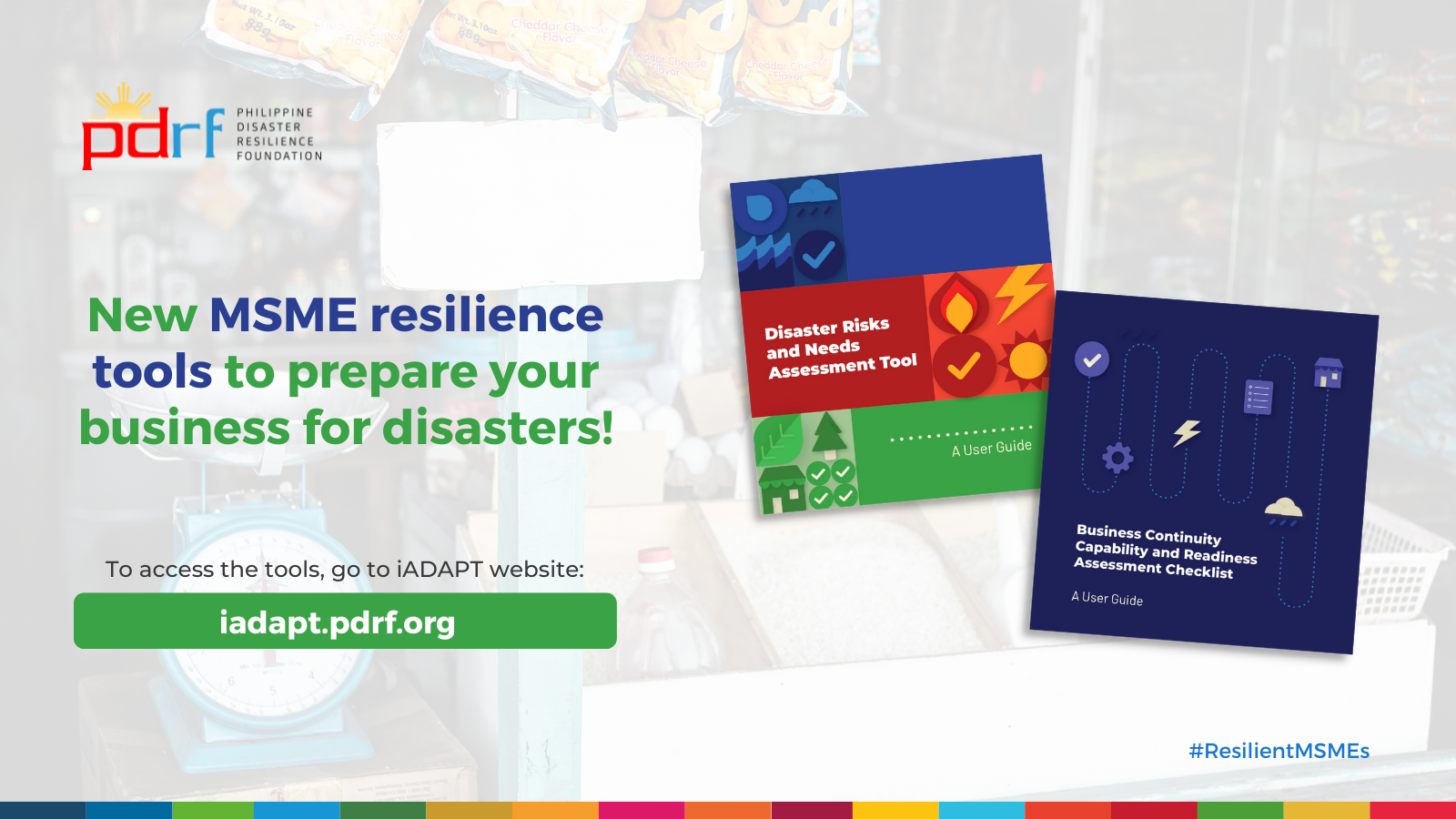
    Inputs and activities required to develop these tools included project funding, technical writers, validation, and FGDs with MSMEs and MSME enablers on disaster resilience, project management and tool development. Through this, the Disaster Risks and Needs Assessment Checklist and the Business Continuity Capability Checklist were produced. The Disaster Risks and Disaster Preparedness Needs Assessment Checklist is designed for MSMEs to measure their vulnerability to disaster risks and ascertain their own needs in terms of knowledge, skills, and resources to avoid, reduce, or mitigate the impacts of disasters in their businesses. The Business Continuity Capability Checklist aims to help MSME owners and managers how to self-accomplish the business continuity capability and readiness assessment checklist.

    Did the Sendai Framework change or contribute to changes in your activities/organization? If so, how?

    As an alliance of businesses dedicated to building the disaster risk management capabilities of the private sector in the country, PDRF both contributes to and is guided by the Sendai Framework for Disaster Risk Reduction.

    This project is also one of the good practices of ARISE, the Private Sector Alliance for Disaster the Private Sector Alliance for Disaster Resilient Societies. It addresses two ARISE commitments, namely, raising awareness with respect to disaster risk and mobilization of private sector, and sharing knowledge, experience and good practices amongst the private sector.

    What led you to make this commitment/initiative?

    What was your position before making this Voluntary Commitment / prior to the Sendai Framework?

    MSMEs account for more than 99% of registered businesses in the Philippines and 67% of the workforce. They are the backbone of the economy and are also among the hardest-hit by disasters. Given their significant contributions, they play a crucial role in building back stronger.

    MSMEs who wish to avail trainings on Disaster Risks and Business Continuity Planning need to sign up with the relevant government agencies or other DRR organizations. Oftentimes, these might take time, money and effort for the MSMEs, resources which they don't have that much luxury since they are busy managing their businesses. Other MSMEs might not be aware also of the importance of assessing their risks in terms of disaster and how having a business continuity plan in place can prevent or reduce losses for their business. Through the MSME Resilience Tools, which are available online at https://iadapt.pdrf.org/PHILPREPTools/, MSMEs can answer the checklists and they will know their risk and resilience index at the end of the tool.

    Deliverables and Progress report

    Deliverables

    Deliverables are the end-products of the initiative/commitment, which can include issuance of publications or knowledge products, outcomes of workshops, training programs, videos, links, photographs, etc.

    Disaster Risks and Needs Assessment Tool
    Intended date of delivery
    31 May 2022

    This Disaster Risks and Disaster Preparedness Needs Assessment Checklist is designed for MSMEs to measure their vulnerability to disaster risks and ascertain their own needs in terms of knowledge, skills, and resources to avoid, reduce, or mitigate the impacts of disasters in their businesses.

    Link
    https://iadapt.pdrf.org/msme-tools/disaster-risks-and-needs-assessment-tool
    Business Continuity Capability Checklist for MSMEs with existing BCP
    Intended date of delivery
    30 June 2022

    For MSMEs with an existing business continuity plan (BCP), the tool will serve as an internal audit and quality check regarding the contents, processes, procedures, and protocols observed by MSMEs in ensuring business continuity amidst the aftermath of a disaster.

    Link
    https://iadapt.pdrf.org/msme-tools/business-continuity-capability-checklist-for…
    Business Continuity Capability Checklist for MSMEs without existing BCP
    Intended date of delivery
    30 June 2022

    For those MSMEs that do not have an existing Business Continuity Plan (BCP), the checklist will help them assess their readiness to come up with their own BCP and will also serve as a menu of protocols, procedures, and processes that they can adopt if these are not existing in the organization.

    Link
    https://iadapt.pdrf.org/msme-tools/business-continuity-capability-checklist-for…
    Organizations and focal points

    Implementing Organization(s)

    • Philippine Disaster Resilience Foundation

    Focal points

    If a VC's contact information has been hidden, the SFVC team can forward a message.

    Partners

    • Bill and Melinda Gates Foundation
    • Office of Civil Defense (Philippines)
    • Center for Disaster Preparedness
    • United States Agency for International Development (USAID)
    • Asian Disaster Preparedness Center

    Explore further

    Sendai priorities
    Priority 1Understanding disaster risk
    Priority 3Investing in disaster risk reduction for resilience
    Sendai targets and indicators
    C-1 (Compound)Direct economic loss attributed to disasters in relation to global gross domestic product
    D-1 (Compound)Damage to critical infrastructure attributed to disasters
    G-6Percentage of population exposed to or at risk from disasters protected through pre-emptive evacuation following early warning
    Hazards Avalanche Cyclone, Hurricane and Typhoon Drought and Desertification Earthquake Epidemic and Pandemic Flood Heatwave and Extreme Heat Insect infestation Landslide NBC - Nuclear, Biological, Chemical Storm surge Tornado Tsunami Volcano Wildfire
    Themes Capacity development Preparedness Private sector Risk identification and assessment Social impacts and social resilience
    Country and region Philippines
    Sustainable Development Goals SDG8: Decent work and economic growth SDG10: Reduced inequalitities SDG13: Climate action
    Budget scale
    USD 5,000 to < 10,000
    Scope
    National (or local) - Philippines
    Scale of beneficiaries
    2,000 to < 5,000
    Secured budget size
    100%
    Umbrella initiative(s)
    UNDRR Private Sector Alliance for Disaster Resilient Societies (ARISE); ARISE: Small and Medium Enterprises (SMEs)
    X (Twitter)
    https://twitter.com/ThePDRF?ref_src=twsrc%5Egoogle%7Ctwcamp%5Eserp%7Ctwgr%5Eauthor
    Related links
    PDRF's iADAPT Website
    News Article: PDRF, partners launch new digital tools to help MSMEs prepare for…

    Is this page useful?

    Yes No
    Report an issue on this page

    Thank you. If you have 2 minutes, we would benefit from additional feedback (link opens in a new window).

    PreventionWeb is the global knowledge sharing platform for disaster risk reduction (DRR) and resilience.

    • Newsletter
    • Submit your content
    • Blog pitches
    • Submission and publishing policy
    • About PreventionWeb
    • Contact us

    Hazards

    • Avalanche
    • Cold Wave
    • Cyclone, Hurricane and Typhoon
    • Drought and Desertification
    • Earthquake
    • Epidemic and pandemic
    • Flood
    • Heatwave, extreme heat and heat stress
    • Insect infestation
    • Land subsidence
    • Landslide
    • Nuclear, biological, chemical (NBC)
    • Sea level rise
    • Technological hazard
    • Thunderstorm
    • Tornado
    • Tsunami
    • Volcano
    • Wildfire

    Regions

    • Africa
    • Americas
    • Asia
    • Europe
    • Oceania

    Themes

    Understanding & managing risk

    • Preparedness
    • Early warning
    • GIS and mapping
    • Data and information management
    • Risk identification and assessment
    • Small Island Developing States
    • Earth Observation

    Natural environment

    • Climate change
    • Environment and ecosystems
    • Food security and agriculture
    • Water

    Cross-cutting

    • Systemic risk
    • Recovery

    Human development

    • Capacity development
    • Children and youth
    • Civil society / NGOs
    • Community-based DRR
    • Cultural heritage
    • Gender
    • Human mobility
    • Inclusion
    • Social impacts and resilience

    Science, knowledge & advocacy

    • Disaster risk communication
    • Traditional and Indigenous knowledges
    • Science-policy-practice interface

    State, governance & economy

    • Financing DRR
    • Fragility and conflict
    • Governance
    • Insurance and risk transfer
    • Private sector

    Infrastructure & critical services

    • Critical infrastructure
    • Education and school safety
    • Health and health facilities
    • Structural safety
    • Urban risk and planning
    Loading