El Niño 2015-2016: Evolution, Vulnerability, And Economics And Social Impacts Of El Niño 2015-2016 Event In Latin America
This report examines the climate evolution of El Niño phenomenon In Latin America and the Caribbean, its impacts in different industries (agriculture, water management, health, infrastructure) and the governments and community responses. Lessons Learnt are highlighted in regards to better preparation and mitigation efforts for future events.
Description
CIIFEN (International Centre for the Research of El Niño Phenomenon in English) works to understand, monitor and forecast climate phenomena like El Niño Southern Oscillation (ENSO), by generating and communicating scientific knowledge that supports the risk reduction and adaptation to climate change in Latin America.
The report “Evolution, Vulnerability, And Economics And Social Impacts Of El Niño 2015-2016 Event In Latin America”, responds to the first priority in the Sendai Framework: “Understanding disaster risk”. This report provides evidence regarding the events, regional effects and socioeconomical consequences, providing key insights for policy and decision-making based on scientific evidence.
The objective of the commitment is to strengthen the understanding of ENSO events and its impacts to support risk reduction strategies. The study covers:
- Scientific analysis of oceanic and atmospheric variables during the El Niño 2015-2016
- Regional assessments of impacts in Mexico, Central America, the Caribbean and South America
- Documentation of the social and economic impacts, especially in agriculture and food security
- Recommendations for better preparation and response for future events
Reached Objectives:
- Event evolution analysis (completed by December 2016)
- Regional impacts assessment (March 2017)
- Document socioeconomic impacts (May 2017)
- Publish and communicate the study in a research journal (Investigaciones Geográficas, July 2017)
- Create evidence base recommendations (June 2017)
All objectives were reached by using CIIFEN’s technical resources.
The main product is the publish scientific document, containing technical analysis, risk and vulnerability assessment and recommendations, cementing a knowledge baseline for policies and risk management
Conclusion:
The El Niño 2015-2016 event showcased advances in monitoring, however it highlighted the gaps in land management, institutional coordination and prevention measures. Through this paper, CIIFEN has contributed to better understanding of risk associated to ENSO, strengthening the connection between science and policy and promoting informed decision making
Did the Sendai Framework change or contribute to changes in your activities/organization? If so, how?
The report was motivated by the need of strengthening the extreme climate events documentation for better risk management and climate adaptation in the region.
What led you to make this commitment/initiative?
What was your position before making this Voluntary Commitment / prior to the Sendai Framework?
The ENSO event in 2015-2016 generated significant impacts in Latin America, shown in the detailed analysis for the betterment of preparation for similar future events.
Deliverables and Progress report
Deliverables
Deliverables are the end-products of the initiative/commitment, which can include issuance of publications or knowledge products, outcomes of workshops, training programs, videos, links, photographs, etc.
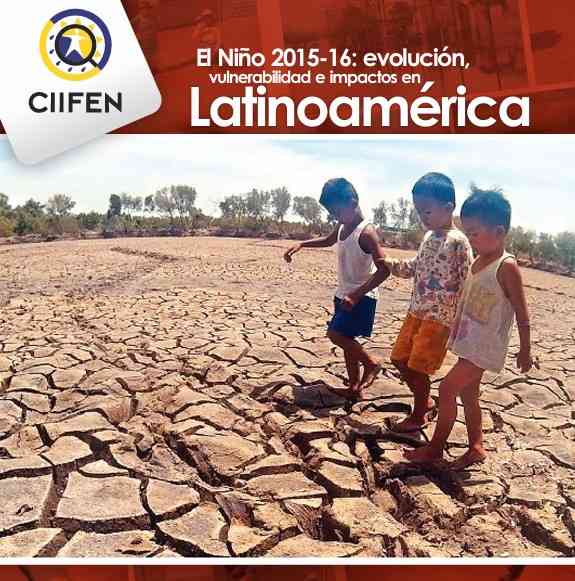
El Niño 2015-16: evolución, vulnerabilidad e impactos en Latinoamérica
The El Niño phenomenon is a global-scale climate event, product of an ocean-atmosphere interaction, where variations of the trade winds cause thermal changes in the surface of the ocean and its circulation, which in turn interacts with the tropical atmosphere. This coupling and feedback of the systems guarantees a permanence of the phenomenon for several months and a propagation through the atmosphere with affectations in the climate of the whole world, being this one of the most influential factors in the natural climate variability. This publication documents in detail the evolution of the most relevant oceanic and atmospheric variables of the 2015-16 El Niño.
Organizations and focal points
Implementing Organization(s)
Focal points