To support the National Consortium for Societal Resilience [UK+] as a forum to discuss societal resilience
To sustain the National Consortium for Societal Resilience (UK+) to enhance the UK+ approach to societal resilience, so that individuals, community groups, businesses, and organisations can all play a meaningful part in building the resilience of our society
Description
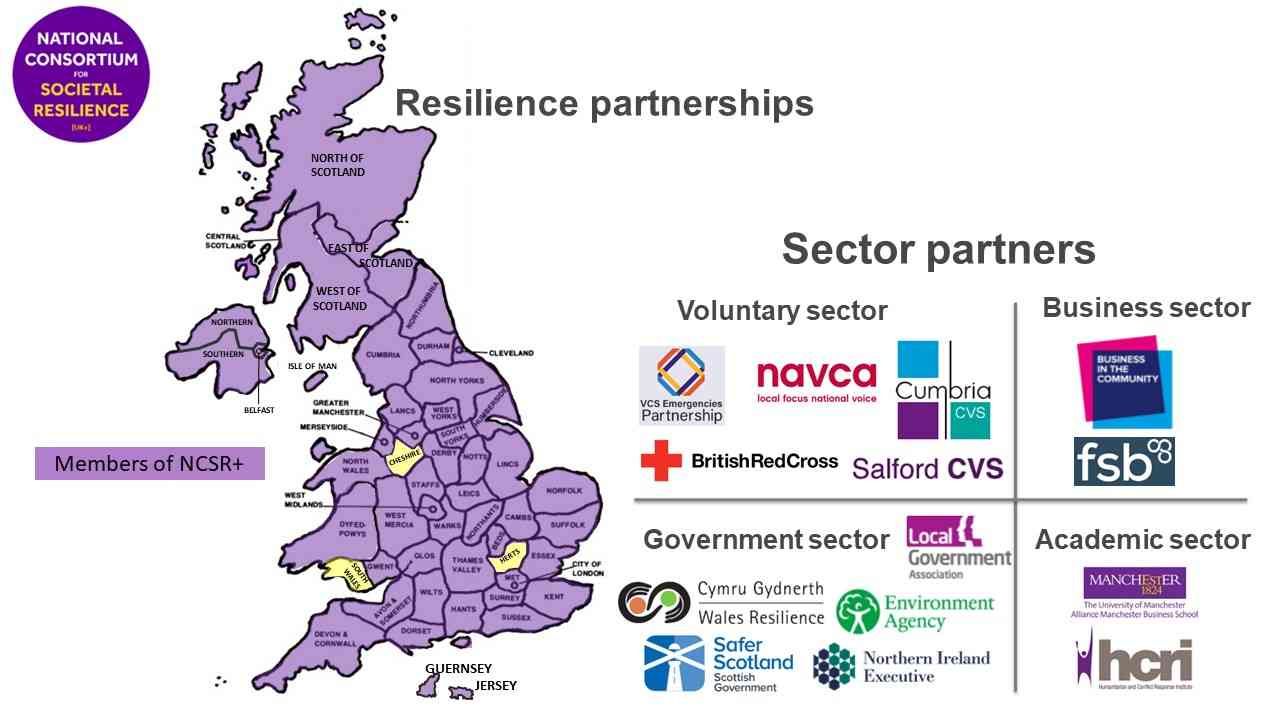
The National Consortium for Societal Resilience [UK+], abbreviated to NCSR+, was co-founded by The University of Manchester and Thames Valley Local Resilience Forum to pursue ambitions on societal resilience. NCSR+ is a forum to discuss how to raise the ability of society to anticipate, prevent, prepare for, respond to, and recover from risks and their effects, such as local disruptions, wide-scale disasters, and climate change. The consortium aims to explore nationally-consistent local foundations on which to build societal resilience and support local governments to implement that in their context. NCSR+ members are collaborating on this as a national endeavour, with their communities, strengthening inclusivity and diversity, knowing each have different starting points on how they understand their risks, pinpoint vulnerabilities, enhance preparedness, and leverage agency. NCSR+ aligns to national guidance and policies – for example, those detailed in The Integrated Review of Security, Defence, Development and Foreign Policy which sets an ambition for whole-of-society resilience.
Through its 50 local resilience partnership members alone, NCSR+ covers 97% of the UK+ population. In addition, NCSR+ has the involvement of a range of 13 sector partners from voluntary, business, local government sectors, and community organisations.
We will continue the conversations with through NCSR+ to progress the focus on local societal resilience resilience in UK+.
Did the Sendai Framework change or contribute to changes in your activities/organization? If so, how?
The Sendai Framework addresses the importance of preventing new and reducing existing disaster risk through partnerships and all-of-society approaches. The NCSR+ strives to sustain a supportive national eco-system to strengthen relationships with each other and society, to learn about how other places have built societal resilience.
What led you to make this commitment/initiative?
What was your position before making this Voluntary Commitment / prior to the Sendai Framework?
The ‘Recovery, Renewal, Resilience’ (RRR) project brought together local resilience partnerships and their sector partners by establishing NCSR+. The devastating impacts of COVID-19 have called for renewal of the foundations of our society. This renewal needs to build a nation that is more resilient in every way.
The term ‘whole-of-society resilience’ challenges UK civil contingencies to collaborate widely and take an integrated approach to build our national resilience which is ‘the product of multiple factors, including effective and trusted governance, government capabilities, social cohesion, and individual and business resilience’. Traditionally this was community resilience territory but its relationship to societal resilience is unclear, therefore, NCSR+ will collectively define what societal resilience means for NCSR+. Collaboration is needed because resilience partnerships have pursued community resilience as a solo effort for years facing similar frustrations in translating national guidance and others’ good practice – difficulties, we think, that stem from locales having different foundations.
Deliverables and Progress report
Deliverables
Deliverables are the end-products of the initiative/commitment, which can include issuance of publications or knowledge products, outcomes of workshops, training programs, videos, links, photographs, etc.
To establish a national eco-system we will:
- Hold regular NCSR+ meetings to share good practices amongst members and work together to co-produce local societal resilience strategy
- Catalogue and share good practices on the NCSR+ website to build widespread awareness about the consortium and its learning
- Organise public webinars to share good (inter-)national practices to enhance the consortium's learning on what is possible
- Hold a public end-of-project conference to celebrate progress, disseminate project findings, lessons learned, and future activities
A collection of videos on UK societal resilience initiatives.
As part of a body of research funded by JRSS Charitable Trust, researchers at Alliance Manchester Business School and the National Consortium for Societal Resilience [UK+] have carried out a literature review to explore how public trust in democratic institutions can be enhanced through crisis communications. The review encompasses national and international examples of research and projects that illuminate how crisis communications can evolve to enhance that trust, and identifies areas where communications sometimes falter.
This report, authored by Dr Judy Scully, Professor Duncan Shaw and David Powell (Alliance Manchester Business School, University of Manchester, UK and National Consortium for Societal Resilience [UK+]) is the final output of a research programme entitled ‘Towards a Resilient Democracy’. The report summarises the recommendations for the resilience sector, from across the research programme.
This document describes how to enhance a whole-of-society approach to resilience, so that individuals, community groups, businesses and organisations can all play a meaningful part in building the local resilience of our society.
To produce a working definition, a literature review identified how the term ‘whole-of-society’ is used in a variety of contexts. We conducted a number of interviews with resilience professionals to understand what the term could mean for them and ran and attended workshops and seminars on the topic. Using all the information we captured, we developed a draft definition which was presented to NCSR+ and revised in alignment with the feedback received. The purpose of the NCSR+ working definition of whole-of-society resilience is to help NCSR+ partners to coalesce around a shared view for the common pursuit that unites the consortium. We continue to work more on whole-of-society resilience before we define it with confidence, the attached document provides detail on this working definition.
To do this, we will identify the components/enablers of good practice through holding discussions with NCSR+ partners and whole-of-society. Using the information gathered, we will provide a brief report on components/enablers of good practice. We will then co-produce the foundations of societal resilience with a brief report on how to configure components/enablers to build solid foundations.
Organizations and focal points
Implementing Organization(s)
Focal points
Partners