Organization of GADRI Global Summit
The Global Alliance of Disaster Research Institutes (GADRI) aims to form a collaborative platform for research and knowledge sharing across DRR and resilience. GADRI organizes its biennial GADRI Global Summit, bringing together its members to present, discuss, report, and evaluate the research being conducted across the network.
Description
The Global Alliance of Disaster Research Institutes (GADRI) aims to form a collaborative platform for research and knowledge sharing across disaster risk reduction and resilience. Established following the 2nd Global Summit of Research Institutes for Disaster Risk Reduction in 2015, GADRI is a platform which brings together research organizations across disaster risk reduction. GADRI aims to;
- Establish and develop a global network of institutions and members involved in disaster-related research.
- Develop a roadmap for research across the field.
- Promote capacity development and knowledge sharing among institutions, researchers, and students.
- Promote global data and information sharing.
- Advocate in decision-making processes as the voice of its members.
They do this by;
- Making and fulfilling commitments to the Science and Technology Roadmap to Support the Implementation of the Sendai Framework for Disaster Risk Reduction 2015 – 2030.
- Publishing the Disaster and Risk Research: GADRI Book Series
As part of this work, GADRI also organizes the biennial GADRI Global Summit, bringing together its members to present, discuss, report, and evaluate the research being conducted across the network. The first Global Summit of Research Institutes for Disaster Risk Reduction (November 2011), held in Kyoto, Japan, saw the initial call for the establishment of GADRI itself, and subsequent conferences have produced active dialogues and responses to some of the field’s biggest challenges for the research community.
Did the Sendai Framework change or contribute to changes in your activities/organization? If so, how?
The Global Alliance of Disaster Research Institutes was formally established as an outcome of the 2nd Global Summit of Research Institutes for Disaster Risk Reduction. The Alliance has commitments to the Science and Technology Roadmap to Support the Implementation of the Sendai Framework. This includes the periodic hosting of the Global Summit to contribute to the monitoring of progress across science and technology partners.
The Sendai Framework explicitly calls for academic, scientific, and research institutions to collaborate and work together closely through the establishment of coordination mechanisms within and across sectors. By working within partnerships, research institutions and other organizations can identify and share good practices across disciplines and borders.
What led you to make this commitment/initiative?
What was your position before making this Voluntary Commitment / prior to the Sendai Framework?
The first Global Summit of Research Institutes for Disaster Risk Reduction was held in the same year of the 2011 Great East Japan Earthquake and Tsunami. The scale of the catastrophic consequences brought into sharp focus the need to reassess the disaster risk reduction field and how lessons could be learned. The Summit aims to bring together researchers to make recommendations for the global disaster research agenda, form partnerships and collaborations, and share knowledge and lessons across institutions. Since this conference, the Sendai Framework for Disaster Risk Reduction 2015 – 2030 was adopted at the Third UN World Conference on DRR in March 2015, and GADRI committed to contribute to the implementation of the Sendai Framework and to guide the international disaster research community in achieving its goals of the Sendai Framework.
Deliverables and Progress report
Deliverables
Deliverables are the end-products of the initiative/commitment, which can include issuance of publications or knowledge products, outcomes of workshops, training programs, videos, links, photographs, etc.
7th Global Summit of GADRI: Converging Disaster Research and Stakeholder-Engagement for Resilience was held on 21st – 23rd July 2025 at the Center for Risk-Based Community Resilience, Colorado State University Fort Collins, USA. The Summit aimed to discuss the gap between the ever-developing science and technology research carried out in the field and its incorporation into policy and implementation for the benefit of communities.
6th Global Summit of GADRI: Towards GADRI Objectives of Achieving a Sustainable Disaster-Resilient World was held on 15th – 17th March 2023 at the Disaster Prevention Research Institute, Kyoto University, Japan. The Summit affirmed that the increasing complexity of systemic risk, cascading impacts, and polycrises demands a more interdisciplinary, inclusive, and coherent approach to disaster risk reduction and decision-making tools.
5th Global Summit of GADRI: Engaging Sciences with Actions was held on 31st August – 1st September 2021 virtually, with an additional hybrid mini-session held in November 2021 in conjunction with the 70th Anniversary of the Disaster Prevention Research Institute, Kyoto University.
4th Global Summit of Research Institutes for Disaster Risk Reduction: Increasing the Effectiveness of Relevance of our Institutes was held on 13th – 15th March 2019 at the Disaster Prevention Research Institute, Kyoto University, Japan.
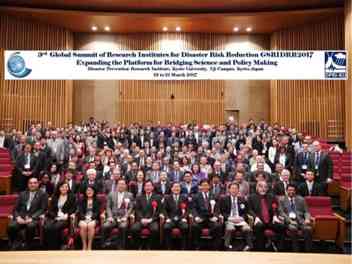
3rd Global Summit of Research Institutes for Disaster Risk Reduction: Expanding the Platform for Bridging Science and Policy Making was held on 19th – 21st March 2017 at the Disaster Prevention Research Institute, Kyoto University, Japan. 102 institutes and 251 participants took part from around the world. The outcomes of this Summit include the launch of the Disaster and Risk Research: GADRI Book Series.
2nd Global Summit of Research Institutes for Disaster Risk Reduction: Development of a Research Road Map for the Next Decade was held on 19th – 20th March 2015 at the Disaster Prevention Research Institute, Kyoto University, Japan. The Summit was attended by 83 research institutions (including 51 from outside Japan). The Global Alliance of Disaster Research Institutes (GADRI) was officially established at this summit, and these participating organisations also drafted and approved a knowledge sharing and collaboration Resolution.
Organizations and focal points
Implementing Organization(s)
Focal points
If a VC's contact information has been hidden, the SFVC team can forward a message.Partners