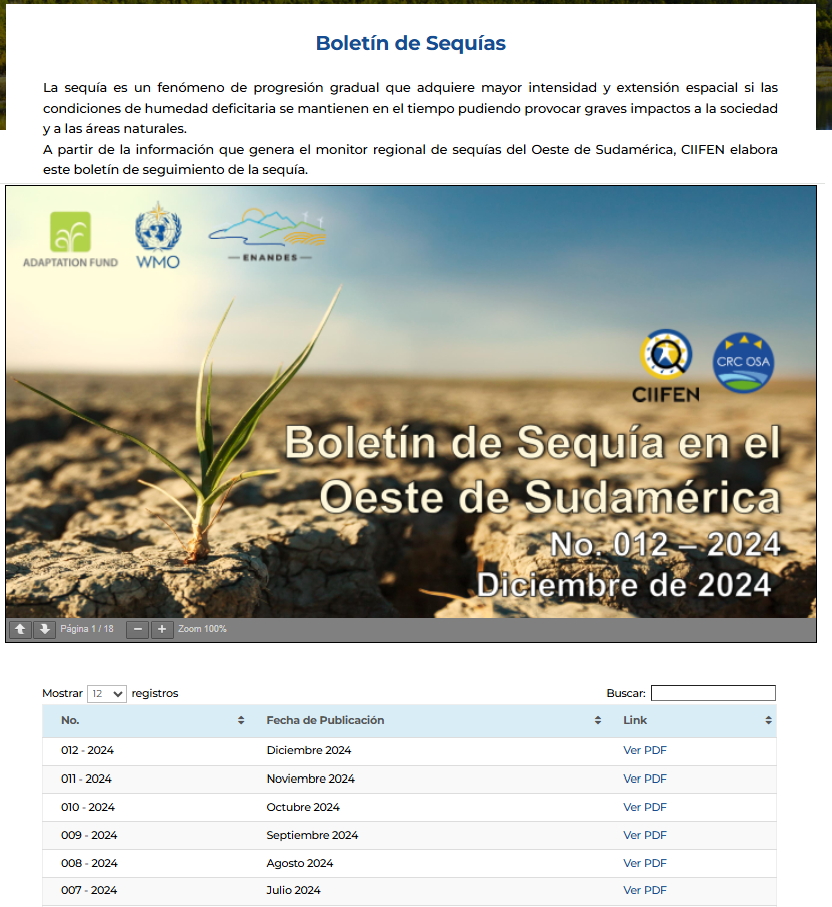
Drought Monitoring in Western South America
National drought monitors were built using routines that calculate a weighted mixed indicator from drought indices for Western South America countries: Venezuela, Colombia, Ecuador, Peru, Bolivia, and Chile. The analysis of the spatially integrated monitors and drought impacts are published on a monthly bulletin.
Description
CIIFEN's mission is to "Strengthen research, information services, and science-policy interaction to build resilience to climate variability and global change in developing countries." Drought is a concern in Western South America (WSA). From 2019 to 2023, CIIFEN actively worked with the national meteorological services (NMHS) of the 6 countries of WSA to implement, transfer, support, and improve a first version of national drought monitors (DMs). DMs are weighted mixed indicators calculated from drought indices based on at least 20 years of time series of hydrometeorological and environmental variables such as precipitation, temperature and soil moisture. DMs are a tool for analyzing the frequency, intensity, and duration of short and long-term drought processes.
Automated routines are used for downloading, extracting, and processing data from global and national repositories, and calculating the indices and DM. DMs have been improved by incorporating new indexes or enhancing the quality of time series.
The spatial integration of the 6 monitors allows for the construction of the WSA drought monitor to analyze the phenomenon from a regional scope. In this regard, binational coordination efforts are being carried out among NMHS to assess border regions, including the Brazilian National Water Agency, whose monitor is based on the same methodology. The outputs of the regional monitor are interpreted and communicated through a monthly bulletin, which also records the most significant drought impacts for future analysis and the identification of early warning thresholds.
The capacity building in the use, maintenance, and improvement of national monitors to NMHS technicians, the creation of the regional monitor, and the operational publication of the WSA drought bulletin contribute to priority 1 of the Sendai Framework for understanding the phenomenon.
CIIFEN is committed to:
• Collaborating with NMHS technicians to support, update, and improve the national drought monitors of the WSA countries to ensure their operational readiness until December 2026.
• Organizing at least 3 training sessions per year to strengthen capacities in drought risk management from 2023 to 2026.
• Publish the WSA drought bulletin from November 2023 to December 2026 (37 issues).
Did the Sendai Framework change or contribute to changes in your activities/organization? If so, how?
Drought monitoring by CIIFEN started with the implementation of the drought monitors in the "Euroclima+: Droughts and Floods - Andes" project of EUROCLIMA. EUROCLIMA aims to achieve a reduction in disaster risk related to droughts and floods and contribute to the objectives and priorities for action of the Sendai Framework.
CIIFEN is the Regional Climate Center for Western South America (RCC-WSA) with the mission of strengthening the operational capacities of the NMHS of WSA to contribute in the improvement of their climate services. The Global Framework for Climate Services (GFCS) contributes to the objectives of the Sendai Framework, it seeks to guide the development and application of science-based climate information and services to support decision-making in climate-sensitive sectors.
What led you to make this commitment/initiative?
What was your position before making this Voluntary Commitment / prior to the Sendai Framework?
The commitment to strengthening capacities in drought monitoring and management was inspired by the growing need for more effective and coordinated systems to address its effects in Western South America. Drought is a phenomenon that has severely impacted countries such as Bolivia, Ecuador, and Chile. The WSA region has experienced an increase in the frequency and intensity of drought events in recent years, affecting water and food security and the quality of life of vulnerable populations. This situation highlighted the urgent need to improve technical and response capacities in response to drought.
Deliverables and Progress report
Deliverables
Deliverables are the end-products of the initiative/commitment, which can include issuance of publications or knowledge products, outcomes of workshops, training programs, videos, links, photographs, etc.
The national drought monitors were implemented between 2019 and 2021 in the IT infrastructure of the meteorological services (NMHS) of Venezuela, Colombia, Ecuador, Bolivia, and Chile. Following implementation, technicians were trained to operate the monitor, and support has been provided to resolve issues such as updating links or versions of data repositories, correcting errors, or installing new features. When improvements are made to a country's monitor, they are transferred to the other countries.
The drought monitor for Peru runs on CIIFEN's IT infrastructure.
The spatial assembly of the monthly outputs from the national drought monitors allows for the generation of the regional drought monitor for WSA, whose outputs are interpreted in the monthly drought bulletin for WSA.
CIIFEN is committed to collaborating with NMHS technicians to support, update, and improve the national drought monitors of the WSA countries to ensure their operational readiness until December 2026.
The spatial integration of the 6 national drought monitors of Venezuela, Colombia, Ecuador, Peru, Bolivia and Chile allows for the construction of the Western South America (WSA) drought monitor to analyze the phenomenon from a regional scope. The outputs of the regional monitor are interpreted and communicated through a monthly bulletin, which also records the most significant drought impacts in a global, regional and national scope.
Drought bulletins for WSA have been operationally published since November 2023. CIIFEN is committed to continuing to publish these monthly bulletins until at least December 2026, reaching the goal of 37 issues in total.
Training sessions are being organized to strengthen the capacities of institutions involved in drought risk management in the six western South American countries in drought monitoring and management techniques.
Knowledge transfer activities on the drought phenomenon began in 2021 with the implementation of national monitors and introductory workshops on their monitoring. Sessions were subsequently held on the strengthening and implementation of monitors and drought management, including inter-institutional communication and cooperation.
CIIFEN is committed to holding at least three training sessions per year, at the national or regional level, in person or virtually, with at least 20 participants to strengthen capacities in drought risk management from 2023 to 2026.
Organizations and focal points
Implementing Organization(s)
- International Research Centre on El Niño
- Spanish Agency for International Development Cooperation
- World Meteorological Organization (WMO)
Focal points
Partners