Contributing to community resilience from the experience of a disaster by Fundación Alto Río
Fundación Alto Río is an organization from the civil society that aims at educating and helping communities to change the culture towards Disaster Risk Management (DRM) so as not to repeat the mistakes of the past.
Description
The earthquake that hit Chile on 27 February 2010 revealed not only human fragility but also the lack of preparedness, obsolete laws, negligence, etc. that cost hundreds of Chileans their lives. We translated the pain into finding effective and timely actions. We realized that social change must start with the people based on their experiences, beliefs, and aspirations.
Forgetting does not mean healing. It was important to face and preserve the memories of the disasters because they allow people to process the experiences and the emotions associated to them. We also believe this facilitates learning processes that are extremely important in a disaster-prone country such as Chile. For this purpose, we work with professionals, public and private institutions, universities, communities, and social actors.
Our mission is to collect, generate and disseminate knowledge related to the history of seismic activities in Chile to promote initiatives for preventing and mitigating the impact of disasters. For this purpose, we conduct training, conduct research, and aid the implementation of technologies as well as protocols that help communities engage in disaster risk management. We work towards the accomplishment of three objectives: 1) Preserve the memory of the 2010 Earthquake that produced severe loss of life and livelihoods; 2) Disseminate the necessary information to strengthen the disaster management culture in our country by registering and documenting the consequences of the 2010 Earthquake; and 3) Educate and prepare communities against future disasters providing relevant information, training, and knowledge to be better prepared at the individual and collective level.
Resilience is the capacity of an individual or group of people to overcome adversity, intense emotional pain or trauma and be able to continue in spite of those destabilizing episodes, achieving an even better performance as if the trauma boosted latent resources that were not known before. We believe our community is an example of resilience. Therefore, we will continue to work hoping for good results, justice, and kindness. We sincerely appreciate all the people that made all the work of emotional and social reconstruction possible.
Did the Sendai Framework change or contribute to changes in your activities/organization? If so, how?
The Sendai Framework proposed a shift from managing disasters to managing risk. It assigns civil society an important role and advocates for resilient communities and an inclusive and all-of-society approach where people participate in all processes related to disaster risk management. Furthermore, it calls for “public and private sectors and civil society organizations, as well as academia and scientific and research institutions, to work more closely together and to create opportunities for collaboration.” The work of Fundación Alto Río contributes to the Sendai Framework.
What led you to make this commitment/initiative?
What was your position before making this Voluntary Commitment / prior to the Sendai Framework?
We are motivated by the vision to become a promotor of citizen self-management in all topics related to preparedness, prevention, and mitigation of the impact produced by disasters in communities at the national and international level. We want to promote the conscience of selfcare, resilience, responsible livelihoods in consideration of the environment, and valuing the historical memory as an element to assign new meaning, reconstruct, and renovate emotional and social contexts.
Deliverables and Progress report
Deliverables
Deliverables are the end-products of the initiative/commitment, which can include issuance of publications or knowledge products, outcomes of workshops, training programs, videos, links, photographs, etc.
The Alto Río Foundation gave the city of Concepción a symbolic rubble from the building that was destroyed by the 2010 earthquake. This "citizen memorial" was left in the city's courthouse as a message of justice and reparation to the victims.
Through a global resilience partnership, the Alto Rio Foundation was able to share learning and resilience experiences with other cities around the world through commemoration and concrete remembrance.
In the context of the activities of the World Conference for the agreement of the Sendai Framework (2015), the Alto Río Foundation represented Chile at the International Meeting of Post-Disaster Women Leaders in Japan.
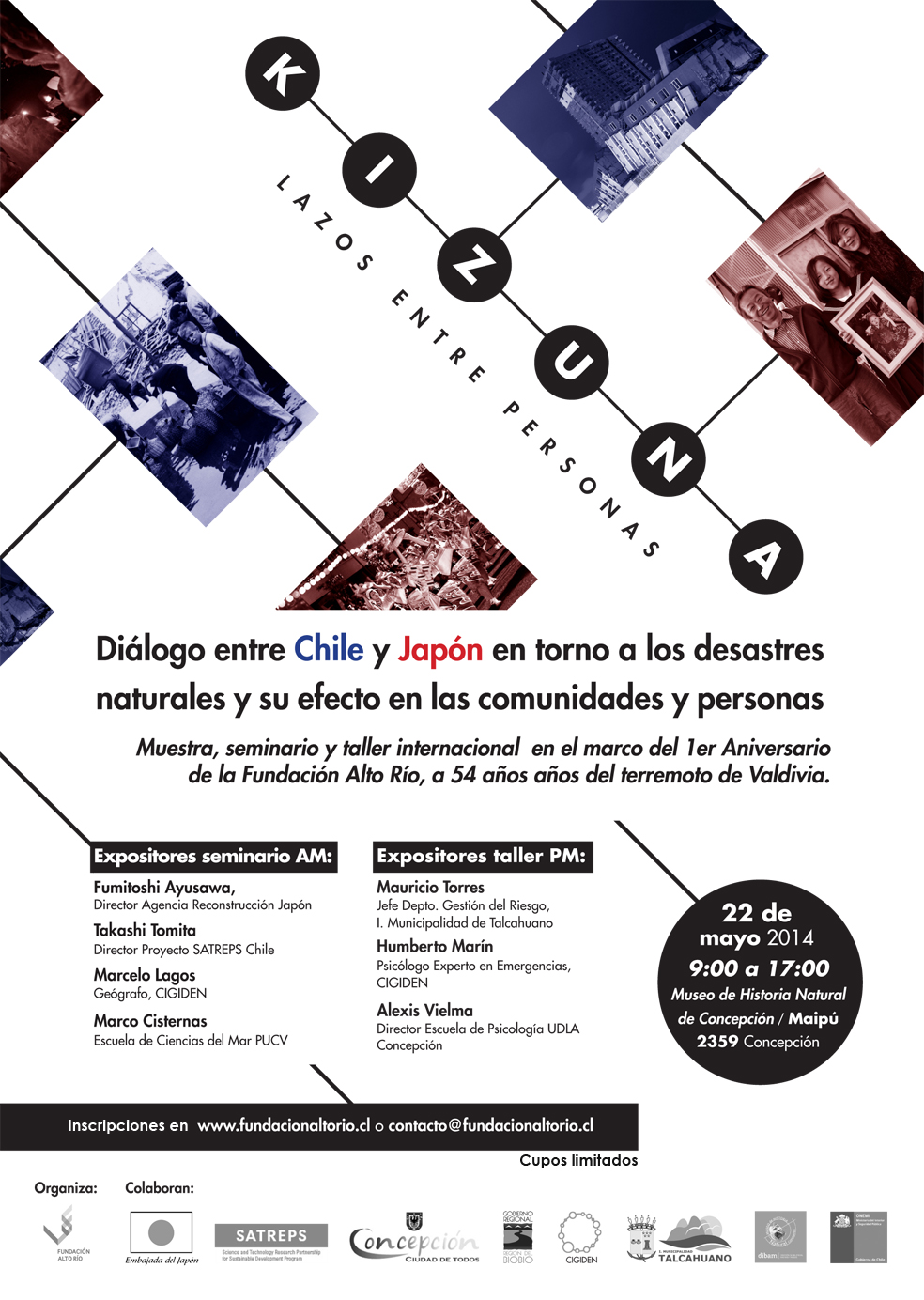
In the context of a new anniversary of the 1960 Valdivia earthquake, the Alto Río Foundation organized an activity of commemoration, reflection and dialogue between countries, communities and individuals. Taking into account the mutual effect that this disaster generated in Chile and Japan, we want to create a bridge that connects the experiences lived by both peoples, projecting it towards the stories that occurred in the disasters of 2010 and 2011.
The “KIZUNA” concept reflects the value and importance of human ties to better prepare for, face and overcome large-scale disasters. This will be the central concept of the activities.
The activity also celebrates the first anniversary of the Alto Río Foundation.
This activity is supported by Embassy of Japan in Chile, Embassy of Chile in Japan, JICA Chile, the Bíobio Regional Government, the Municipalities of Concepción, Talcahuano and CIGIDEN
In article published by Diario El Sur, the experience of survivors and resilience was shared by the president of Fundación Alto Río.
To commemorate the 9 years of the February 27 earthquake, a vertical beam of light pointed to the place where the Alto Río building was located - which was seen from anywhere in Concepción - and it remained lit until 3:34 a.m. in which the earthquake of February 27, 2010 occurred.
In two episodes, the experience from the tragedy of the Alto Río building was shared through Radio Duna.
Against the crisis of the Chilean economic development model, Fundación Alto Río invited individuals, communities, and organizations related to the topic of disaster risk management to exchange ideas about the connections between development and the generation of disasters. The town halls were conducted in Santiago and Concepción.
Pieces of the rubble from the Alto Río building (destroyed by the earthquake of 2010) were included in the exhibition by La Moneda Cultural Center.
It is a reminder that disasters are not natural.
As part of the yearly commemorations, Fundación Alto Río, Proyecta Memoria and local governments organized a series of activities to remember 10 years since the earthquake (one of the strongest in the world) and tsunami of 2010.
Fundación Alto Río, Proyecto Memoria, and the Municipality of Concepción signed an agreement to declare Concepción a City with Good Memory (Ciudad con Buena Memoria).
It is commitment not to forget the lessons learned from disasters.
Fundación Alto Río organized a cycling tour visiting symbolic places that were affected by natural disasters.
Celebrating the International Day of Disaster Risk Reduction, Fundación Alto Río organized a webinar to exchange ideas on topics relevant to disaster risk reduction and the process of drafting a new constitution for the country.
This free and online training is offered for all volunteers.
It covers an introduction to the Chilean Standard ISO 22319 as a guide for spontaneous volunteers. The reception and management of volunteers is also covered.
This part of the yearly activities to commemorate the earthquake of 27 February of 2010.
Are you prepared for a mega earthquake of 8.8?
Fundación Alto Río sponsored and participated in this webinar to share a guide to reduce disaster risk. the objective is to have a community prepared for disasters.
The first response to disasters is not often delivered by the professional responders but by the communities and affected families. For this reason, preparation against disasters is an ethical responsibility that has to be assumed by all members of society. This knowledge products contributes to this purpose.
Interview with one of the survivors of the fall of the Alto Río building during the 2010 earthquake: Mrs. Corina Bastías Troncoso. The incredible story of resilience of one of the members of the Alto Río Foundation. This video was produced by a group of volunteers from the Alto Río Foundation.
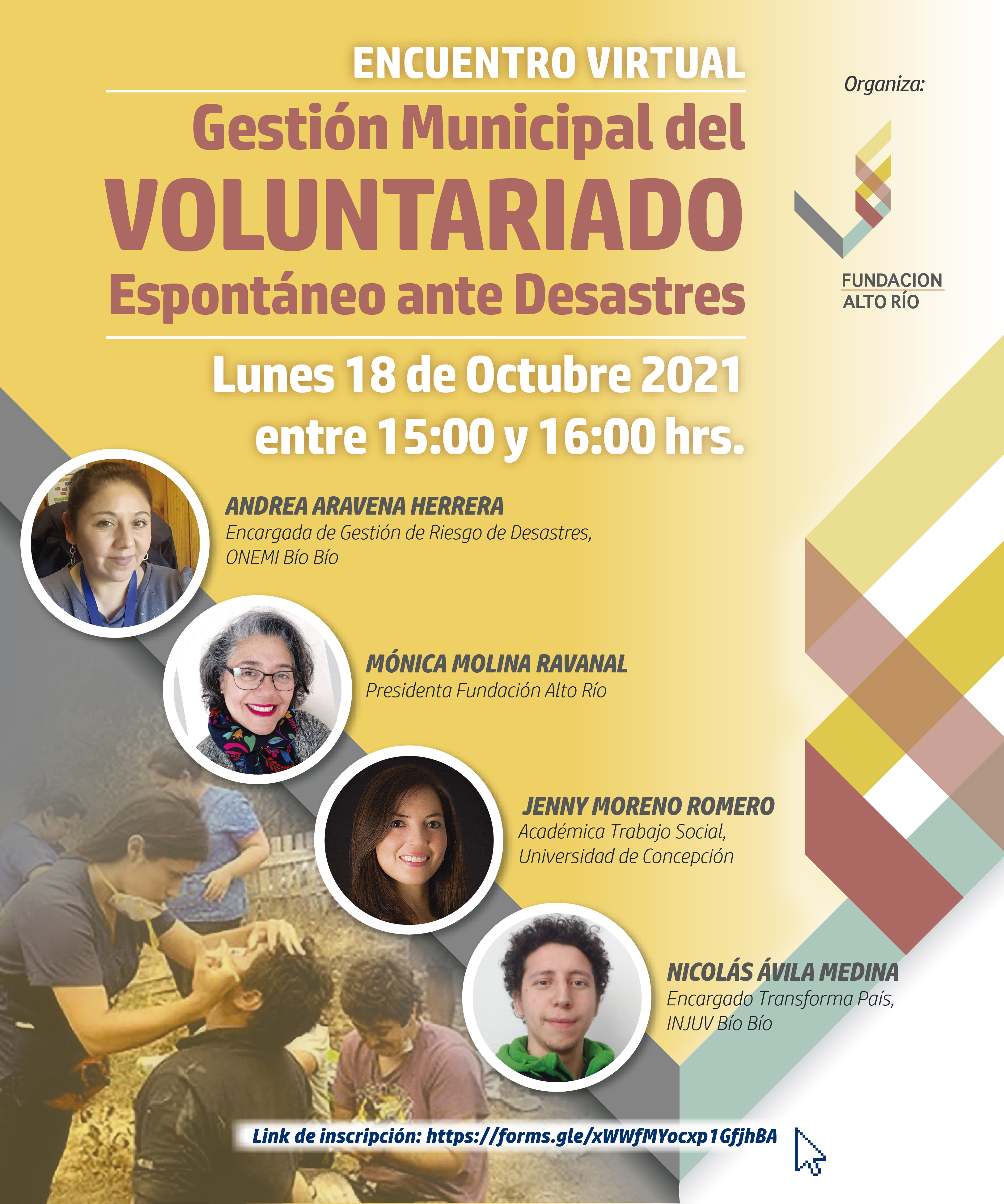
Alto Río Foundation is pleased to invite you to participate in the Virtual Meeting "Municipal Management of Spontaneous Volunteering in the Face of Disasters", which it has organized on the occasion of the commemoration in October of the International Day for Disaster Risk Reduction. The meeting will be held next Monday, October 18 between 3:00 p.m. and 4:00 p.m. and is mainly aimed at professionals from municipalities in the Biobío and Ñuble regions.
The objective of this meeting is to assess the management that municipalities can carry out to coordinate spontaneous volunteering when disasters occur and to promote the dissemination of the project that Fundación Alto Río has developed for these purposes, based on NCh ISO 22319.
Speakers:
- Andrea Aravena Herrera, Head of Disaster Risk Management, ONEMI Biobío.
- Mónica Molina Ravanal, President of Alto Río Foundation
- Jenny Moreno Romero, Academic Social Work, University of Concepción
- Nicolás Ávila Medina, Country Transform Manager
Organizations and focal points
Implementing Organization(s)
Focal points
Partners