My account
Menu
Your experience on PreventionWeb

Please help us improve PreventionWeb by taking this brief survey. Your input will allow us to better serve the needs of the DRR community.

See the survey

Published on
22 July 2022
Status
Completed

Build Change Prevents Housing Loss Caused by Disasters

Expected duration
Jan 2013 - Dec 2030
SFVC commitment ID
20210521_003
Version
2.0
Author
Monica Schroeder
Upload your content

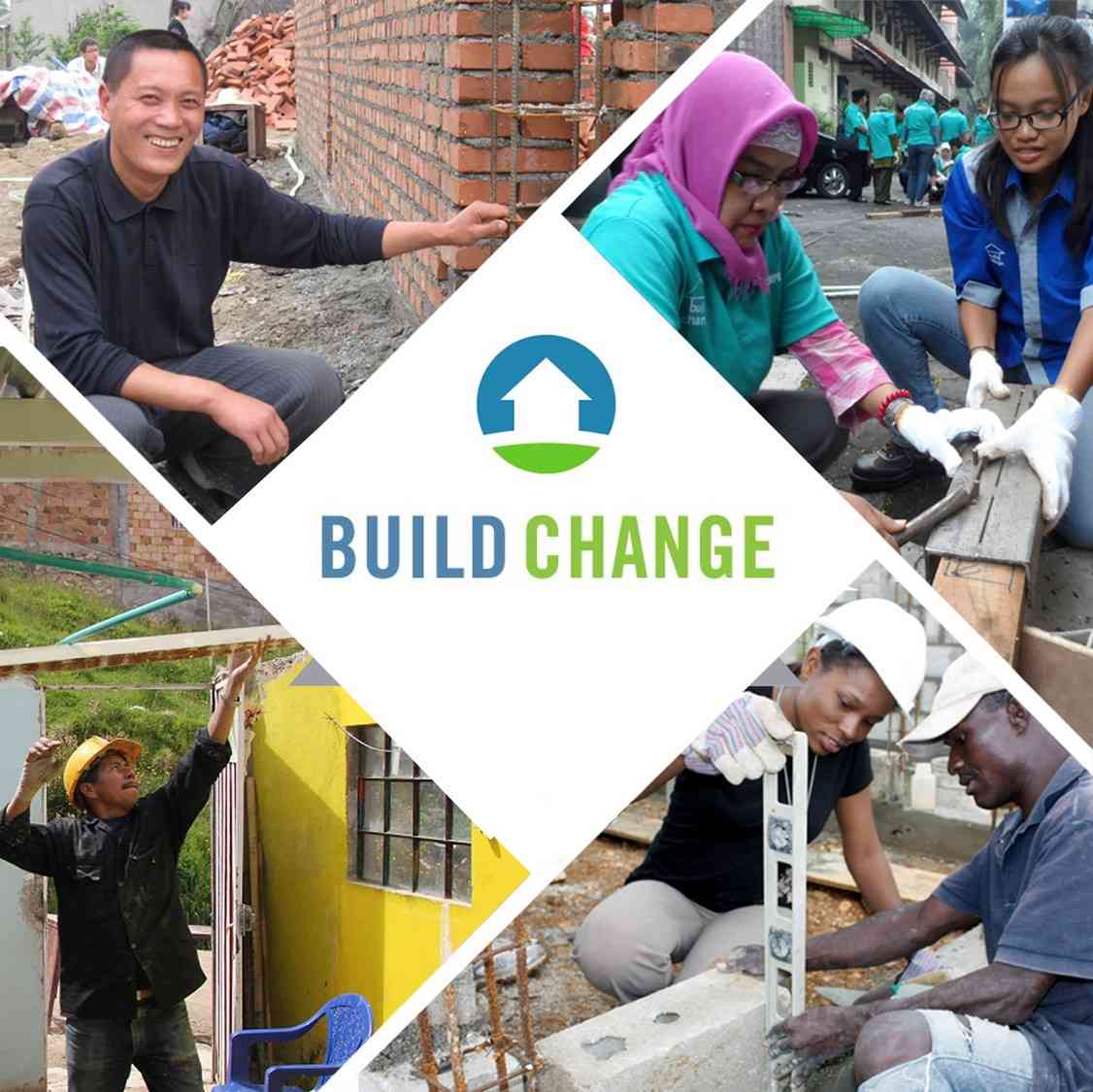
Build Change, the global leader in systems change for resilient housing, works to make each house disaster resilient for safer homes and safer people.

    Description

    Build Change mobilizes people, money, and technology to transform systems for regulating, financing, building, and improving houses around the world.

    Our theory of change involves overcoming three barriers to adoption common to so many development challenges: people, money and technology. Through our engagement with people, we strengthen the demand for resilient housing; through our advancement of technology, we advance the supply of resilient housing; and by overcoming the barrier of money, we mobilize financing for resilient housing. We can create thriving economies, develop resilient communities, and eliminate disaster risk.

    Build Change has contributed to more than 90,000 safer buildings, 470,000 safer people, 78,000 people trained, 33,000 jobs created and 120 organizations changed.

    Did the Sendai Framework change or contribute to changes in your activities/organization? If so, how?

    The Sendai Framework prioritizes "building better from the start to withstand hazards through proper design and construction", which is well aligned to Build Change's mission and approach and reflects our commitment to prevention to strengthen homes and protect families. The themes of disaster risk reduction and preparedness are central to our work and play a significant role in advancing systems change for housing resilience worldwide.

    What led you to make this commitment/initiative?

    What was your position before making this Voluntary Commitment / prior to the Sendai Framework?

    Now is the time to catalyze action to protect people from disasters. We are publishing this initiative to strengthen investment in resilient housing, to shape global and national policies relating to resilient housing, and to bring together the best technical expertise for cutting-edge innovations to bring resilient housing to scale.

    Deliverables and Progress report

    Deliverables

    Deliverables are the end-products of the initiative/commitment, which can include issuance of publications or knowledge products, outcomes of workshops, training programs, videos, links, photographs, etc.

    Evaluation and Seismic Retrofitting Manual for Housing Vulnerability Reduction
    Intended date of delivery
    31 December 2030

    Seismic Evaluation and Retrofit Manual. Produced by SwissContact and Build Change for use in Colombia.

    Link
    https://buildchange.org/app/uploads/2018/05/BC_Manual-de-Evaluacion-y-Reforzami…
    Retrofitting of Private Housing Post 2015 Gorkha Earthquake
    Intended date of delivery
    31 December 2030

    This paper will further support the implementation of retrofitting of vulnerable houses that need seismic retrofitting based on experiences gleaned from retrofitting implemented following the 2015 Gorkha Earthquake in Nepal and in coordination with the Nepalese National Reconstruction Authority (NRA).

    Link
    https://buildchange.org/app/uploads/2021/06/NRA-Experience-Paper-on-Retrofittin…
    Seismic Retrofit of Housing in Post-Disaster Situations: a Primer
    Intended date of delivery
    31 December 2030

    This Primer introduces engineering and development professionals to the basic steps in the process of planning and executing post-disaster seismic retrofit of housing projects funded by the United States Agency for International Development (USAID). It is intended to provide government officials with the steps, principles, and best practices that need to be taken to carry out safe and effective housing retrofit in a post-disaster situation.

    Link
    https://pdf.usaid.gov/pdf_docs/pbaac537.pdf
    Site and Retaining Wall Hazard Mitigation in Post-Disaster Situations
    Intended date of delivery
    31 December 2030

    This Primer covers the basic steps in the process of selecting a model for planning and executing site hazard mitigation projects. It is intended to provide government officers with the steps, principles, and best practices that need to be taken to carry out
    construction of site hazard mitigation measures properly in a post-disaster situation. It provides a road map for developing a project through planning, design, and implementation.

    Link
    https://pdf.usaid.gov/pdf_docs/pbaac536.pdf

    Porgress report

    Progress date
    1 July 2022
    Summary

    Build Change continued to implement resilient housing interventions throughout the world. In 2021, Build Change recommenced interventions in Haiti, launched a new program in Honduras, and continued operations in its flagship programs, including Colombia, Philippines, and Indonesia, among others. Build Change launched the Build Change Guide to Resilient Housing, a resource for governments and practitioners to design and implement resilient housing programs and based on Build Change's nearly 20 years of implementation experience.

    Achievements at a glance

    In 2021, select achievements include:
    - Launched the Build Change Guide to Resilient Housing
    - Supported the city of Bogota, Colombia in the design and pilot for Plan Terrazas. The city of Bogotá now has a working Curaduría Pública Social and the program is advancing in its goal to strengthen and improve 1,250 houses.
    - In the Philippines, strengthened over 100 houses and made over 500 people safer through increased access to housing finance
    - Launched the Intelligent Supervision Assistant for Construction to enable AI to support and strengthen construction at scale
    - Joining the Race to Resilience and advocating for Resilient Housing at COP26

    Build change has also published their 2021 Annual Report, which can be found in this link: https://www.flipsnack.com/buildchangeintl/build-change-2021-annual-report.html

    Organizations and focal points

    Implementing Organization(s)

    • Build Change

    Focal points

    Main focal point
    Monica Schroeder (Director, Global Advocacy, Build Change)

    Explore further

    Sendai priorities
    Priority 3Investing in disaster risk reduction for resilience
    Priority 4Enhancing disaster preparedness for effective response, and to «Build Back Better», rehabilitation and reconstruction
    Sendai targets and indicators
    A-2Number of deaths attributed to disasters, per 100,000 population
    B-1 (Compound)Number of directly affected people attributed to disasters, per 100,000 population
    B-3Number of people whose damaged dwellings were attributed to disasters
    B-4Number of people whose destroyed dwellings were attributed to disasters
    B-5Number of people whose livelihoods were disrupted or destroyed, attributed to disasters
    C-1 (Compound)Direct economic loss attributed to disasters in relation to global gross domestic product
    C-4Direct economic loss in the housing sector attributed to disasters
    Hazards Cyclone, Hurricane and Typhoon Earthquake Storm surge
    Themes Disaster risk communication Capacity development Climate change Community-based DRR Education and school safety Gender Private sector Science-policy-practice interface Social impacts and social resilience Structural safety Urban risk and planning
    Sustainable Development Goals SDG3: Good health and well-being SDG6: Clean water and sanitation SDG8: Decent work and economic growth SDG9: Industry, innovation and infrastructure SDG11: Sustainable cities and communities SDG13: Climate action SDG17: Partnerships for the goals
    Scope
    Global
    Secured budget size
    100%
    Umbrella initiative(s)
    Build Change
    X (Twitter)
    https://twitter.com/BuildChange
    Videos
    Related links
    Facebook
    LinkedIn
    YouTube
    Website

    Is this page useful?

    Yes No
    Report an issue on this page

    Thank you. If you have 2 minutes, we would benefit from additional feedback (link opens in a new window).

    PreventionWeb is the global knowledge sharing platform for disaster risk reduction (DRR) and resilience.

    • Newsletter
    • Submit your content
    • Blog pitches
    • Submission and publishing policy
    • About PreventionWeb
    • Contact us

    Hazards

    • Avalanche
    • Cold Wave
    • Cyclone, Hurricane and Typhoon
    • Drought and Desertification
    • Earthquake
    • Epidemic and pandemic
    • Flood
    • Heatwave, extreme heat and heat stress
    • Insect infestation
    • Land subsidence
    • Landslide
    • Nuclear, biological, chemical (NBC)
    • Sea level rise
    • Technological hazard
    • Thunderstorm
    • Tornado
    • Tsunami
    • Volcano
    • Wildfire

    Regions

    • Africa
    • Americas
    • Asia
    • Europe
    • Oceania

    Themes

    Understanding & managing risk

    • Preparedness
    • Early warning
    • GIS and mapping
    • Data and information management
    • Risk identification and assessment
    • Small Island Developing States
    • Earth Observation

    Natural environment

    • Climate change
    • Environment and ecosystems
    • Food security and agriculture
    • Water

    Cross-cutting

    • Systemic risk
    • Recovery

    Human development

    • Capacity development
    • Children and youth
    • Civil society / NGOs
    • Community-based DRR
    • Cultural heritage
    • Gender
    • Human mobility
    • Inclusion
    • Social impacts and resilience

    Science, knowledge & advocacy

    • Disaster risk communication
    • Traditional and Indigenous knowledges
    • Science-policy-practice interface

    State, governance & economy

    • Financing DRR
    • Fragility and conflict
    • Governance
    • Insurance and risk transfer
    • Private sector

    Infrastructure & critical services

    • Critical infrastructure
    • Education and school safety
    • Health and health facilities
    • Structural safety
    • Urban risk and planning
    Loading