1. Home
  2. Knowledge Base | PreventionWeb
  3. Hazards

Landslide

Landslide is the downslope movement of soil, rock and organic materials under the effects of gravity, which occurs when the gravitational driving forces exceed the frictional resistance of the material resisting on the slope. Landslides could be terrestrial or submarine (Varnes, 1978).

Landslides can be triggered by geological and physical causes such as glacier or snow melts, heavy rains and water pressure, earthquakes, volcanic eruptions and overly steep slopes. Landslides can also be triggered by human action, the most common being building on unstable slopes. Submarine landslides, or massive slides and rock falls hitting the sea can also cause tsunamis.

Landslides can reach speeds of over 50 km/h and can bury, crush or carry away people, objects and buildings. Landslides cannot be predicted but warning systems measuring rainfall levels can provide warning to people living in landslide-prone areas.

Instrumental monitoring to detect movement and the rate of movement can be implemented, for example, extensometers, global positioning system (GPS), seismometers, aerial photography, satellite images, LiDaR (Highland and Bobrowsky, 2008), with varying degrees of success. Increasingly, the science of landslide physics is allowing the nature of these hazards to be understood, which is leading to better techniques through which they can be managed and mitigated (HIP).

Risk factors

  • Population growth
  • Rapid urbanisation
  • Environmental degradation (deforestation and inappropriate use of lands and slopes)
  • High population density, heavy rainfall and rapid land use changes increase the instability of slopes

Risk reduction measures

  • Early warning systems to observe and alert before landslides happen
  • Hazard maps to identify landslides risk and vulnerabilities
  • Integrate landslide risk assessment into urban planning strategies
  • Building codes and standards for materials that reinforce landslide resilience
  • Improve drainage, building tunnels and trenches to stabilise slopes
  • Protect forest cover and regulate logging
  • Raise awareness of landslide risk
  • Regular drills and community evacuation exercises
  • Establish national, regional, and local evacuation plans
Latest Land Slide additions in the Knowledge Base

Uploaded on
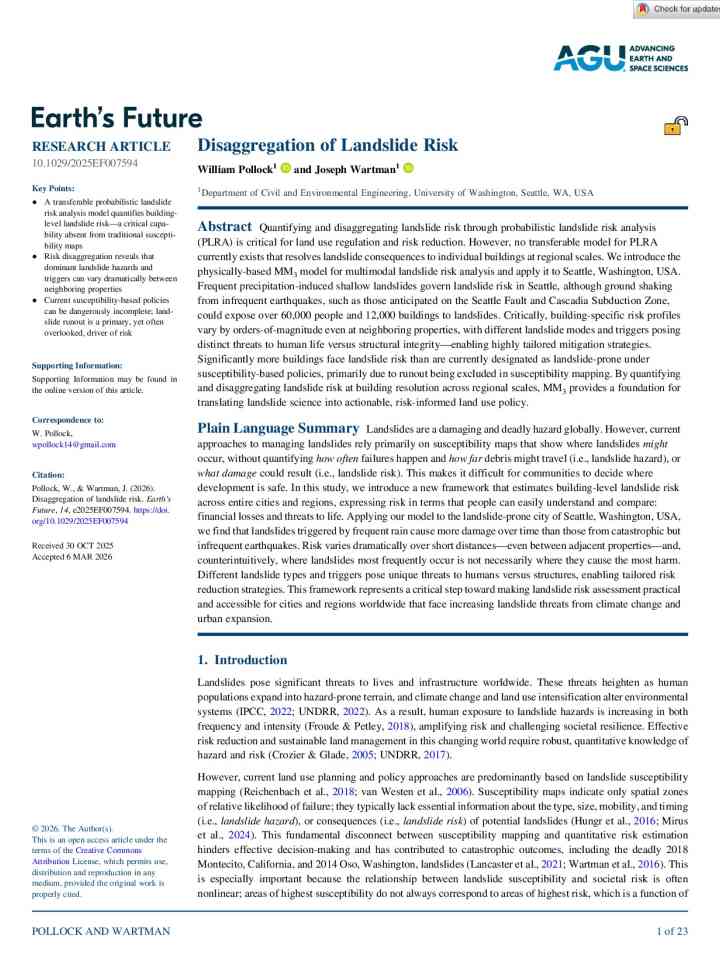
Disaggregation of landslide risk
Documents and publications

This study introduces a new framework that estimates building-level landslide risk across entire cities and regions, expressing risk in terms that people can easily understand and compare: financial losses and threats to life.

Earth's Future (AGU)
Articulations and enactments of climate adaptation citizenship: how citizens in small remote communities in the Nordics engage with climate change-related hazards thumbnail
Documents and publications

This paper is about how citizens in small, remote Nordic communities engage with climate adaptation through awareness, everyday practices, and local political action.

Environmental Politics (Taylor & Francis)
Vulnerability of people in wood-frame buildings to rapid flow-type landslides thumbnail
Documents and publications

The authors developed an empirical life-loss vulnerability curve for people inside wood-frame buildings as a function of impact pressures from flow-type landslides.

Natural Hazards (Springer)
Nature-based solutions in mountains: assessing the potential of nature-based solutions for disaster risk reduction in Central Asia and South Caucasus thumbnail
Documents and publications

This study examines climate vulnerability and the potential of nature-based solutions (NBS) across six countries in Central Asia and the South Caucasus: Armenia, Georgia, Kazakhstan, Kyrgyz Republic, Tajikistan, and Uzbekistan.

World Bank, the
Towards a safer and resilient Nagaland: what we do, why we do, and how we learn thumbnail
Documents and publications

This publication explores how Nagaland is building a more resilient and disaster-ready system through coordinated efforts involving government institutions, local communities, and international partners.

All India Disaster Mitigation Institute
State of the Climate Kenya 2025  thumbnail
Documents and publications

The State of the Climate Kenya 2025 report shows how rising temperatures and uneven rainfall are already affecting Kenya’s agriculture, water, health, and livelihoods, while warning of higher climate risks in 2026.

Kenya Meteorological Department
Nature-based Solutions for landslide risk reduction in informal settlements of Salvador da Bahia, Brazil thumbnail
Documents and publications

Study finds nature‑based solutions can match or exceed traditional engineering for landslide risk reduction in Salvador’s informal settlements, at lower cost and with added social and ecological benefits.

International Journal of Disaster Risk Reduction (Elsevier)
Case study
Location: Poland
A complex engineering intervention secured slopes at risk of landslides in the Małopolska region, Poland. It ensures the continued operation of road transport in areas affected by increasing intense rainfall due to climate change.
  • Climate-ADAPT
Uploaded on