1. Home
  2. Knowledge Base | PreventionWeb
  3. Hazards

Landslide

Landslide is the downslope movement of soil, rock and organic materials under the effects of gravity, which occurs when the gravitational driving forces exceed the frictional resistance of the material resisting on the slope. Landslides could be terrestrial or submarine (Varnes, 1978).

Landslides can be triggered by geological and physical causes such as glacier or snow melts, heavy rains and water pressure, earthquakes, volcanic eruptions and overly steep slopes. Landslides can also be triggered by human action, the most common being building on unstable slopes. Submarine landslides, or massive slides and rock falls hitting the sea can also cause tsunamis.

Landslides can reach speeds of over 50 km/h and can bury, crush or carry away people, objects and buildings. Landslides cannot be predicted but warning systems measuring rainfall levels can provide warning to people living in landslide-prone areas.

Instrumental monitoring to detect movement and the rate of movement can be implemented, for example, extensometers, global positioning system (GPS), seismometers, aerial photography, satellite images, LiDaR (Highland and Bobrowsky, 2008), with varying degrees of success. Increasingly, the science of landslide physics is allowing the nature of these hazards to be understood, which is leading to better techniques through which they can be managed and mitigated (HIP).

Risk factors

  • Population growth
  • Rapid urbanisation
  • Environmental degradation (deforestation and inappropriate use of lands and slopes)
  • High population density, heavy rainfall and rapid land use changes increase the instability of slopes

Risk reduction measures

  • Early warning systems to observe and alert before landslides happen
  • Hazard maps to identify landslides risk and vulnerabilities
  • Integrate landslide risk assessment into urban planning strategies
  • Building codes and standards for materials that reinforce landslide resilience
  • Improve drainage, building tunnels and trenches to stabilise slopes
  • Protect forest cover and regulate logging
  • Raise awareness of landslide risk
  • Regular drills and community evacuation exercises
  • Establish national, regional, and local evacuation plans
Latest Land Slide additions in the Knowledge Base

Uploaded on
Debris flow disaster information representation and perception based on knowledge graphs and virtual geographic environments thumbnail
Documents and publications

The paper demonstrates that a knowledge-driven VGE system with 3D animations significantly improves public disaster risk perception compared to static or textual formats, validated through eye-tracking experiments and comparative NLP model analysis.

Nature Scientific Reports
Aerial view of an avalanche in the Swiss alps
Update

Over many millennia, it has eroded the foot of the slope, resulting in a visible steepening here. Like a pile of sand whose base is dug away, this may eventually lead to the collapse of the material above.

Swiss Federal Research Institute for Forest, Snow and Landscape Research (WSL)
Research briefs

A study by Sun et al. 2026 shows that in six earthquakes in China between 2010 and 2022, landslides and rockfalls were responsible for at least half of the total fatalities.

Eos - AGU
Are the poor more exposed to climate hazards in Latin America? thumbnail
Documents and publications

This paper addresses two main questions. First, what proportion of people are exposed to climate hazards in Latin America and the Caribbean, especially among the poor versus the nonpoor?

World Bank, the
Update

New evidence from the Natural Hazards Commission – Toka Tū Ake (NHC) shows that landslides are now New Zealand’s most costly natural hazard.

Eos - AGU
Inoperability assessment of interdependent critical infrastructures exposed to natural hazards considering climate change thumbnail
Documents and publications

This work presents a climate change-informed modeling framework for assessing the inoperability of interdependent critical infrastructures exposed to NHs.

International Journal of Disaster Risk Reduction (Elsevier)
Update

Destructive landslides are more likely to occur after wildfires, but how does the hazard change as vegetation regrows? Scientists are improving prediction methods to reduce costly unnecessary warnings

Geological Society of America, the
A view of Surprise Glacier from the ocean in western Prince William Sound, AK
Research briefs

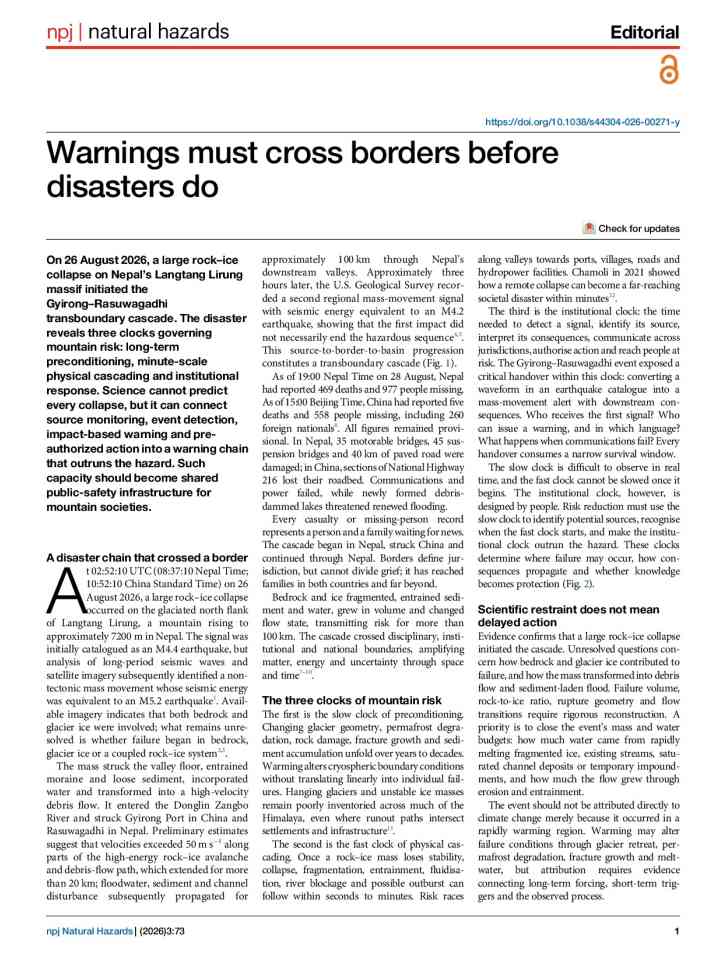
On the evening of Aug. 9, 2025, passengers on the Hanse Explorer were taking photos and videos of the South Sawyer Glacier. Twelve hours later, a landslide collapsed into the fjord, initiating the second-highest tsunami in recorded history.

Conversation Media Group, the
Uploaded on