1. Home
  2. Knowledge Base | PreventionWeb
  3. Hazards

Landslide

Landslide is the downslope movement of soil, rock and organic materials under the effects of gravity, which occurs when the gravitational driving forces exceed the frictional resistance of the material resisting on the slope. Landslides could be terrestrial or submarine (Varnes, 1978).

Landslides can be triggered by geological and physical causes such as glacier or snow melts, heavy rains and water pressure, earthquakes, volcanic eruptions and overly steep slopes. Landslides can also be triggered by human action, the most common being building on unstable slopes. Submarine landslides, or massive slides and rock falls hitting the sea can also cause tsunamis.

Landslides can reach speeds of over 50 km/h and can bury, crush or carry away people, objects and buildings. Landslides cannot be predicted but warning systems measuring rainfall levels can provide warning to people living in landslide-prone areas.

Instrumental monitoring to detect movement and the rate of movement can be implemented, for example, extensometers, global positioning system (GPS), seismometers, aerial photography, satellite images, LiDaR (Highland and Bobrowsky, 2008), with varying degrees of success. Increasingly, the science of landslide physics is allowing the nature of these hazards to be understood, which is leading to better techniques through which they can be managed and mitigated (HIP).

Risk factors

  • Population growth
  • Rapid urbanisation
  • Environmental degradation (deforestation and inappropriate use of lands and slopes)
  • High population density, heavy rainfall and rapid land use changes increase the instability of slopes

Risk reduction measures

  • Early warning systems to observe and alert before landslides happen
  • Hazard maps to identify landslides risk and vulnerabilities
  • Integrate landslide risk assessment into urban planning strategies
  • Building codes and standards for materials that reinforce landslide resilience
  • Improve drainage, building tunnels and trenches to stabilise slopes
  • Protect forest cover and regulate logging
  • Raise awareness of landslide risk
  • Regular drills and community evacuation exercises
  • Establish national, regional, and local evacuation plans
Latest Land Slide additions in the Knowledge Base

Uploaded on
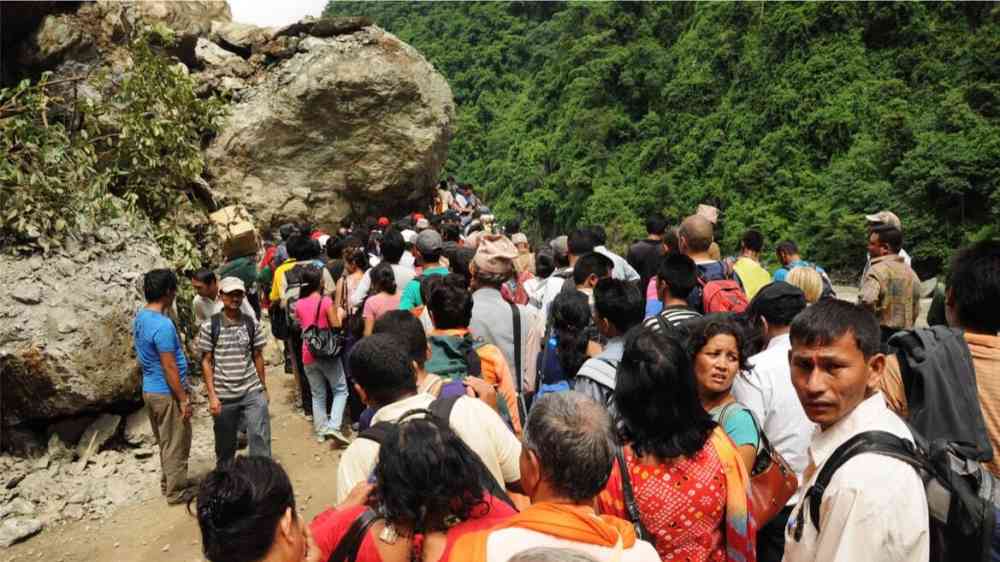
Nepalis wait as engineers remove a boulder fallen on the road due to a landslide
Update

In Landslides, it is difficult to locate potential survivors, as landslides carry away buildings and their occupants in an unpredictable manner. What causes these devastating events and why are they so sudden and unpredictable?

Conversation Media Group, the
Landslide-affected road
Update

More than 2,000 people are now feared dead after a huge landslide buried a village in the highlands of Papua New Guinea, Australia's nearest neighbor.

Conversation Media Group, the
Cover
Documents and publications

Based on research of past scenario efforts as well as emerging approaches, this guidance is designed to help practitioners develop “next generation” scenarios that motivate policy development and action to mitigate risk.

GeoHazards International
Research briefs

Researchers from IIT-Roorkee have claimed to have formulated a framework which can provide early warnings in the hills at least six hours in advance by studying rainfall patterns.

Times of India, the
Nepal - Badil Lama is an engineer trained in landslide mitigation by building safer roads
Update

Bioengineering techniques were used to stabilize exposed slopes in Himachal Pradesh as part of a flagship government to provide reliable all-weather connectivity.

Dialogue Earth
Landslide-affected road
Research briefs

By introducing a new paradigm for studying landslide shapes and failure types, a global team of researchers has provided help for those who work to predict landslides and risk evaluations.

Rochester Institute of Technology
The ruined remains of a building after an earthquake
Research briefs

By studying a miniature version of the ground in the lab, scientists at the UvA Institute of Physics have demonstrated how earthquakes and landslides can be triggered by a small external shock wave.

The University of Amsterdam
Repairs to an active landslide on U.S. Route 101 in 2021
Research briefs

A new study goes deep into the Gulf of Alaska to examine the sixth-largest underwater landslide and investigate why a similar event hasn’t happened since.

Eos - AGU
Uploaded on