1. Home
  2. Knowledge Base | PreventionWeb
  3. Hazards

Landslide

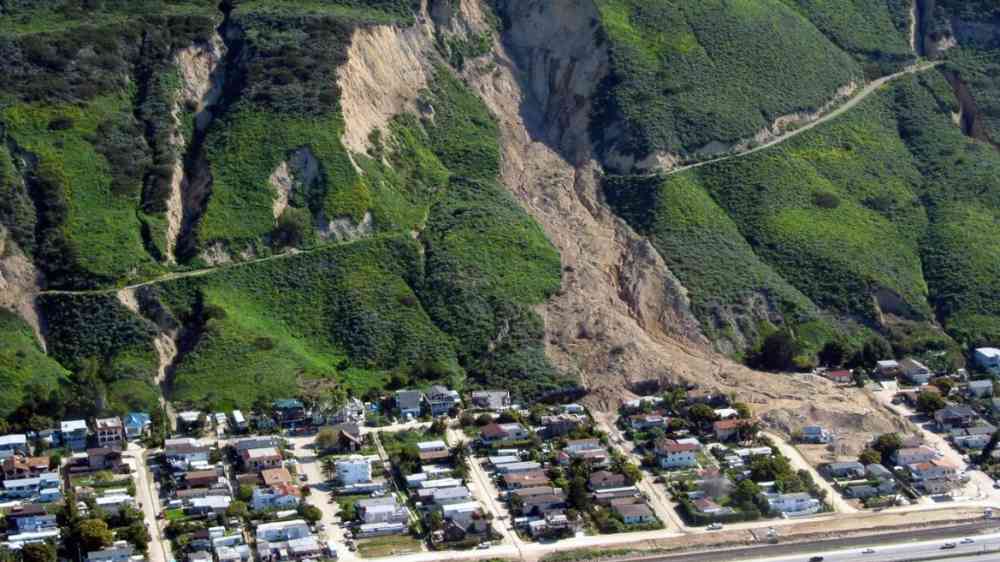
Landslide is the downslope movement of soil, rock and organic materials under the effects of gravity, which occurs when the gravitational driving forces exceed the frictional resistance of the material resisting on the slope. Landslides could be terrestrial or submarine (Varnes, 1978).

Landslides can be triggered by geological and physical causes such as glacier or snow melts, heavy rains and water pressure, earthquakes, volcanic eruptions and overly steep slopes. Landslides can also be triggered by human action, the most common being building on unstable slopes. Submarine landslides, or massive slides and rock falls hitting the sea can also cause tsunamis.

Landslides can reach speeds of over 50 km/h and can bury, crush or carry away people, objects and buildings. Landslides cannot be predicted but warning systems measuring rainfall levels can provide warning to people living in landslide-prone areas.

Instrumental monitoring to detect movement and the rate of movement can be implemented, for example, extensometers, global positioning system (GPS), seismometers, aerial photography, satellite images, LiDaR (Highland and Bobrowsky, 2008), with varying degrees of success. Increasingly, the science of landslide physics is allowing the nature of these hazards to be understood, which is leading to better techniques through which they can be managed and mitigated (HIP).

Risk factors

  • Population growth
  • Rapid urbanisation
  • Environmental degradation (deforestation and inappropriate use of lands and slopes)
  • High population density, heavy rainfall and rapid land use changes increase the instability of slopes

Risk reduction measures

  • Early warning systems to observe and alert before landslides happen
  • Hazard maps to identify landslides risk and vulnerabilities
  • Integrate landslide risk assessment into urban planning strategies
  • Building codes and standards for materials that reinforce landslide resilience
  • Improve drainage, building tunnels and trenches to stabilise slopes
  • Protect forest cover and regulate logging
  • Raise awareness of landslide risk
  • Regular drills and community evacuation exercises
  • Establish national, regional, and local evacuation plans
Latest Land Slide additions in the Knowledge Base

Uploaded on
Cover
Policies and plans
Policy type
National policies and plans

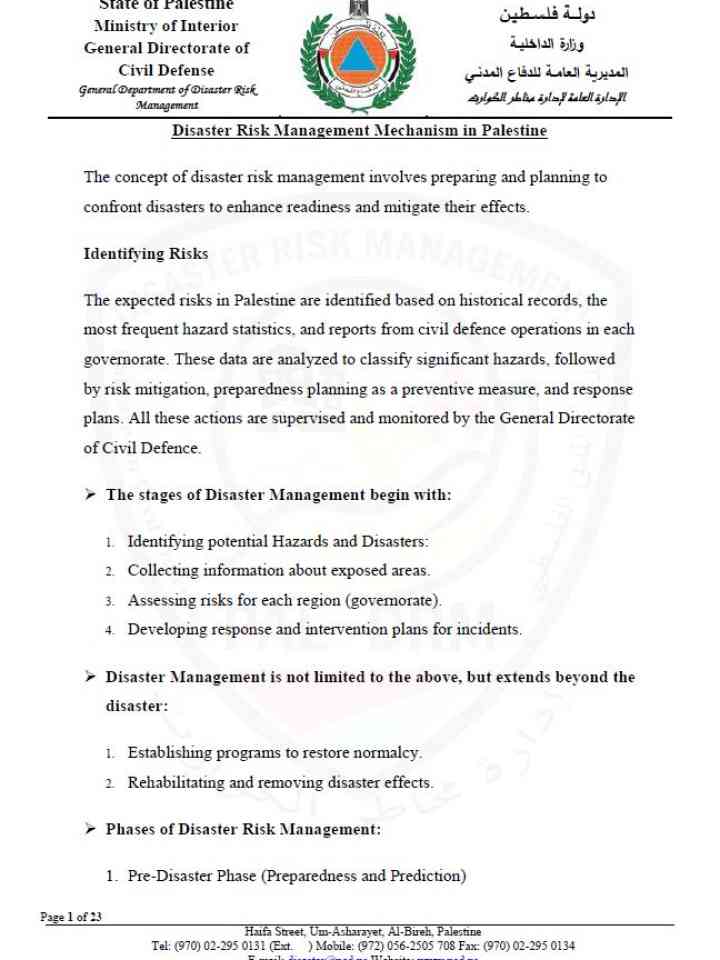
This document explains the disaster disk management mechanism in Palestine.

State of Palestine - government
Cover
Documents and publications

This report analyzes the 2024 Hualien (Taiwan) and Noto Peninsula (Japan) earthquakes, focusing on disaster risk management and critical infrastructure impacts.

防災科学技術研究所 National Research Institute for Earth Science and Disaster Resilience
National Science and Technology Center for Disaster Reduction, the (NCDR)
Cover
Documents and publications

This study utilizes historical data from the Kalahaisu landslide in Xinyuan County, Ili region, which was monitored using various techniques.

Nature Scientific Reports
Research briefs

From rockfall to ice avalanches, climate change is altering natural hazards in the Alps.

Swiss Federal Research Institute for Forest, Snow and Landscape Research (WSL)
Rocks block a road in Tejeros, Gran Canaria, Spain after heavy rains trigger landslides and rockfalls
Research briefs

When the Brienz rockslide rumbled down into the valley in 2023, a research team from WSL and ETH Zurich successfully measured the tremors using a new method.

Swiss Federal Research Institute for Forest, Snow and Landscape Research (WSL)
Rock and soil cover destroyed houses in La Conchita, California after a landslide tore through the community in 2005.
Update

A new method provides highly accurate continental-scale landslide susceptibility maps that are being used in the aftermath of Hurricane Helene.

Eos - AGU
Research briefs

The finding is an important breakthrough suggesting that a model designed for faults can also be used to predict landslide behavior. The new study used detailed data from two landslide sites in Northern California.

University of California, Santa Cruz
 Flood Refuge
Update

Researchers from Nepal, India, Sweden, Australia, the United States, and the UK collaborated to assess to what extent human-induced climate change altered the likelihood and intensity of extreme rainfall that led to devastating landslides and floods.

World Weather Attribution
Uploaded on