Queensland Betterment Fund, investing to create stronger, more resilient Queensland communities
Queensland leads the nation in delivering betterment programs that demonstrate how upfront investments in stronger, more resilient assets, saves money for all levels of government in future disasters.
Description
QRA is responsible for managing and coordinating the Queensland Government’s program of infrastructure renewal and recovery within disaster‐affected communities, with a focus on working with our state and local government partners to continue to deliver best practice administration of public reconstruction and resilience funds.
Examples of betterment include improvements to vital infrastructure such as roads, bridges and floodways. These improvements can vary from stabilisation of low-lying roads to reduce erosion and scouring, upgrades to drainage structures to increase capacity or replacing gravel with reinforced concrete to improve resilience.
Queensland Betterment Funds are jointly funded (50:50) by the Australian and Queensland Governments.
Under the program there have been six separate betterment programs:
• 2022 Central, Southern and Western Queensland Rainfall and Flooding; Ex-Tropical Cyclone Seth Flooding; and the South-East Queensland Heavy Rainfall and Flooding event $170 million Betterment Fund
• 2021 (2020-21) disaster season $20 million Betterment Fund
• 2019 North and Far North Queensland Monsoon Trough $102 million Betterment Fund (delivered)
• 2017 Severe Tropical Cyclone Debbie $41.85 million Betterment Fund (delivered)
• 2015 Severe Tropical Cyclone Marcia $20 million Betterment Fund (delivered)
• 2013 Severe Tropical Cyclone Oswald $80 million Betterment Fund (delivered).
Did the Sendai Framework change or contribute to changes in your activities/organization? If so, how?
The Sendai Framework continues to assist in setting policy context for these programs, encouraging investment in disaster risk prevention to improve project outcomes and Queensland’s future resilience to disasters.
The continued influence of the Sendai Framework is highly prevalent in the development of these programs and more broadly, highlighted in the Queensland Strategy for Disaster Resilience (QSDR) 2022-2027, which identifies strategic commitments that will embed disaster risk reduction and resilience into decision making. The QSDR is aligned to international best practice, including the Sendai Framework, promoting opportunities to build resilience across Queensland.
What led you to make this commitment/initiative?
What was your position before making this Voluntary Commitment / prior to the Sendai Framework?
QRA is the state’s lead agency responsible for disaster recovery and resilience policy in Queensland. The Queensland Government is committed to strengthening disaster resilience to ensure communities are better equipped to deal with the increasing prevalence of disasters.
Prior to the creation of the Betterment program, projects were being repaired without emphasis on the need to make them more resilient to future potential disasters. Therefore, the approach to reconstruction needed to change and the focus moved to betterment.
Through making this commitment, QRA will be able to share our learnings in relation to betterment programs, demonstrate the importance of investment in resilience, and highlight our progress with the international community.
Deliverables and Progress report
Deliverables
Deliverables are the end-products of the initiative/commitment, which can include issuance of publications or knowledge products, outcomes of workshops, training programs, videos, links, photographs, etc.
232 projects across 35 local government areas were approved.
Project Highlight: Gayndah Mundubbera Road
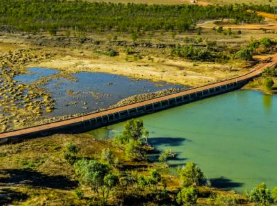
Gayndah Mundubbera Road is an essential freight and transport link for the North Burnett region. The road was damaged in 2011 and rebuilt only to be re-damaged in 2013. Betterment funding from 2013 was used to increase the resilience of the two-kilometre section of road adjacent to the Burnett River that was washed out, relocating it 11 metres uphill. New stormwater drainage works (including concrete lined channels, culverts and scour protection) were also completed, improving functionality of the entire Gayndah Mundubbera Road.
The road has since been impacted by seven natural disaster events (one in 2015, one in 2016, two in 2017 and three in 2022) and has remained functional with only minor expenditure required to clean up and remove debris.
58 projects across 8 local government areas were approved.
Project highlight: Scenic Highway
Scenic Highway suffered major landslips and severe erosion at Statue Bay during Severe Tropical Cyclone Marcia in 2015.
The highway is the key link between Yeppoon and communities along Keppel Coast. It provides key access to tourism and boating facilities at Rosslyn Bay - the only access to the Keppel Islands and the Great Barrier Reef from Central Queensland.
The work was a complex balance between sensitivity and engineering as it is adjacent to delicate marine ecosystems in a challenging location with exposed coastal conditions. It was also a complex geotechnical site, with a steep cliff face to the east with residents atop, and a severely damaged downslope interfacing with both sand and rock. Council was approved for a NDRRA Category D Betterment project to restore and increase the resilience of the road at the impact site and reopened the road on July 2018.
83 projects across 22 local government areas were approved.
Project highlight: Shute Harbour Restoration
Shute Harbour in the Whitsunday Regional Council area was significantly damaged as a result of Severe Tropical Cyclone Debbie in late March 2017.
QRA also secured three extensions of time for the project , extending the allowable time limit until 31 December 2021, and approved final budget for costs under the NDRRA of approximately $60 million with Council also contributing to the project.
Following demolition works, construction of the new marine facility commenced in February 2021. Not only has the project seen the complete rebuild of the terminal facility, the finger wharves and the ferry pontoons, a discreet $1.8 million Betterment project to raise the height of the seawall by up to a metre, helping to protect the new facility against future cyclonic events.
107 projects across 35 local government areas were approved.
Project highlight: Sedan Dip Road
Sedan Dip Road in Cloncurry Shire in remote north western Queensland has been rebuilt better than ever after it was damaged by the monsoon and floods in February 2019.
The road works received $9.4 million in Betterment funding under the joint Commonwealth and Queensland Governments Disaster Recovery Funding Arrangements. Sedan Dip Road provides essential access for livestock from major pastoral operations across two shires.
This betterment funding has allowed Cloncurry Shire Council to increase the longevity of the road, giving primary producers the ability to move to and from their properties as required.
The Betterment upgrade works will also provide the remote communities of Cloncurry and McKinlay access to vital services in the event of a crisis.
The Betterment Funding created construction jobs as well as improving the safety and efficiency of The Sedan Dip Road many times over.
The Queensland Government has established a $20 million Betterment Fund that will be available in 47 local government areas in Queensland impacted in the 2020-21 disaster season. It is jointly funded by the Australian and Queensland governments.
The Queensland Government has established a $170 million Betterment Fund ($150 million under DRFA Category D and $20 million DRFA Category E) that will be available across local government areas in Queensland impacted in the 2021-22 disaster season. It is jointly funded by the Australian and Queensland governments.
Porgress report
DELIVERABLE FIVE: 2021 (2020-21) disaster season $20 million Betterment Fund.
The Queensland Government has established a $20 million Betterment Fund that will be available in 47 local government areas in Queensland impacted in the 2020-21 disaster season.
There are 38 projects across 20 councils that have been approved and are in delivery. Just over $8.8 million has been approved for betterment projects in 8 Aboriginal and Torres Strait Islander Local Government Areas.
DELIVERABLE SIX: 2022 Rainfall, Flooding and Ex-Tropical Cyclone $170 million Betterment Fund
The Queensland Government has established a $170 million Betterment Fund that will be available across local government areas in Queensland impacted in the 2021-22 disaster season.
There are 44 approved projects across 20 Local Government Areas and the Department of Transport and Main Roads. These projects total a value of $52.4M (as of 11 July 2023). This program has been oversubscribed due to high demand.
Of the 531 betterment projects completed to date, 423 projects have been subsequently impacted a total of 1173 times across 44 events. An interactive map on Betterment projects is available on the QRA website - https://www.qra.qld.gov.au/betterment/betterment-projects-interactive-map-and-list
79 per cent of those impacted suffered no damage, or only minor superficial damage. From a $174 million investment, there is $397.5 million in avoided reconstruction costs*.
*Avoided costs are estimates only, based on data provided by councils on impacts or likely impacts, and calculated on eligible reconstruction costs under Category B of the Disaster Recovery Funding Arrangements / Natural Disaster Relief and Recovery Arrangements at the time of project approval. Information is current as of July 2023.
Organizations and focal points
Implementing Organization(s)
Focal points
Partners