100 years of fortitude: Strengthening urban resilience against disasters
In today’s world, faced with the threats of climate change and extreme weather events, high marks are given to those cities that are built for residents’ well-being, even in the face of hazards.
As a place to live, work, study and travel, Tokyo, ranked second on the Savills Resilient Cities Index for 2024, is uniquely placed to provide resilience because of its experience of rebuilding after natural disasters. During the Great Kanto earthquake in 1923, nearly half of the city was destroyed by fire. In the process of rebuilding, Tokyo developed new parks, schools, roads, bridges and housing, transforming itself into a modern city and laying the foundation for the Tokyo we know today, a century after the disaster.
“Building on the spirit of our predecessors, the Tokyo Metropolitan Government (TMG) has steadily achieved results on city resilience by enhancing a wide range of measures,” Kiyotoshi Koga, Director for Project Promotion, Planning and Coordination Division, Office of the Governor for Policy Planning says. “These include planned implementation of various infrastructure projects to prepare for disasters like earthquakes and floods, and promoting initiatives that encourage self-help and mutual aid.”
Building on the spirit of our predecessors, the Tokyo Metropolitan Government (TMG) has steadily achieved results by enhancing a wide range of measures
— Kiyotoshi Koga, Director for Project Promotion, Planning and Coordination Division, Office of the Governor for Policy Planning, Tokyo Metropolitan Government
Delivering a century of safety
Crucially, the centenary of the quake inspired TMG to formulate the TOKYO Resilience Project in December 2022. This project outlines the vision for a resilient Tokyo by the 2040s, addressing five major crises: wind and flood disasters, earthquakes, volcanic eruptions, disruptions to power and communications, and infectious diseases, clarifying the vision for Tokyo and the direction for its realisation.
In December 2023, the project was upgraded "to accurately grasp evolving risks, such as the increasing frequency and severity of wind and water disasters due to climate change, and to strengthen and expand countermeasures from both hardware and software perspectives,” according to Mr Koga. The enhancements help solidify the path toward realising the project’s vision for the 2040s, aiming for a resilient and sustainable city where people can live with a peace of mind for the next 100 years.
Guarding against floods
The Kanda River, which runs about 25km east-west through central Tokyo, historically broke its banks so often after storms and typhoons that it earned the nickname Abaregawa (“rampage river”).
In 1958, for example, a typhoon caused the river system to flood nearly 40,000 houses across 1,194 hectares of land. A few decades later, a huge underground regulating reservoir was constructed, which has since greatly reduced flood risks, with a typhoon in 2004 inundating just 4 hectares and 46 buildings.
Following reports by the Intergovernmental Panel on Climate Change and Japan’s land ministry, greater threats from flooding are expected to hit Tokyo in the decades to come, with increased temperatures and rainfall along with a sea-level rise of up to 60cm. The city’s vision for the future involves protecting areas that are low-lying or next to water and securing evacuation routes, so that residents can live without worrying about flood and storm damage.
This builds on existing flood-resistant measures such as sloping “super levees”—found along the Sumida, Nakagawa, Kyu-Edo, Shin-Nakagawa and Ayase rivers—which replace traditional vertical seawalls with gently sloping embankments together with pedestrian walkways. These improvements not only protect against rising sea levels and tsunamis, but also boost urban mobility and increase the appeal of the city’s riversides.
Further super levees and floodgates will be built to protect against storms and high tides, while seawalls are being raised to new heights that account for projected sea levels. Work will also be done to prevent objects such as roadside trees, signboards and abandoned buildings from turning into projectiles during high winds.
Related video: How Japan uses drones and technology to save lives from tsunamis
In 2011, the Great East Japan Earthquake and Tsunami revealed critical gaps in early warning systems, with 35% of people in exposed areas missing vital audio alerts.
Since then, Japan has invested heavily in disaster-resilient infrastructure, early warning systems, and cutting-edge technologies to protect communities. In Sendai, drones now automatically take off when tsunami warnings are issued, reaching areas traditional speakers cannot, and helping save lives while keeping people safe.
Building for earthquakes
There is a 70% chance that a magnitude 7 class earthquake will hit the Tokyo area in the next 30 years. But the city will be well prepared, having already implemented stringent building codes and advanced early-warning systems, and invested substantially in seismic retrofitting.
The goal is for Tokyo to be a city that can avoid collapse or fire and save lives even in a major earthquake. That means building infrastructure with high seismic resistance. Flood control facilities are already designed with this in mind, and seismic reinforcement are being implemented in water pipelines. Seismic joints implementation, and financial support initiatives for retrofitting ageing apartment buildings and wooden houses will also be continued.
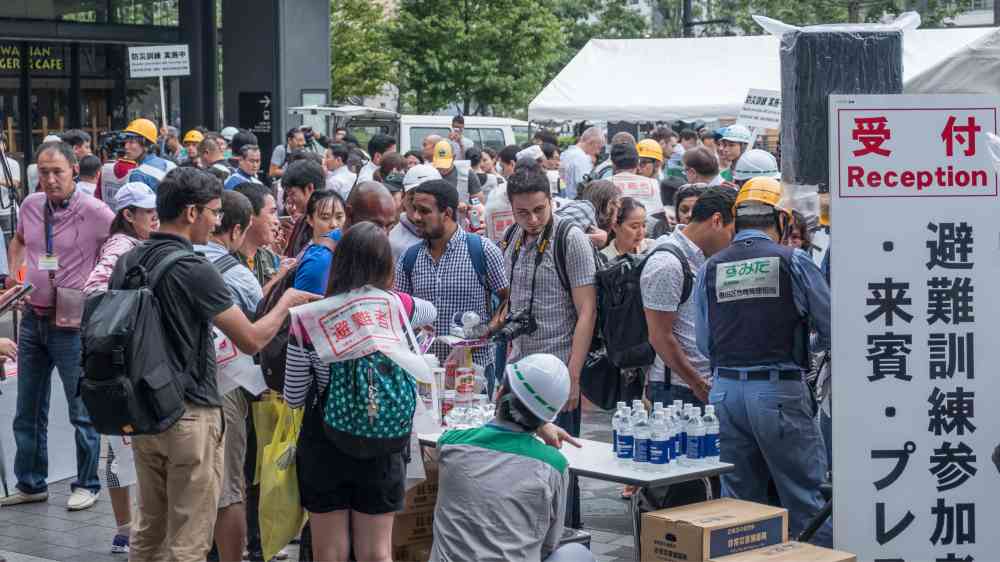
Beyond infrastructure development, resident-participatory disaster drills are crucial for enhancing disaster resilience. TMG, in collaboration with wards, cities, towns, and villages, is advancing initiatives to strengthen self-help and mutual aid capabilities. This includes conducting drills where residents can learn disaster preparedness skills through simulation exercises.
Withstanding the fires
When it comes to disaster preparedness, fire safety can be a blind spot—despite the fact that fires could cause 70% of deaths from an earthquake in the Tokyo Metropolitan area. Recalling the Great Kanto earthquake, it was the widespread fires that raged in the days after that claimed majority of the lives lost.
As such, fire and disaster prevention training is a high priority for the city, with the Tokyo Fire Department reporting that it held almost 10,000 drills in the fiscal year 2024, with nearly 1.5m participants, focused on firefighting, evacuation and first aid.
Furthermore, fire rescue mobile units called Hyper Rescue, that are special advanced rescue teams, are strategically deployed throughout Tokyo. They possess advanced expertise in rescue operations, chemical, biological, radiological or nuclear materials (CBRN) disaster response, hazardous material handling, heavy machinery operation, and emergency medical care. They are also equipped with the latest rescue equipment, including ground acoustic probes and electromagnetic life detection devices. Combined, this system enables swift and precise response during disasters.
A secure destination for work, travel—and life
Tokyo’s vision for resilience in the coming century doesn’t just stop within the city, but expands beyond to regional cooperation in terms of sharing technology, solutions and best practices. In 2022, TMG launched the Global City Network for Sustainability, also known as ‘G-NETS’, to share insights around common challenges faced by cities worldwide with over 100 participating locations. “We believe ‘multicity lateral cooperation’—pursuing knowledge sharing and practical actions for cities to mutually support each other—is more important than ever,” Mr Koga says.
We believe ‘multicity lateral cooperation’—pursuing knowledge sharing and practical actions for cities to mutually support each other—is more important than ever
— Kiyotoshi Koga, Director for Project Promotion, Planning and Coordination Division, Office of the Governor for Policy Planning, Tokyo Metropolitan Government
Tokyo’s high quality of life is already a significant draw for the talent that Tokyo wants, and these continued efforts by TMG to strengthen its future against myriad threats only offer higher confidence to those who visit or live, work and study in the city. “We are also advancing measures against power and communication outages, promoting the use of renewable energy and diversifying communication methods to maintain urban functions even during disasters,” Mr Koga says. “We will steadily advance our initiatives to enhance resilience and realise a resilient and sustainable Tokyo where people can live with peace of mind for the next 100 years.”