What a Swiss nuclear disaster could do to Europe

If there were to be a serious accident at one of Switzerland's nuclear reactors, many of the radiation victims would be residents of other countries.
A Swiss-led study has calculated the potential effect of nuclear meltdowns on the health of people living nearby. Its focus is on how meteorology and geography would influence the movement of a radioactive cloud.
For example, this clip illustrates how the weather conditions on January 19, 2017 would have shaped the aftermath of an accident at the Gösgen reactor between Bern and Zurich.
The study was led by Frédéric-Paul Piguet at Institut BiosphèreExternal link, an interdisciplinary research institute in Geneva. Piguet and his team examined the accident risk at Switzerland's five nuclear power plants, which fall between Fukushima and Chernobyl in terms of size. This includes 50-year-old Beznau I in northern Switzerland, the oldest nuclear reactor in the world.
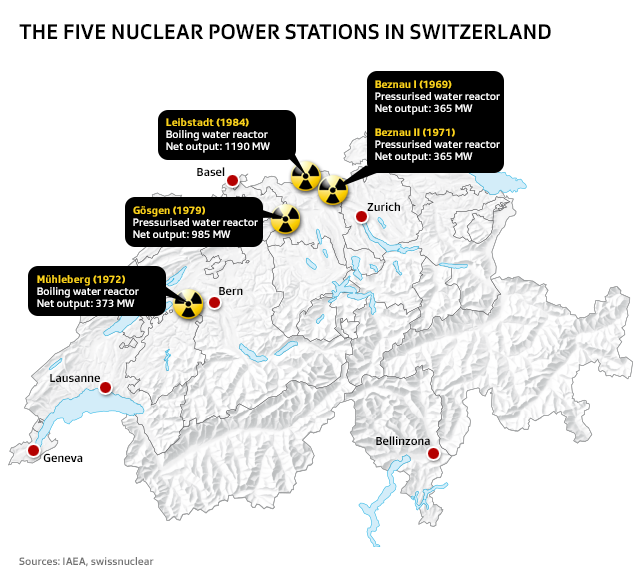
The research team used the weather conditions throughout 2017 to calculate the fallout of disasters at the Swiss reactors and concluded that 16-24 million Europeans would be affected by a nuclear meltdown in Switzerland, which itself has a population of 8.5 million. They reckoned that 12,500-31,100 people would die on account of cancer and heart problems caused by the radiation. On top of that, there would be additional health problems, including genetic maladies and sterility.
According to the study, wet weather would nearly double the number of severe radiation-related illnesses. In 2017, there were 36 such "bad weather" days. The study is being presented in detail on Tuesday in Bern.
An 'unrealistic event'
The association of Swiss nuclear power station operators, swissnuclearExternal link, told swissinfo.ch that it had taken note of the study and was planning to examine it in detail in the next days.
"The Swiss nuclear power plants have been designed, built and regularly retrofitted in such a way that they can cope with severe accidents," explained a swissnuclear spokeswoman, calling the situation described by the study an "unrealistic event".
"Thanks to multiple and independent safety systems, it is extremely unlikely that a serious accident will occur."
Switzerland's nuclear power plants are supervised by the Swiss Federal Nuclear Safety InspectorateExternal link.
In 2017, the Swiss voted to gradually phase out nuclear power and to ban the construction of new nuclear power plants. About 32% of Switzerland's electricity productionExternal link is nuclear.
This article originally appeared on swissinfo.ch, the International Service of the Swiss Broadcasting Corporation.