Towards anticipatory disaster risk financing and index insurance mechanisms for resilience building in Eastern Africa
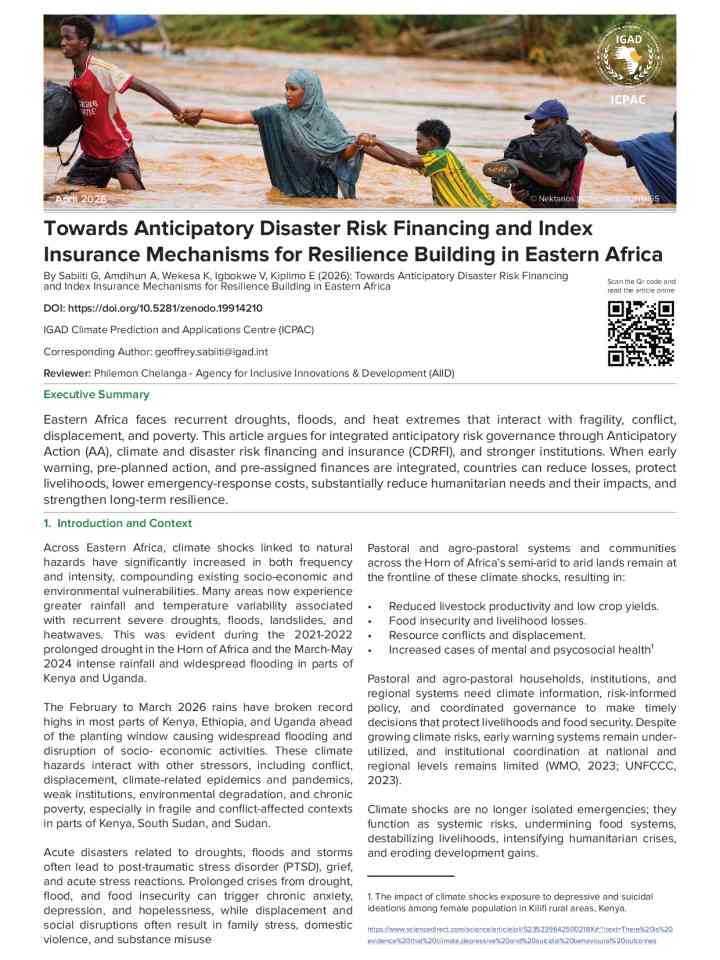
Eastern Africa faces recurrent and intensifying climate hazards — including droughts, floods, landslides, and heatwaves — that interact with conflict, displacement, fragility, and chronic poverty to compound vulnerability across the region. Pastoral and agro-pastoral communities in the Horn of Africa's semi-arid lands bear the greatest burden, experiencing livestock losses, food insecurity, resource conflicts, and deteriorating mental health. The 2021–2022 prolonged drought caused the loss of over 13 million livestock, while African countries are estimated to lose 2–5% of GDP annually to climate extremes, with some governments diverting up to 9% of public budgets to climate response. Against this backdrop, this article argues for a paradigm shift from reactive post-crisis response toward integrated anticipatory risk governance, combining Anticipatory Action (AA), climate and disaster risk financing and insurance (CDRFI), and strengthened regional institutions.
The findings demonstrate that when early warning systems, pre-arranged financing, and pre-agreed early actions are integrated, the results include reduced livelihood losses, lower humanitarian costs, faster response times, and improved food security. Under conservative to moderate implementation assumptions, integrated AA and CDRFI systems could generate approximately US$1.5–6.0 billion in annual avoided losses and response-cost savings across Eastern Africa. Despite this potential, a protection gap exceeding 80% persists, with the region requiring an estimated US$27 million per year, while in 2025 only 34% of the US$7 billion needed for 34 million people was funded. Key barriers to scaling include weak climate data infrastructure, fragmented humanitarian and development financing, limited insurance market development, low financial inclusion, and policy rigidity. The article recommends institutionalizing anticipatory action within national disaster risk frameworks, expanding sovereign and regional risk pooling, scaling micro-insurance for vulnerable households, and strengthening governance to ensure transparent and accountable use of anticipatory funds across Djibouti, Ethiopia, Kenya, South Sudan, Sudan, Somalia, and Uganda.
Explore further