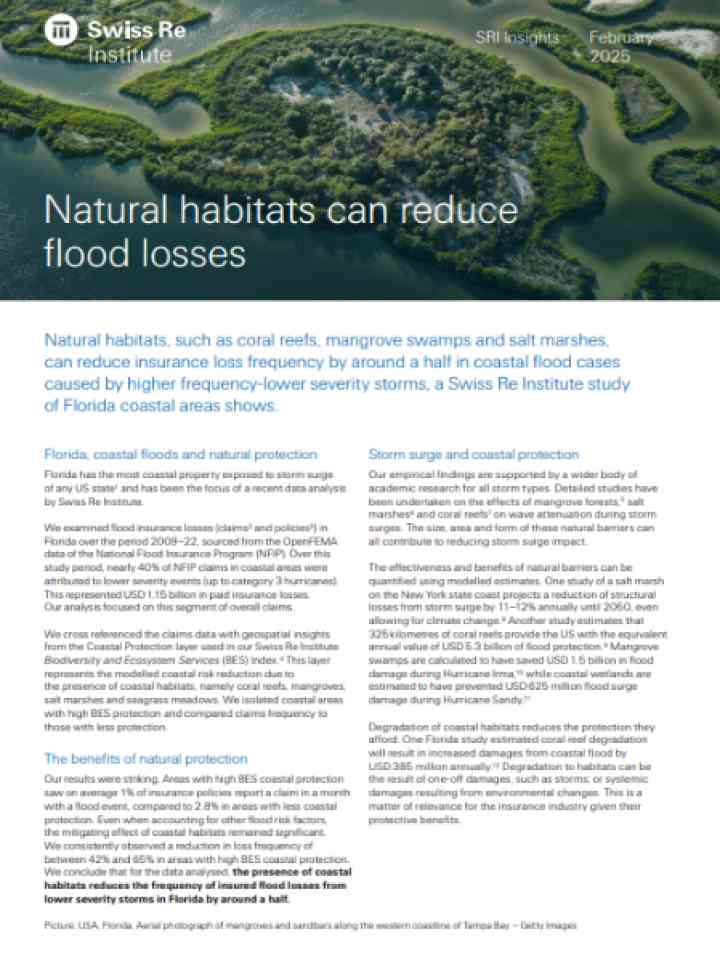
Report: Natural habitats can reduce flood losses
This Swiss Re Institute briefer explains how natural habitats, such as coral reefs, mangrove swamps and salt marshes, can reduce insurance loss frequency by around a half in coastal flood cases caused by higher frequency-lower severity storms. Florida has the most coastal property exposed to storm surge of any US state and has been the focus of a recent data analysis by Swiss Re Institute. The study examined flood insurance losses (claims and policies) in Florida over the period 2009‒22, sourced from the OpenFEMA data of the National Flood Insurance Program (NFIP). Over this study period, nearly 40% of NFIP claims in coastal areas were attributed to lower severity events (up to category 3 hurricanes). This represented USD1.15 billion in paid insurance losses.
Swiss Re Institute's analysis focused on this segment of overall claims. The authors cross referenced the claims data with geospatial insights from the Coastal Protection layer used in the Swiss Re Institute Biodiversity and Ecosystem Services (BES) Index. This layer represents the modelled coastal risk reduction due to the presence of coastal habitats, namely coral reefs, mangroves, salt marshes and seagrass meadows. The authors isolated coastal areas with high BES protection and compared claims frequency to those with less protection. The results demonstrate the effectiveness of coastal habitats in reducing the impact of higher frequency-lower severity storm events in Florida.
Explore further