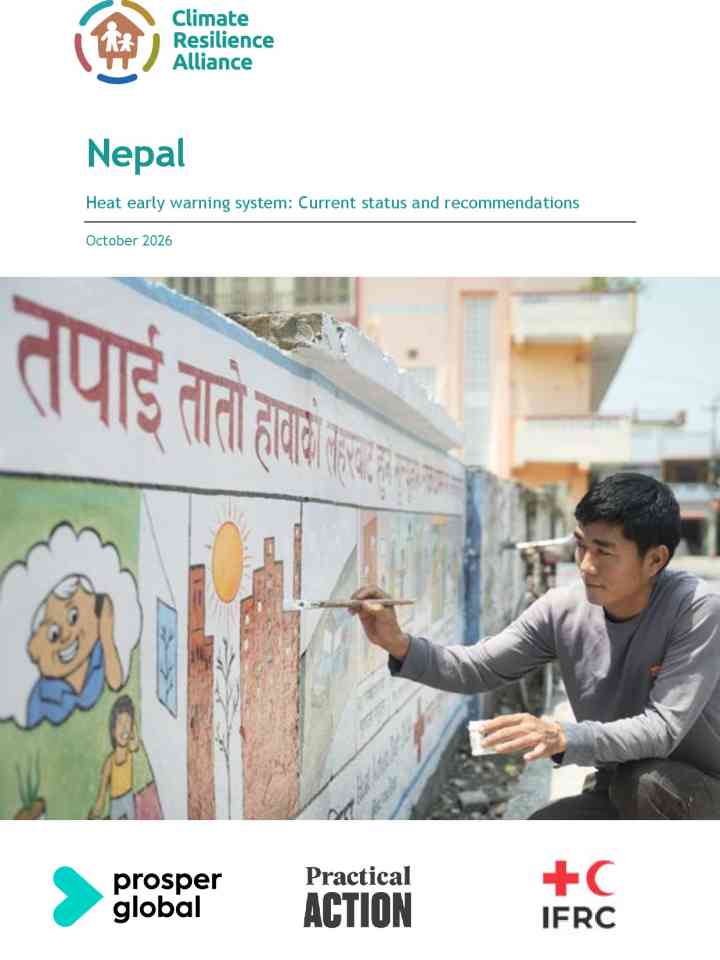
Heat early warning system in Nepal: Current status and recommendations
This case study examines the current status of Nepal’s heat early warning system (HEWS), focusing on risk knowledge, monitoring, warning dissemination, and preparedness. It was conducted through semi-structured interviews with stakeholders from meteorology, health, and humanitarian sectors—including DHM, Practical Action, Prosper Global, and the Ministry of Health—as well as a targeted review of peer-reviewed literature and grey documentation. The study is part of a wider assessment covering eight countries by the Zurich Climate Resilience Alliance, applying a common framework to analyse gaps, good practices, and enabling conditions for people-centred, impact-based early warning systems in Nepal.
Key findings highlight increasing awareness of heat risks, but note persistent gaps in national risk mapping, impact data, and institutionalized response. DHM has advanced heat monitoring and bulletins based on temperature percentiles, but limited use of humidity, short lead times, and unequal information dissemination constrain impact-based warnings. Expansion of municipal Heat Action Plans and simplified Early Action Protocols, mainly supported by NGOs and humanitarian partners, marks progress, yet these efforts require clearer national protocols, defined roles, and sustainable mechanisms to scale up. The authors recommend strengthening heat-health surveillance and data linkage, evolving warning triggers to include humidity and impact metrics, scaling local action plans, improving last-mile communication and feedback, and building on growing government engagement for better coordination and resourcing of HEWSs.
Explore further