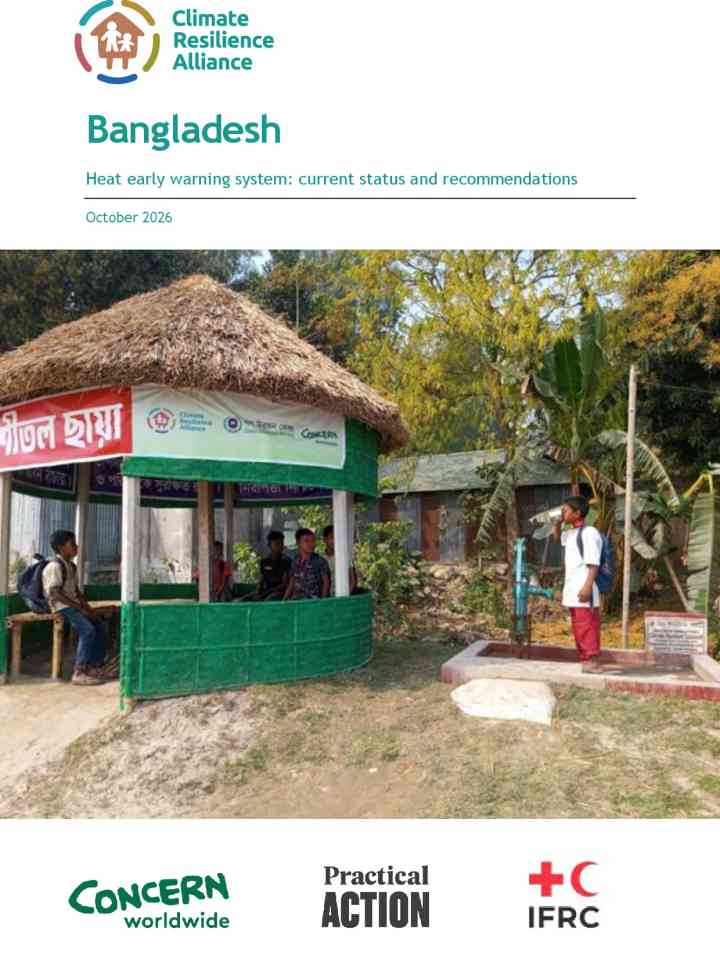
Heat early warning system in Bangladesh: Current status and recommendations
This case study examines the current status of Bangladesh’s heat early warning system (HEWS), outlining how heat risk is understood, monitored, and communicated, and how warnings prompt actions across institutions. Conducted in 2025 by the Zurich Climate Resilience Alliance, the study used a common analytical framework and gathered evidence from semi-structured interviews with key stakeholders—including meteorological and humanitarian organizations—as well as a targeted review of peer-reviewed and grey literature. The assessment was structured around four pillars of early warning systems: disaster risk knowledge; monitoring, analysis, and forecasting; warning dissemination and communication; and preparedness and response capabilities, with a focus on both urban and rural contexts.
Key findings show that while heat risk research is expanding, data remains uneven and concentrated in cities. The Bangladesh Meteorological Department employs national, hazard-based thresholds for warnings, but these do not account for regional or sectoral differences. Translating warnings into locally actionable information and linking them to concrete preparedness remains a challenge, as does institutional coordination, since heatwaves are not formally recognized as disasters within the country’s disaster management framework. The authors recommend strengthening impact data and localized risk knowledge, adopting region-specific thresholds, simplifying warnings for local audiences, institutionalizing community-based structures, and establishing formal trigger-action protocols. They also call for formal recognition of heatwaves within Bangladesh's disaster risk management system and full adoption and operationalization of the National Early Action Protocol to enable effective, coordinated heat preparedness and response.
Explore further