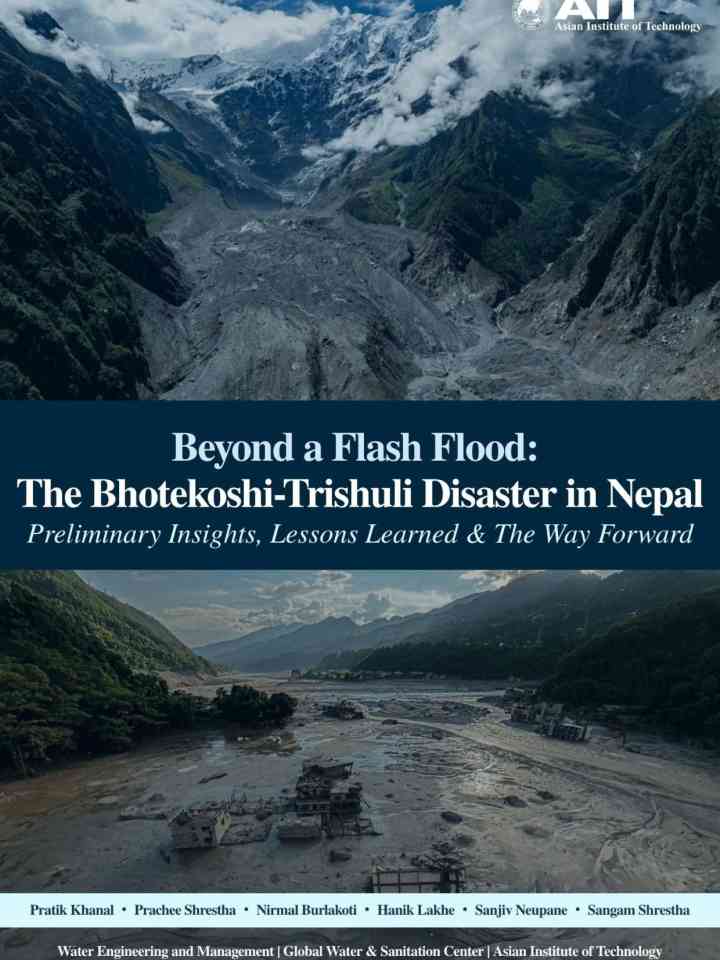
Beyond a flash flood: The Bhotekoshi-Trishuli disaster in Nepal - Preliminary insights, lessons learned and the the way forward
This report analyzes the catastrophic flash flood of 26 August 2026 in Nepal’s Rasuwa District, which devastated the Bhotekoshi-Trishuli river corridor. The study integrates meteorological and climate data, seismic records, satellite imagery, field observations, and sophisticated numerical modelling to reconstruct the event's causes, sequence, and impacts, to establish the disaster’s origins—a massive rock-ice avalanche—while evaluating hydroclimatic and seismic preconditions over several decades. .
Long-term warming, reduced snow cover, and glacier/permafrost degradation are found to have increasingly destabilized high mountain slopes, preconditioning the region for such failures. The authors recommend systemic shifts in risk management, highlighting the need for real-time slope and catchment monitoring, multi-hazard early warning systems, risk-informed and cross-border infrastructure planning, and localized, impact-based community warnings. The report emphasizes integrating satellite, seismic, and ground-based data and calls for a paradigm shift towards multi-hazard preparedness and transboundary cooperation to build resilience in vulnerable Himalayan regions.
Explore further