The 2025 Southeast Asian extreme rainfall: role of anthropogenic climate change
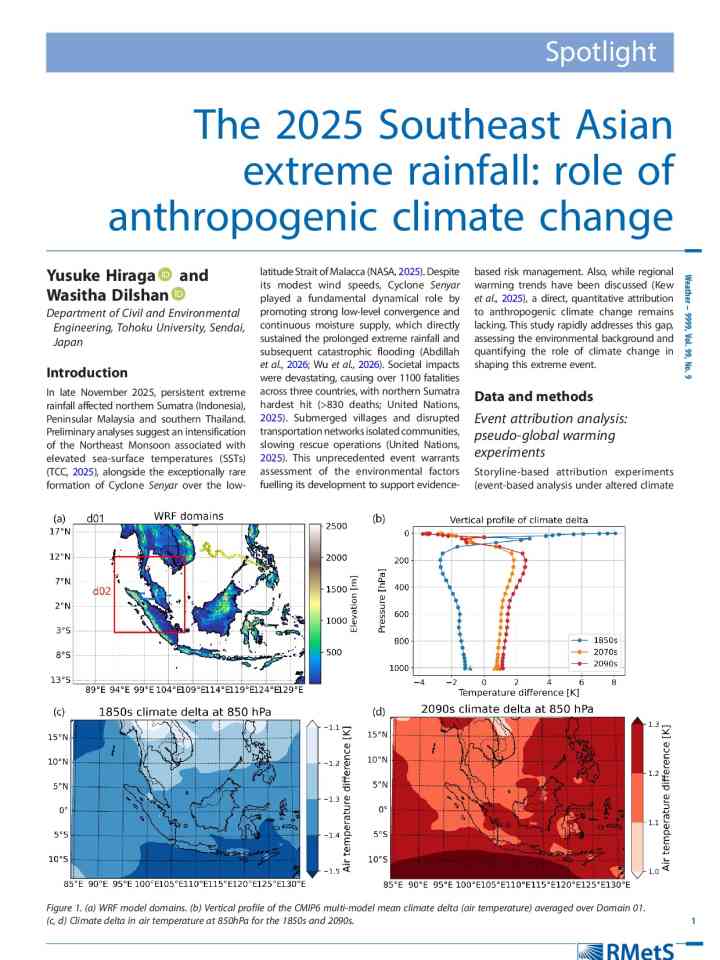
This study assesses the environmental background of the November 2025 extreme rainfall event that affected northern Sumatra, Peninsular Malaysia and southern Thailand, and quantifies the role of anthropogenic climate change in shaping the event. The authors used the Weather Research and Forecasting (WRF) model with storyline-based attribution experiments with a pseudo-global warming approach, combining climate signals from an 11-model CMIP6 ensemble with 36 simulations across four climate states from the 1850s to the 2090s. The analysis also used Multi-Source Weighted-Ensemble Precipitation (MSWEP) precipitation data and cyclone-track datasets to examine rainfall magnitude, rarity and future changes.
The study finds that anthropogenic climate change since the 1850s substantially increased the intensity of the event, with local rainfall enhancements exceeding 150 mm over parts of southern Thailand, northeastern Peninsular Malaysia and northern Sumatra. The authors show that rainfall intensification cannot be explained by thermodynamic moisture increases alone, highlighting severe, non-linear increases in flood risk. Projections indicate that this intensification will persist into the future. The authors recommend further research into low-latitude cyclone dynamics under warming, improved access to ground-based rainfall observations across Southeast Asia, evaluation of uncertainties in model physics parameterisations, and integration of hydrological and landslide modelling to strengthen climate risk assessment and adaptation planning
Explore further