Reading between the lines: Leveraging news data for AI-powered food insecurity forecasts

Reprinted by permission from VoxDev
A new AI-driven early warning system uses news data to predict food crises up to 12 months in advance–enabling faster, proactive responses.
Rethinking humanitarian responses to food crises
In early 2020, as COVID-19 lockdowns swept across East Africa, food prices surged, trade flows stalled, and millions were suddenly unable to access basic staples (FSIN and GNAFC 2020, FSIN and GNAFC 2021). Yet existing early warning systems remained largely silent. Forecasts issued just months earlier had considerably underestimated the scale of the unfolding crisis. By the time household surveys resumed and food security indicators were updated, the pandemic’s disruptions had already pushed food insecurity far beyond original forecasts, leaving policymakers ill-prepared to respond (FSIN and GNAFC 2021). Traditional monitoring systems simply could not keep pace with the rapidly evolving crisis.
This scenario is not unique to East Africa. Around the world, humanitarian and development actors routinely scramble to respond to crises that could have been anticipated months in advance. But the scale of global food insecurity demands more than reactive responses. The number of undernourished people worldwide increased from 572 million in 2014 to 733 million in 2023 (FAO et al. 2024). Climate change, the COVID-19 pandemic, and conflicts such as the war in Ukraine have pushed the world further from achieving Sustainable Development Goal 2: ending world hunger.
The consequences extend far beyond hunger. Food insecurity contributes to poor health outcomes, reduced productivity, and slower economic development–ultimately weighing down GDP growth (Ilaboya et al. 2012). In response, a growing consensus has emerged from UN agencies to bilateral donors, emphasising the urgent need for anticipatory action (FSIN and GNAFC 2025). Evidence shows that such early interventions can reduce humanitarian costs by up to 30%, yielding savings of US$2.8 for every $1 invested (World Bank 2023).
The promises and perils of existing systems
In response, the development community has made important strides in advancing anticipatory models. A wave of promising research efforts (Lentz et al. 2019, Foini et al. 2023, Shafi et al. 2023, Machefer et al. 2025), along with publicly available early warning systems such as the World Food Programme’s HungerMap are helping to turn this vision into reality. However, three critical limitations persist, highlighting a fundamental data challenge that undermines the effectiveness of early warning systems:
- Scalability: Household surveys–the backbone of many existing systems–are costly and infrequent, resulting in temporal lags and geographic gaps in data.
- Continuity: Government-maintained indicators, such as local food prices, often suffer from interruptions due to institutional capacity constraints–especially during conflict, a well-documented driver of food crises (Hendrix and Brinkman 2013).
- Reliability: Expert-based systems like the widely used FEWS NET Integrated Food Security Phase Classification, while valuable, rely on human judgement, which can slow the detection of emerging trends and introduce biases (Masri et al. 2024).
Figure 1: Overview of scalable AI system using news for food crisis predictions

Learning from the news: A new approach to crisis prediction
Meanwhile, the availability of digital data has expanded dramatically over the past decade–from satellite imagery (Jean et al. 2016) to mobile phone records (Blumenstock et al. 2015)–providing researchers with powerful new tools to address development challenges. Our research (Balashankar et al. 2023) explores another underutilised yet promising source of insights: news reporting.
News articles offer several unique advantages for crisis prediction. Unlike many traditional indicators used in early warning systems that reflect conditions after-the-fact, news is published daily, enabling high-frequency forecasting that can capture rapidly changing conditions. News aggregators provide transparent access to media content spanning decades, allowing researchers to build rich historical datasets for training AI models. Moreover, authoritative sources such as the BBC, Associated Press, or Reuters are widely trusted for their accuracy, even in local contexts, while regional outlets contribute additional perspectives that support more granular, district-level forecasts.
Figure 2: Uncovering text features related to food insecurity

We demonstrate how deep learning and natural language processing can harness the strengths of news data to predict food crises with unprecedented accuracy and timeliness. To do so, we developed a novel method that extracts references to food insecurity risk factors from 11+ million news articles covering food-insecure countries published between 1980 and 2020.
Through comprehensive analysis, we identified nearly 170 risk mentions (Figure 2) grounded in existing food insecurity research–including conflict, pests, drought, floods, and rising food prices–that signal emerging food security threats. We then constructed dynamic risk indicators based on the temporal and geographic patterns of these mentions, producing a rich, contextualised understanding of crisis drivers.
These news-derived features are then integrated into a machine learning model to generate monthly, district-level predictions of the Integrated Food Security Phase Classification (IPC), a globally recognised and widely used benchmark for measuring food security by policymakers and humanitarian agencies.
Our pilot study across 37 countries highlights the system's potential to deliver a fundamentally new type of early warning capabilities. The AI-powered approach predicts food crisis outbreaks up to 12 months in advance at the district-level, achieving 46% higher accuracy compared to existing systems. By delivering predictive insights that are both localised and timely, this approach offers a powerful and scalable complement to traditional monitoring tools.
Case study: The fall armyworm in South Sudan
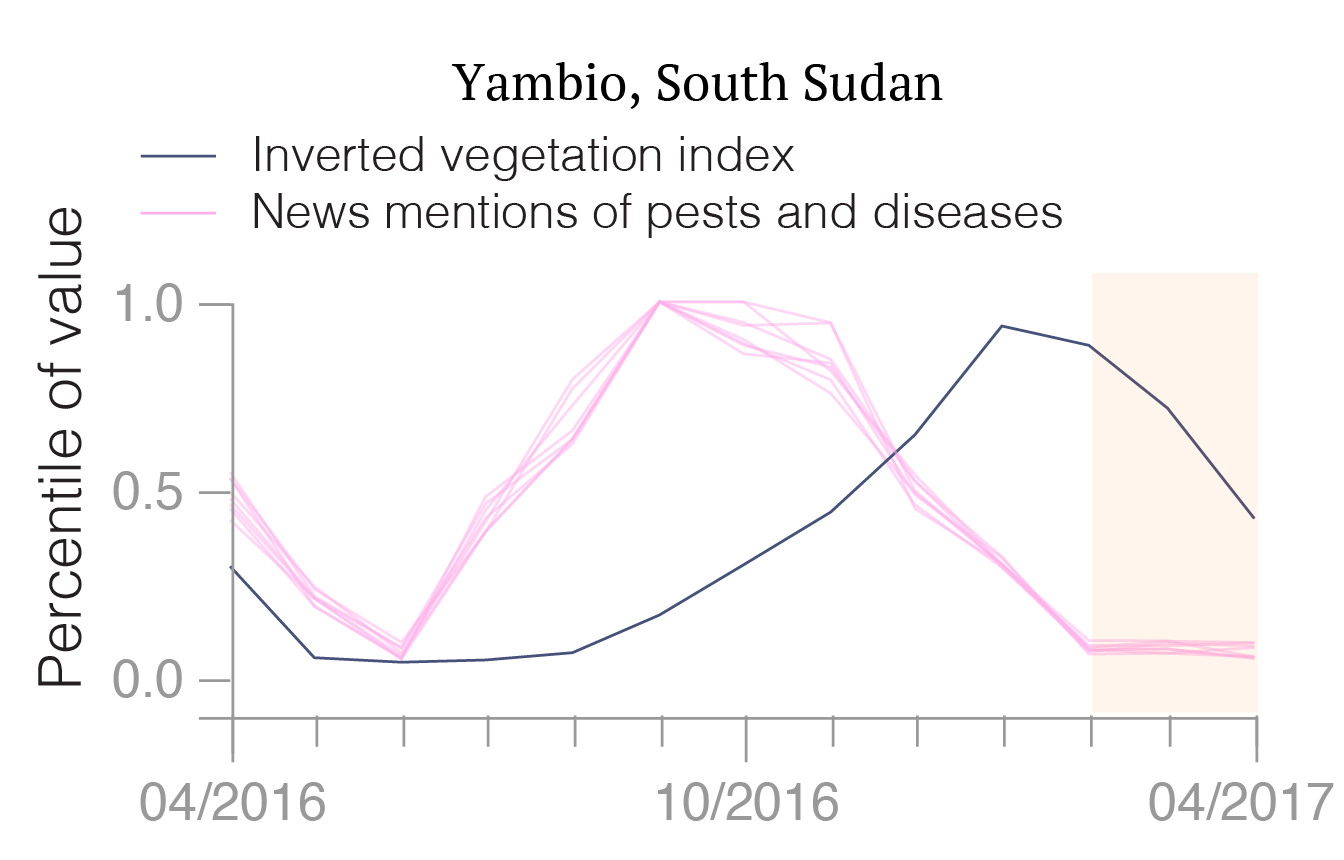
In early 2016, the fall armyworm–a lepidopteran pest native to the Americas–began spreading across 20 countries in Africa, decimating crop yields. In South Sudan's Yambio county, news mentions of pest-related terms peaked in September 2016, five months before the area’s IPC classification escalated from the ‘stressed’ to ‘crisis’ phase.
Our news-based model correctly predicted the impending crisis three months before the official classification change. In contrast, the vegetation index commonly used in traditional models detected signs of crop damage only one month prior to the crisis’ onset, providing far less lead time for meaningful intervention. This example illustrates how the early signs of agricultural disruption were captured in news coverage well before they appeared in satellite-based indicators.
Policy dividends of interpretability
Beyond accuracy, news-based forecasts offer a critical advantage: interpretability. Unlike machine learning models often criticised for being black boxes, our system enables policymakers to trace predictions back to specific spikes in news coverage–such as mentions of pests, price hikes, or conflict. The transparency supports more targeted and context-sensitive responses to emerging crises. The 2016 fall armyworm outbreak in South Sudan illustrates this advantage well. The model’s alert was directly linked to a surge in pest-related reporting, providing actionable insight months ahead of traditional indicators.
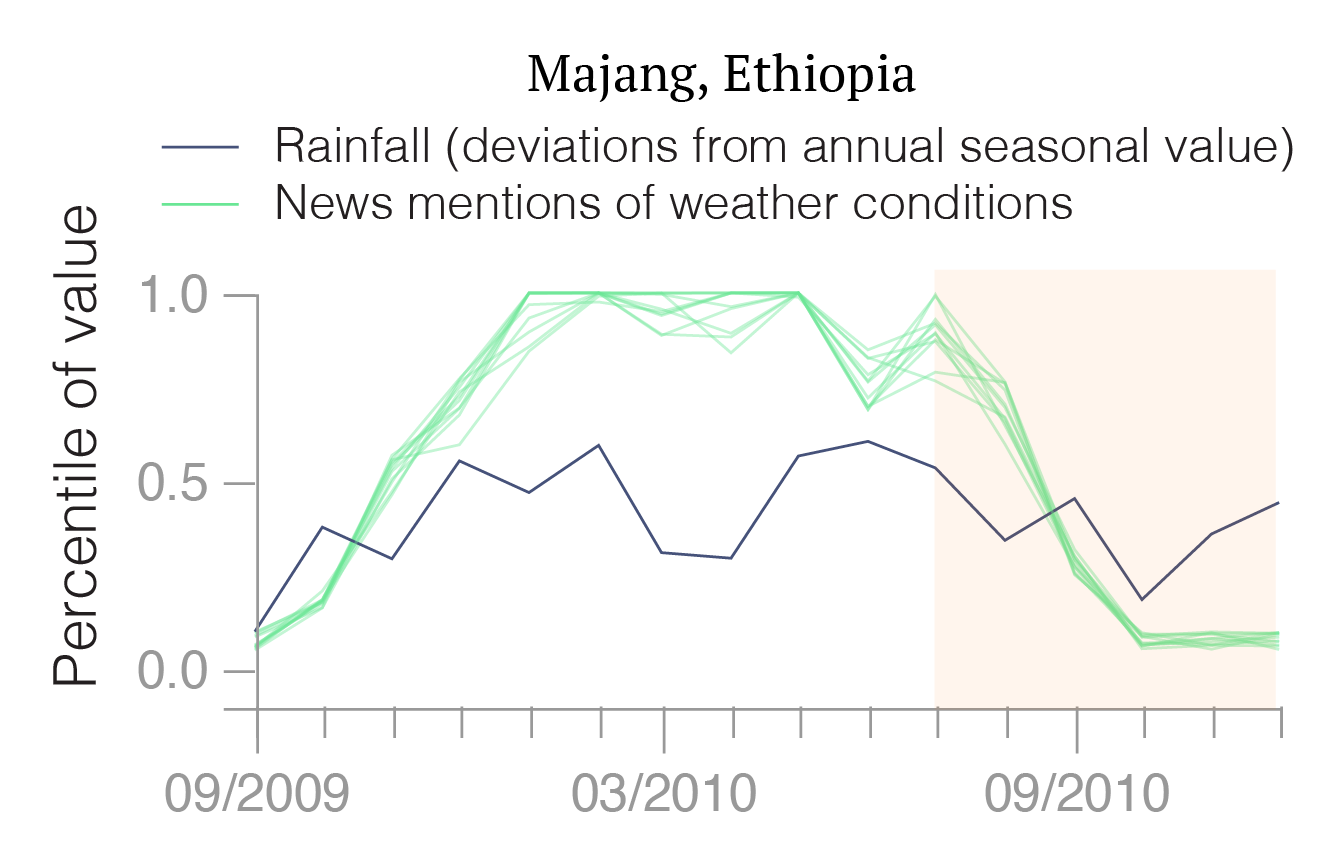
Such interpretability translates into more effective decision-making. For example, if a model alert is driven by disruptions in grain imports, appropriate responses might include revised import strategies or immediate in-kind food assistance (Mamun and Glauber 2025). If the signal is dominated by low rainfall, then scaling up irrigation support would be more effective (Chai et al. 2016). This level of specificity enhances both the efficiency and impact of interventions (Figure 3).
Figure 3: Illustration of temporal advantage of news-based risk indicators
The value of improved forecasting extends beyond accuracy–it critically enhances the timing of anticipatory measures. For instance, in rural Niger, small, regular cash transfers enabled households to smooth income and build resilience ahead of drought shocks. Welfare gains among drought-affected households exceeded the value of the transfers, with overall consumption increasing by 10% on average (Premand and Stoeffler 2022). In Nepal, households that received anticipatory cash support before severe flooding consumed more food and were 19% less likely to resort to harmful coping strategies–such as relying on less preferred food–compared to those receiving post-shock aid (Dunsch et al. 2025). Our findings underline the potential of anticipatory action, especially when paired with timely, interpretable early warnings. By integrating news-driven indicators into financing mechanisms such as the UN’s Central Emergency Response Fund ($535 million allocated in 2024) or the World Bank’s Crisis Response Window ($2.5 billion in crisis response funding), stakeholders can deploy resources both faster and more precisely when it matters most.
From research to impact: Global food security
To maximise impact, we are turning the research pilot into a live public good, providing weekly, district-level updates on food insecurity risks across all 78 International Development Association countries, with support from Google.org. Rather than replacing existing early warning systems, the tool is designed to complement them by offering an additional layer of timely, interpretable information in a complex and rapidly evolving environment. Leading humanitarian agencies like the World Food Programme can use these news-based insights to enhance and strengthen their existing analytical frameworks.
Our approach marks a step-change in anticipatory action for food security. By reading between the lines of daily journalism, we can forecast crises earlier, target interventions more precisely and ultimately save both resources and lives.
Equally important as technical innovation is the need to build institutional pathways that connect forecasts to real-time funding decisions and policy responses (Legovini et al. 2016). While forecasting methods are advancing rapidly, policy instruments need to keep pace: only 2.7% of total international crisis financing was spent on pre-arranged, anticipatory funding in 2021 (Plichta and Poole 2023). Creating these ‘future-orientated’, crisis-ready institutions may be one of the greatest challenges–and opportunities–in transforming humanitarian preparedness for the 21st century.