
Preparing for climate extremes means we must work with uncertainty
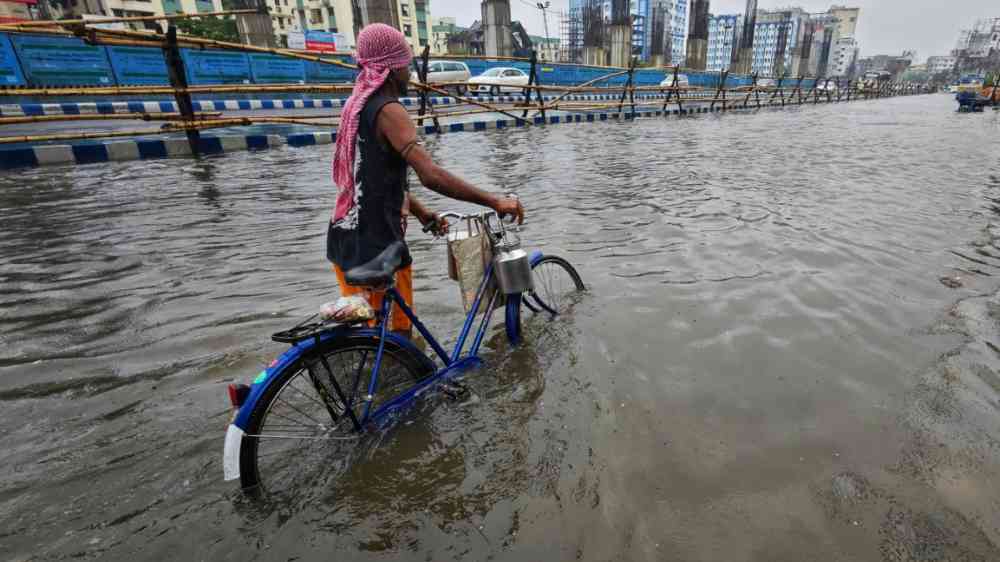
Climate change is expected to increase the frequency and intensity of extreme weather events, which are creating significant uncertainties for local communities as well as private and public agencies across the world.
This makes preparedness for climate extremes a major global challenge as high variability becomes the new normal of our global climate system. Given significant uncertainties about the scale, frequency and impact of these extreme events, standard approaches to risk reduction and anticipatory action are under substantial pressure. In this blog, Shilpi Srivastava introduces their Future Leaders Fellowship project, RELIABLE , based at IDS, which attempts to respond to this challenge by arguing for uncertainty-responsive approaches that build reliability.
Moving away from risk-based thinking
Extreme weather events are increasingly becoming a norm for our volatile climate system, and terms like “unprecedented” have become commonplace in public discourse. For example, we are witnessing record-breaking heatwaves , flash floods, and droughts in various parts of the world. As well, global weirding or whiplash effects (swings between extreme dry and wet weather) are here to stay. The frequency of these events is increasing whilst also compounding both spatially and temporally in many parts of the world. As a result, we are seeing more extremes and facing deeper uncertainty about how, where, and how fast they will intensify.
This shift highlights a move away from risk-based thinking, where the probabilities of events and their impacts can be calculated, towards uncertainty , where the incidence, scale, and impacts of these events cannot be fully predetermined. These compounding events underscore the need for strategies beyond traditional risk management and assessment models. This presents a significant challenge for systems and organisations that are built for certainty and stationarity and rely on predict-and-then-act models . Then how do we prepare for such intensifying/accelerating climate uncertainties?
The RELIABLE project
While emerging research has focused on integrating climate science with local knowledge , there is limited work on how policy processes need to be reoriented to prepare for these uncertainties. Policy actors are often cast as rational actors, but we know that they are socially embedded and draw on a repertoire of social, relational and affective practices . For example, they interpret scientific knowledge through lived experience, values, identities and agency that often guide their decision-making. However, there is limited acknowledgement of their experience-based or tacit knowledge and lived experiences.
While uncertainty is predominantly studied from a physical climate science perspective (such as uncertainties in models and disputed scenarios), RELIABLE takes a social turn on DMDU (decision-making under deep uncertainty) approaches to explore the material and embodied manifestations of uncertainty, which are shared through cognitive, emotional and behavioural reactions, leading us to understand the social and relational aspects of decision-making.
Working with mid-level actors
To study this, the project focuses on a relatively understudied group of ‘mid-level’ actors, who are placed between the macro scales of policy design (policy elites responsible for designing plans and policies such as ministers, senior bureaucrats) and micro-operation of implementation ( those actors working at the ‘street’ level ). These mid-level actors could be the control room operators who deal with a highly dynamic situation in crisis settings, irrigation officials who craft workable plans for flood response, or NGO managers who broker and build alliances.
Far from being ‘passive executors’, they skillfully enact and convert diverse information and protocols into practical solutions , and govern on the go by routinely exercising considerable discretion in the process. We define this skilful operationalisation as uncertainty management, where instead of controlling or reducing uncertainty, these actors work with uncertainty to generate reliability. Building on Emery’s Roe work on mess management and reliability professionals, we define reliability as the safe and stable delivery of services to minimise impact under conditions of high variability, where highly variable input conditions (as experienced during extreme events) are transformed into safe and stable delivery of services to minimise impact.
Where we are working
Our research focuses across South Asia and the UK, which are increasingly experiencing extreme weather events. These sites represent ‘varieties’ in institutional arrangements, response contexts (centralised, decentralised, delegated), and organisational capacities. Using transdisciplinary methods spanning across social sciences and arts and humanities, the cases will draw out the diverse practices of uncertainty managers by studying:
- the material, experiential and embodied practices that inform decision-making;
- the relational practices through networks and collaborations; and
- institutional arrangements and political cultures that facilitate or impede uncertainty management.
By switching attention away from prediction, anticipation and risk management expertise towards uncertainty management, RELIABLE will offer a novel perspective on building climate preparedness. Ultimately, the project aims to generate an understanding of uncertainty-responsive approaches that recognise the interplay between emotions, political cultures and organisational response.
Rising uncertainties should not justify inaction and the status quo; they can be seen as opportunities for innovation and creativity. Over the next few years, the project will work through case studies on climate extremes, gather stakeholder perspectives and co-produce uncertainty-responsive pathways that are tailored to specific contexts. RELIABLE will explore when, how and under what conditions such capabilities work and can be propagated and to this end, build a community of practitioners and scholars to learn from each other.