A perfect firestorm: The social, political, and climate forces that keep Athens burning
On a warm Sunday morning in early June, I boarded a train in central Athens headed towards Kifissia, an affluent suburb to the north of the city. We had just rattled away from the station for the Athens Olympic Sports Complex in Marousi when I spotted a spire of smoke rising in the distance, behind a ridge of mountains.
It was quite the coincidence, since I was on my way to see Giorgos Dertilis, the head of the Volunteer Forest Firefighting and Rescue Team in Ekali, part of the Kifissia municipality.
When Dertilis met me at the station a short time later, I asked him about it. He wrinkled his brow at me in surprise and hopped on the radio to learn more. Back at headquarters, it was confirmed: Someone had been burning tires, probably to recover scrap metal. There's a blanket ban on outdoor fires during Greece's fire season, which extends from the first of May to the end of October, but that doesn't stop people from testing fate. In July 2018, a man burning brush in his yard kicked off a deadly conflagration that swept through the seaside resort town of Mati, 20 miles from central Athens, killing 104 people.
Although the number of wildfires recorded annually in Greece has decreased since 2000, wildfires are getting larger, burning nearly 1,500 acres more on average with each passing year. In 2023, a wildfire broke out in the Evros region in northeastern Greece, near the Turkish border. It burned for more than two weeks, eventually scorching more than 237,000 acres - the largest recorded wildfire in Europe since the European Forest Fire Information Service began keeping track - and killed 20 people, including 18 Syrian asylum seekers.
Fires are also becoming more common outside of the traditional fire season, with the number of fires between November and April increasing by 47 percent since 2012; these fires are also burning larger areas with each passing year. There are myriad factors at play in these dangerous trends; two of the biggest are land-use and climatic changes.
I was in Athens for a little over a week, which was just enough for me to get a taste of the hot and windy climate that can nurture any stray spark into an inferno. I climbed to the top of the Acropolis, sweating in the early evening sun with other tourists. I spent a day with volunteer firefighters, driving around to see the burn scars from blazes they battled last summer. I was buffeted by gusts while visiting an observatory that narrowly escaped the flames last year. I hiked through Parnitha National Park and saw new pine trees growing in the shadow of blackened tree trunks. The threat of fire seemed ever present, especially at the edges of the city, where drones hovered on high-risk fire days, part of Greece's burgeoning early-detection program.
Some of my taxi drivers, upon hearing of my interests, regaled me with tales of heroism and loss: One told me of a friend who lost his house in a wildfire last year. Another said he evacuated his parents from his childhood home and then went back to personally ensure the building did not burn; the fire came into their yard and consumed all the vegetation, but the house is still standing.
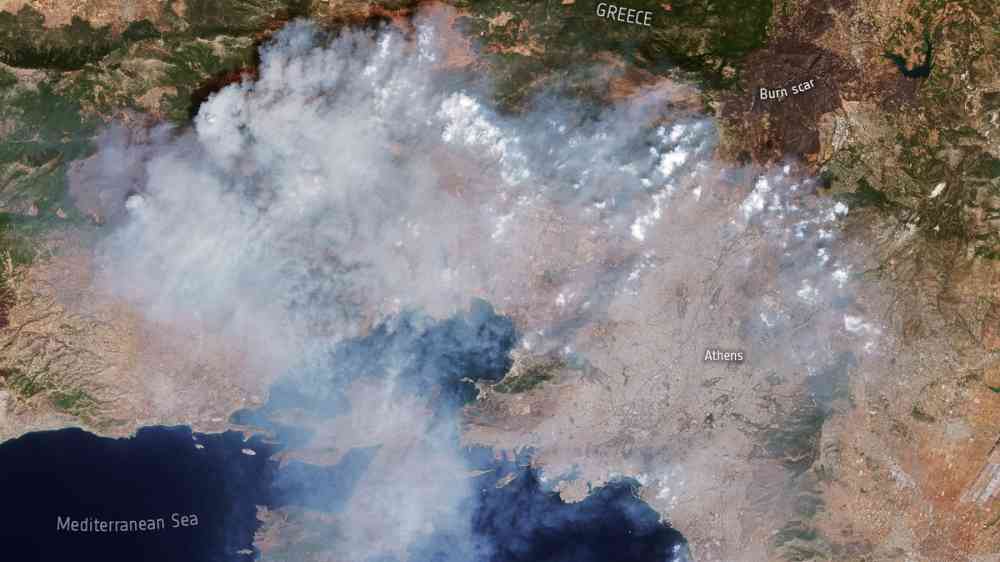
I was left with the impression of a city and country on edge - doing its best to adapt and cope, but in general, and like many other fire-prone regions, ill-prepared for the kind of extreme wildfires that climate change is unleashing. As I was finalizing this story, wildfires driven by gale-force winds broke out at multiple locations around Athens, forcing evacuations, as other fires raged to the west in the Peloponnese and on multiple Greek islands.
A social problem
Giorgis Dertilis - or George, as he invited me to call him - is wiry and very tan, with a large, warm smile. He has been a volunteer firefighter for almost 15 years. One day in 2011, he walked past the station, saw the firefighting team, and asked how to join. He now runs the place, often logging 12-hour shifts during the week and 24-hour shifts on weekends. He is also the public relations manager for the Panhellenic Federation of Volunteer Forest Protection and Firefighting Organizations, which represents nearly three dozen volunteer firefighting groups across the country. This is all on top of his day job as a project coordinator at a construction company.
Although Dertilis understood most of my questions without assistance, he preferred to answer in Greek and have Emmanuel Mendonça, a soft-spoken English expat who has lived in Greece for more than 20 years and volunteered as a firefighter for five, translate his answers. His responses were measured and diplomatic; he was well aware of the responsibility of representing not just his own crew, but the entire federation.
Fighting wildfires is only part of what Dertilis' group does. They also put out house fires and assist after car accidents, floods, and other disasters, manmade and natural. Last year they responded to roughly 400 incidents. Volunteer crews like theirs are an essential part of Greece's emergency response system. Their nonprofit organization, which is entirely funded by donations, has more equipment - specifically firetrucks - than the official Hellenic fire service in the area, which has just one truck for all of Kifissia, a verdant northern suburb of Athens known for its annual flower show and luxurious villas.
"Overall, human activity is believed to be responsible for more than 90 percent of wildfires in Greece."
Dertilis and his co-workers gave me a tour of their headquarters, a modest multibuilding complex with dormitories for overnight shifts; a locker room with gear laid out for quick changes (they have two sets: one for structure fires, which burn hotter and more intensely, and a lighter version for wildfires that allows for more ease of movement); and a combination office-lounge area where on-duty firefighters hang out, monitor conditions, and wait for calls to come in. Outside, long tendrils of hoses were draped in the sun to dry after being washed clean of dust, ash, and toxins.
That afternoon, we climbed into a pickup and went for a drive around the suburbs. Our first stop was Fasideri Forest, a small, wooded park in Ekali, a fully residential part of Kifissia, where we turned onto a rough dirt road. We drove under a downed tree, and Dertilis pointed out that if there was a fire here and they needed to come through in one of the larger fire trucks, they wouldn't be able to clear it. He'd like to cut it down, but getting permission from the government is a bureaucratic tangle-just one example of the obstacles firefighters face in doing preventative safety work. We passed someone out for a walk with a dog and what looked like a birthday party, with tables, balloons, and food - the kind of gathering that could easily produce an ignition source from a stray candle, an illegal barbecue, or a cigarette.
Dertilis gestured at the thick underbrush under the trees, which in some places reached nearly as high as the canopy. In a distant, more pastoral time, he said, people might have let sheep or goats into these woods to graze, which would keep the shrubs down. But amid social and economic shifts over the past decades, livestock grazing has declined - and not just in the Athens metropolitan region, but in all of Greece's mountainous areas.
When there's enough space between the vegetation on the forest floor and the canopy, Dertilis explained, a fire can move through the woods and only scorch the trunks, leaving the treetops untouched and the forest mostly whole. But as it is now, if a fire were to start in these woods, the shrubs would catch, and the flames would likely reach high enough to burn the treetops as well, fueling a much larger and more destructive fire.
Even in this ostensibly public park, we passed a house tucked into the trees and a large mansion under construction, with an olive orchard out front. The firefighters were reluctant to single specific structures or their owners out, but it's not uncommon in Greece for homes to be built illegally and then eventually grandfathered by government amnesty. Such constructions even have a name: "afthereta" or "arbitrary." Kifissia is also a desirable suburb, home to wealthy and well-connected families who might be able to pull strings to secure official permits.
"If the city expands to the forest, then you bring the fire problem to the forest."
The dangers of illegal construction were thrown into the spotlight after the deadly Mati wildfire in 2018, when residents found access points to the sea cut off by thousands of unlicensed buildings and walls, and many burned to death trying to escape the maze of ill-planned streets. Just days before I arrived in Athens, nine former fire officials were convicted of charges related to the disaster, as well as the man responsible for starting the fire, but 11 others, including three politicians, were acquitted. Although afthereta were widely condemned as contributing to the steep death toll, prosecutors did not cite the role illegal construction may have played when they made their case.
Back out on the paved road, we passed through more residential neighborhoods, including quite a few new homes under construction. Most of the fine houses had lush gardens and mature trees looming over their roofs. The state officially recommends that homeowners leave a six-meter gap between structures and vegetation, Dertilis said, but compliance seemed virtually nonexistent. Nobody wants to give up much-needed shade in the hotter months.
We reached a viewpoint where we could look out to the mountains on the other side of the valley, where large wildfires in 2007, 2021, and 2023 burned large swaths of Parnitha National Park. They pointed out the band of dark green that cuts through the heart of the park, sloping down from Mount Parnitha - what remains of the forest after nearly back-to-back fires. Everything to the right, they said, burned in 2021, and everything to the left in 2023.
From our perch we could also look down into the leafy enclave of Ekali - a dense blanket of green dotted with houses. It looked, to me, like a tinderbox-in-waiting.
Where human development meets and mingles with forested or otherwise unoccupied land has been given a name by fire management experts: the wildland-urban interface, or WUI, and this is where most wildfires start. Faulty electrical cables, illegal vegetation burns, car accidents, and even a beekeeper smoking their hive have all started wildfires in Greece. Overall, human activity is believed to be responsible for more than 90 percent of wildfires in the country, according to Elias Tziritis, the forest fires coordinator at World Wildlife Fund Greece (WWF Greece), who also volunteers as a firefighter in a crew near Parnitha.
"If the city expands to the forest, then you bring the fire problem to the forest," Tziritis said when we spoke earlier in the spring. "So as we say, forest fires in Greece is not an ecological problem. It's a social problem." Athens has a lot of wildland-urban interface, covering up to 10 percent of the region, according to one analysis.
Our next stop was at the end of a residential street overlooking the neighboring suburb of Dionysos. Last August, a fire started near the small town of Varnavas, about 9 miles north from where we stood as the crow flies, but it rapidly spread south, towards the city center, engulfing this very spot. A blackened trail of devastation wound its way down the slope like a river. From this vantage point, it was clear how close the fire came to densely populated neighborhoods. Boards and low barricades of charred sticks had since been installed in long lines along the hillside to keep the soil from washing away in heavy rain.
The truck was making a weird noise and Dertilis had a call with the federation scheduled, so we drove back to the station to switch vehicles and pick up new guides to our last point of interest - another spot in the Penteli foothills, where the team halted the advance of the Varnavas fire last year. We pulled over by a rocky gulch, one side a vibrant green, covered by maquis - the dense evergreen shrubland common in the Mediterranean, similar to North American chaparral - and the other blackened and almost bare. The air smelled spicy and sweet.
One of the firefighters, Thanasis Koutourlos, walked with me up the hill, explaining that this is where he and more than a dozen others formed a human chain to lug the long hoses up the incline. Even in my long hiking pants and sneakers, it was rough going up the trailless and rocky hillside. I struggled to imagine doing it in a full firefighting kit, while nearby flames leapt as high as 80 feet in the air.
There is no single, universally agreed upon definition of an extreme wildfire. One review published in 2020 found 25 different terms in the scientific literature that attempt to define and describe "powerful and extraordinary wildfires," including megafire, megablaze, firestorm, conflagration, catastrophic fire, and disaster-fire.
But whatever the definition, what's certain is that powerful wildfires are becoming more common here in Greece and around the globe.
Fire weather
The Penteli Observatory is perched on Koufos Hill, at the foot of Mount Pentelicus - the famous source of the marble used at the Acropolis. My taxi driver dropped me off at the gate, where I told the security guard who I was meeting, and he waved me in. As soon as I stepped away from the sheltering walls of the squat building, the wind slapped into me like a wave, whipping my hair in all directions. Later that afternoon, I messaged one of the volunteer firefighters and learned it was the first Category 3 day - on a scale of five - of the 2025 fire season.
I leaned into the gale as I climbed the quarter-mile drive. Had I not been so concerned about losing my belongings or being blown off the road, I might have paid more attention to the blackened ground to my right - more destruction left by the Varnavas fire last year, which came within feet of the nearby research institute. New trees had been planted in neat lines on the scorched earth.
Theodore Giannaros, a senior researcher with the National Observatory of Greece's Institute for Environmental Research and Sustainable Development, met me by the domed observatory, and we settled down for our conversation in the cafe. (He suggested talking outside, but I worried the wind would drown out his voice on my recorder, and that I wouldn't be able to write on a fluttering notepad.)
Giannaros is a fire meteorologist who studies how weather and climate interact with wildfire. "Our research focuses on understanding how meteorological conditions and climatic conditions influence the general probability of having a wildfire, and as soon as we get a wildfire, we focus on understanding how weather determines how it will spread, how it will behave," he explained. "And equally important, we also focus on understanding how the fire creates its own weather."
Greece is naturally fire prone. It has a Mediterranean climate, with hot and dry summers - especially in Attica, the administrative region that includes the entire Athens metropolitan area - and, beginning in July, strong winds blowing in from the north over the Aegean Sea. "We call them Meltemi or Etesian winds," Giannaros said. "'Etesian' means 'wind that blows once per year.'"
These winds are most frequent and intense in August, but Giannaros says they seem to be arriving earlier and persisting longer in recent years, which is contributing to longer wildfire seasons. Changes in temperature, humidity, drought, and wind - all linked to global warming - are conspiring to lengthen the wildfire season across the Mediterranean.
If the wildfire season is getting longer, one could also say wildfire days are getting longer. Climate change, Giannaros explained, causes asymmetrical warming, meaning nighttime temperatures are increasing at a faster rate than daytime temperatures. "Many firefighters have anecdotally been saying over the last years that they are seeing wildfires persisting and having a lot of intensity during the night," he said. "And this is weird for them, because typically at night, you would expect temperature to drop, relative humidity to rise, and this would allow the fuels-the vegetation that is burning-to recover some moisture. And this, in turn, would help slow down the fire spread." Firefighters in the United States have made similar reports.
This change in night temperatures places more strain on firefighting forces, but, Giannaros said, it also increases the likelihood that fires will interact with the atmosphere with explosive results.
In what might be called normal circumstances, the lowest part of the atmosphere-the planetary boundary layer-extends higher and is more turbulent during the daytime hours, as heated air rises. When the sun sets and temperatures fall, the planetary boundary layer drops lower to the Earth's surface and becomes shallower and calmer-normally. But, if warmer surface temperatures prevail into the night, and hot air continues to rise, the more turbulent daytime conditions can persist. "This facilitates any fire to couple with the atmosphere and suddenly, for example, bring down higher level winds that are moving faster," Giannaros said. "This will change the fire behavior beyond what the practical knowledge tells us to expect."
"We are at a point where, due to climate change, we need to make a very clear distinction between what I would call two types of wildfires," he said. The first are "normal" wildfires, which behave in predictable ways in response to wind conditions and fuel availability. "But in recent years, we are getting more of what we call the extreme wildfires. And these extreme wildfires are those that couple with the atmosphere and present a non-steady fire behavior with nonlinear interactions." These are the kind of megablazes that create their own weather and behave in unpredictable and harder-to-control ways.
"Climate change, Giannaros explained, causes asymmetrical warming, meaning nighttime temperatures are increasing at a faster rate than daytime temperatures."
Already, he said, climate change is causing more intense and prolonged heat waves, which create more unstable boundary levels that allow wildfires to couple with the atmosphere more easily. One of the big unknowns in the equation: how climate change will impact the structure of the atmosphere in the future and, in turn, the behavior of wildfires.
"Until now, all climate projections, when it comes to assessing how much more dangerous wildfires will be in the future, they use only surface fire weather," Giannaros said. "This leads to underestimation of our data, because in the future climate, we may have a more unstable atmosphere."
Giannaros would like to see Greece invest more in data collection and analysis of wildfires, particularly extreme wildfires, which can help inform fire prevention and response strategies. He pointed out that the governments of Portugal, Spain, and Italy have fire behavior analysis units, while Greece does not. "The missing piece here is the data," he said.
The fire paradox
Fire management falls into two categories, prevention and suppression, and in Greece, each is done without much consideration for the other. The forest service handles prevention, and the fire brigade handles suppression. In 2021, WWF Greece found 84 percent of available wildfire management funds go to suppression, and just 16 percent go to prevention.
The problem with a nearly single-minded focus on suppression is that it creates the conditions for larger wildfires in the future.
"One thing that we should avoid doing is put it out at every cost," Giannaros said. "In fact, this is what creates what we call the fire paradox. And the fire paradox says that the more we extinguish fire, the more fuel we create for fire, then the more wildfire we get."
The solution, argues Elias Tziritis, the forest fires coordinator at WWF Greece, is greater investment in fire prevention.
"The fire paradox says that the more we extinguish fire, the more fuel we create for fire, then the more wildfire we get."
"The problem with Greek forests is that for the past 30 years, we have had a lack of forest management," Tziritis explained. "We have tremendous gaps in forest management because of lack of funds and the personnel to do prevention."
This is beginning to change. This year, he said, the balance for suppression and prevention is closer to 70-30, but he'd like to see it shift to 40 percent suppression, and 60 percent prevention.
"We don't want the suppression funds to be decreased," Tziritis clarified. "We want the suppression funds to be the same or to be increased. But prevention funds must be increased a lot and must be more than suppression."
In Greece, fire prevention mostly involves thinning forests to manage fuels. The state has no programs for prescribed burning or targeted grazing - at least not yet. Prescribed burning falls into a legal grey area, Tziritis explained - neither legal or illegal. But he and his colleagues are trying to get it into the public dialogue. Beginning in 2021, WWF Greece partnered with the Institute of Mediterranean Forest Ecosystems on a prescribed burning pilot project on Chios Island and delivered a report to the General Directorate of Forests at the Ministry of Environment, which included a legal proposal for the establishment of prescribed burning in Greece. They've subsequently had several promising conversations with the directorate, but are still awaiting an official response. Grazing is another possibility for managing forest fires, but one the forest service has been reluctant to adopt.
Parnitha is a good illustration of how thorny the grazing debate can become. In 2014, wolves were spotted in the national park for the first time since the 1950s - which is surely an environmental success, from a certain perspective. But since their return, Tziritis said, the population of red deer has declined, and so there are fewer wild animals grazing in the forests. There is now an active debate over whether the wolf population should be removed - as one Greek prosecutor has ordered - to protect the remaining population of red deer, listed as an endangered species in Greece. Scientists have argued that this order is premature, and that other factors - like loss of habitat from wildfires - could be at play, and a natural balance between predator and prey may still reassert itself.
Grazing is a kind of ecosystem service: deer eat and keep vegetation (wildfire fuel) in check; humans benefit from safer, less flammable forests. In theory, the drastic decline in grazing by deer could be offset by allowing domestic animals into the park to graze, but this is illegal in Greece.
"This is a problem because the forest service is not flexible," Tziritis said. "They had a past mentality that grazing is bad, grazing is not good for ecosystems. But this is an old mentality. You must be dynamic, and you must see how you can use grazing for your own good in order to increase biodiversity or prevent forest fires."
Giorgos Dertilis said the government has recently taken concrete steps to expand hands-on fire prevention, citing the AntiNero forest protection program, a €400 million multiphase project by the Greek government that began in 2022 and includes preventative clearing in critically important and at-risk forest ecosystems - removing dry debris and excess undergrowth, thinning shrubs and bushes, and trimming the tree canopy.
"You must be dynamic, and you must see how you can use grazing for your own good in order to increase biodiversity or prevent forest fires."
But even this seemingly benign forest-management effort is not without controversy; Maria Zacharia, a Greek politician in the European Parliament, has questioned the efficacy of the program in preventing fires and raised the issue of impact on wildlife habitat in protected areas.
Awareness of forest-management initiatives, and why they're important, remains low. Last August, on the day the Greek Orthodox Church celebrates the Assumption of Mary, there was a clearing crew working in the forest as part of the AntiNero fire prevention program - not cutting trees, just clearing away some of the underbrush. Members of the public complained to the police. Crew members were arrested and held for several hours until the police could reach the public prosecutor by phone and confirm that they had permission.
Greece has advanced in some ways in its fire-suppression efforts, nearly doubling the number of fire surveillance drones in its arsenal over the past two years (I spotted one on the gusty day I visited Penteli) and investing heavily in more firefighting aircraft. But in an article for the International Association of Wildland Fire, a number of Greek experts criticized the country's overreliance on aerial response and lack of coordination by on-the-ground responders.
After the fires
The cab dropped me off at the trailhead at the edge of Parnitha National Park just before 5:30 a.m., when the sky was beginning to lighten to a pale bluish white. The forecast said it was going to be hot that day, in the 90s, and I was hoping to finish the 7.5-mile loop before noon to avoid the worst of it. I had downloaded a map and had a full phone battery and a portable charger. I also was carrying snacks and an excessive amount of water, having read a few too many stories about tourists in Greece perishing on hikes during a heat wave last summer.
Parnitha is often called the "lungs of Athens." It is the closest national park to a capital city in all of Europe and receives around one million visitors every year. "It's important because people, particularly up here, they have memories from childhood of visiting the mountain," Mendonça translated for Dertilis. "Hiking, bike riding, things like that. Emotionally - there's a tie to it." This explains why, after Parnitha burned for a second time in just three years, Athenians responded with fury and frustration - and why I was determined to visit myself.
Tziritis had explained to me that the forests of Parnitha are dominated by two types of trees: Abies cephalonica, or the Greek fir, which grows at higher elevations, and Pinus halepensis, or the Aleppo pine, which populates the lower elevations, along with the evergreen Mediterranean shrubland called maquis. Aleppo pine forests are fast-growing and drought-tolerant and generally fire-resilient because their cones open and release seeds when burned, allowing for quick regeneration. But Greek firs are not fire adapted, and so when fir forests burn, they could be lost forever without human intervention.
"All forests can be burned if the conditions - the meteorological conditions, the conditions of the forest, humans and all these things-are bad. One myth that we had until 2007 is that the fir forest of Parnitha was unburned because we think that it's fire resistant. And it's still fire resistant, if you compare it with the pine forests," Tziritis said. "But if you have a bad fire season with bad weather conditions or the moisture inside the vegetation is low, then you have a problem with fire in fir forests, too."
More than half of Parnitha National Park burned in 2007, and Tziritis said that - at least in the areas that did not burn again in 2021 or 2023 - the Aleppo pine forests are growing back quickly. But the fir trees require technical restoration to recover-tree planting or reforestation, essentially. And if Aleppo pine forests burn multiple times in quick succession, they also lose their resilience.
"It is not uncommon to have, let's say, an area that has been burned again and again and again," Giannaros told me. "However, the more times the same area is burned, the harder it is for vegetation to recover, and then you have an increased risk of desertification. This is especially the case for the region of Attica."
In addition to keeping fire prevention in the public dialogue and pressuring government to increase funding, WWF Greece works on restoring forests after wildfires. Part of this involves identifying areas of highest priority - which generally means those that have burned multiple times in quick succession. WWF Greece has secured government contracts to carry out technical forest restoration in parts of Sounio National Park, 30 miles southeast of Athens, and in parts of the Evros region that have been triple-burned in the last 20 years.
For this, the challenge is selecting which species to replant. "We try to make a mix of a young forest with oaks, with cypresses, with pine forests-all endemic to Greece," Tziritis said. "Foreign species are not allowed. You must respect the ecological history of the area.... We try to not to make a monoculture in planting, but to use different species and mainly fire resistant."
But the work is slow, laborious, and expensive.
Political outrage
Fires have already drastically reshaped the Attica landscape. Since 2017, the region has lost 37 percent of its forests and grasslands. Of the four mountains that form land boundaries around Athens - Mount Parnitha to the north, Mount Pentelicus to the northeast, Mount Aigaleo to the west, and Mount Hymettus to the east - all but Mount Hymettus have experienced large wildfires in the past few decades. It's little wonder that Athenians are angry and want somebody to blame.
"There's political outrage as well as a political debate all the time," Michalis Diakakis, an assistant professor of geography and climatology at the National and Kapodistrian University of Athens, told me by video call. "Every time a fire catches, the public is outraged. It's sad that it becomes political, because most of the problem is scientific... It's not so much a matter of political parties, rather of long-term policy. And when it becomes political, it becomes more difficult to solve."
In 2023, as Parnitha burned, some Athenians interviewed by the New York Times seemed to suggest that the government was using climate change as a cop-out. "Every year, they say the same thing, 'We're doing what we can; it's climate change,'" one person said.
As a climate journalist, I can sympathize with politicians like Greek Prime Minister Kyriakos Mitsotakis, who has said the wildfires that have ravaged the country show "the reality of climate change." Obviously, climate change has played a role - as fire meteorologist Giannaros repeatedly pointed out, if the conditions are ripe for an extreme wildfire event, no amount of fuel management can stop it.
But climate change is not the only factor. The people of Greece clamor for solutions - as they have every right and reason to - and the firefighters and scientists I interviewed have lots of ideas for how to mitigate wildfires, and to improve prevention and suppression alike. They would just like to see more research, more data, and more funding to put their ideas to the test.
A week after I flew back to New York City, a fire on the Greek island of Chios scorched 11,600 acres. In early July, another fire started inside Parnitha National Park; fortunately, mild weather conditions and quick response by emergency services meant it was quickly suppressed. Later that month, a fire in the northern suburbs of Athens prompted evacuations in Kryoneri - a town just a few miles north of Ekali and the Fasideri Forest.
These are just a handful of the blazes that have menaced Greece this summer. In one 24-hour period in late July, the fire brigade said at least 44 new wildfires were reported.
And there are nearly three months of fire season to go.