
How EU wildfire prepositioning helps fight fires
‘Exercise-exercise-exercise!’
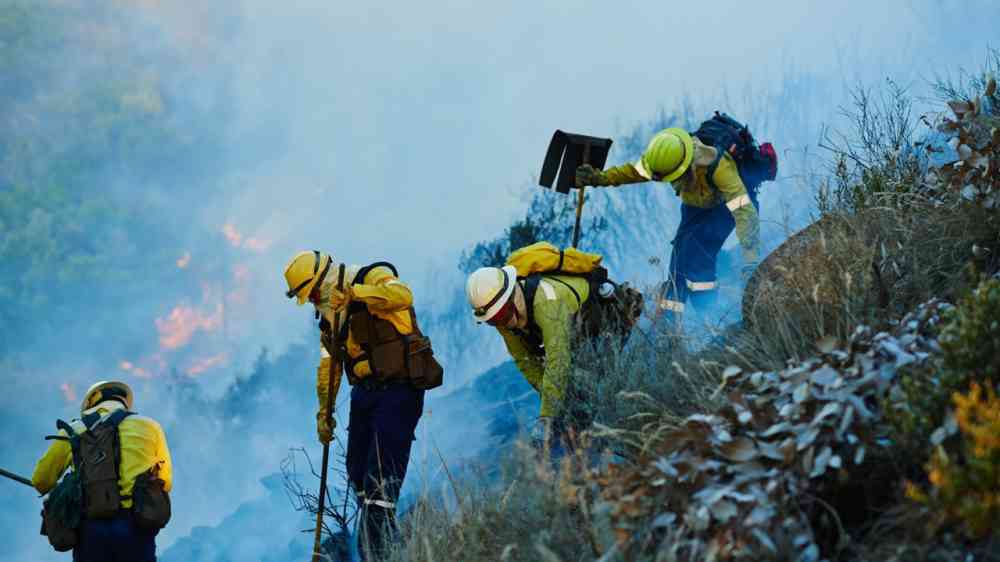
If it wasn’t for the exercise designation called over the radios, you could easily think you were in the middle of a real forest fire in the Schinias nature reserve outside Athens, a protected area where pine trees reach down to the beach.
As our host Greek Fire Lieutenant Vassilis Bikas directs the newly arrived Romanian firefighters deeper into the forest he explains more about these pine trees.
Pine trees are a blessing and a curse. They provide shade, but can also catch fire easily.
- Fire Colonel Bikas, Head of the Liaison Officers’ Coordination Cell
What is wildfire prepositioning?
This is the second day in Greece for the group of 40 Romanian firefighters, sent to work alongside their Greek colleagues in the framework of a European programme called prepositioning. Launched in 2022, in the aftermath of a summer of catastrophic fires in Greece and elsewhere in Europe, this programme places additional firefighters, from across the EU, in high-risk areas during the summer wildfire season.
The programme has gone from 236 firefighters in 2022, to almost 800 in the summer of 2026, deployed from 14 European countries to 6 high-risk ones: Greece, Spain, Portugal, France, Italy and Cyprus.
In Greece, the prepositioned teams this summer came from France, Czechia, Moldova and Romania. As part of the programme, Greek firefighters were sent to France and Cyprus.
How wildfire prepositioning works in Greece
As part of a media trip organised by the European Commission’s Directorate-General for European Civil Protection and Humanitarian Aid Operations, we spent a day with the Romanian firefighters in their Nea Makri base of operations.
Lieutenant Fire Colonel Bikas, who is the Head of the Liaison Officers’ Coordination Cell (LOCC) for the prepositioning programme, explains the benefits:
We train together, learn how to put out fires in different areas, address the various challenges. It’s a win-win situation for everyone.
Lieutenant fire Colonel Bikas, Head of the Liaison Officers’ Coordination Cell
Practical challenges for cross‑border teams
And these challenges can be very practical. When the prepositioning programme was launched, fire services across the EU discovered that equipment is not always inter-changeable: couplings that work in one country do not work in another. Face masks, uniforms, hoses, may be different, or not compatible with Greek geomorphology.
The EU funds a warehouse of supplies that the prepositioned fire-fighters can use during their tour of duty. Known affectionately as the supermarket, it provides everything they may need during their stay in Greece.
Language was another barrier at the beginning, so the Greek Fire Service prepared glossaries in the languages of the various teams prepositioned in the country.
Who supports visiting teams on the ground?
Perhaps the most important role in welcoming a team from another European country, training with them, and deploying with them if needed rests with the red and blue 'angels'.
Known as the red angels, the liaison officers – Mr. Bikas and his counterparts – ensure that the stay, training and deployment of the firefighters is as smooth and as productive as possible.
From their side, the blue angels are the support officers: volunteers who facilitate the process and take care of daily tasks.
Why prepositioning?
Because we have to think beyond today and tomorrow. And at least part of a solution to a global issue is the EU solidarity in the field
- Lieutenant fire Colonel Bikas, Head of the Liaison Officers’ Coordination Cell
And if every day cannot be like this, at least we know that, when facing wildfires, no country is alone.